



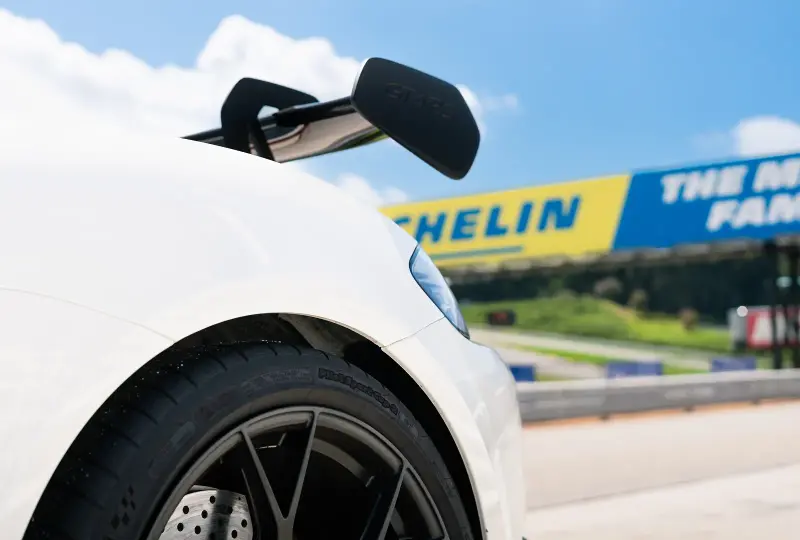
The tires on race cars today are part of mobile research labs as companies like Pirelli, Michelin and Continental test compounds under extreme conditions.
“We use the term track the street. There’s no tougher place to test your products than on the track,” Matthew Cabe, president and CEO of Michelin North America told Newsweek.
During a race, tires are exposed to the extremes of physics. “We believe that endurance racing is the place where you get the most out of that test in a in a short amount of time. You go out for 24 hours in Daytona, you go out for ten hours in Petite [Le Mans], and they are pushing the limits through all of those sessions. What we get is a real laboratory-type opportunity to see what [Michelin] can do,” Cabe said.
Customers are generally not going to drive their vehicle for a full day at a time, nor will they be driving 200 mph regularly, powered by engines designed to maximize power output over fuel efficiency.
The CEO explained: “Your average consumer is not going to drive at full capacity for 24 hours. Especially in [the] IMSA [motorsports performance driving series], we’re driving vehicles that are not so far away from the [ones] drive[n] on the road. Obviously, they’re way more powerful. Obviously, they’re able to push harder. But, the dynamics of those vehicles are not dissimilar to what we drive in every day.”
Not just that, but Michelin can change up its tire compounds to adapt to the results of the on-track action, getting new compounds to the track in a matter of weeks and months.
“We have the opportunity, in the next race, to be able to come back and to try something new and, to continue to innovate,” Cabe said. “We collaborate with all of the manufacturers there and real time and stress test ourselves really quickly.”
All those laps also result in Michelin having a test bed for the products of tomorrow, including those that contain increased levels of sustainable materials. The company is working across its upstream, operations and downstream product channels to deliver on short- and long-term sustainability goals.
Many electric vehicles were developed by automakers under similar sustainability goals. Hand-in-hand, Michelin worked to develop tires to take on the types of strain those models put on their rubber, which is different than what is presented by traditional internal combustion engined vehicles.
“We’ve been working with tires for with electric vehicles for quite a long time. Some of the challenges that come along with electric vehicles: the weight and incredible torque,” Cabe explained. “It’s interesting. You get high torque so it causes additional wear.”
Michelin isn’t developing tires just for electric vehicles. Their tires must be able to withstand the rigors of the vehicle they’re affixed to, regardless of powertrain.
“When we make a product, we want to make sure that it’s capable of not just delivering on one of those aspects that a consumer’s looking for in a product, but really delivering [capability in a meaningful way],” he said.
Michelin does not want its customers to feel as if they are compromising on any factor by choosing their tires, not on longevity, rolling resistance or handling in wet conditions.