



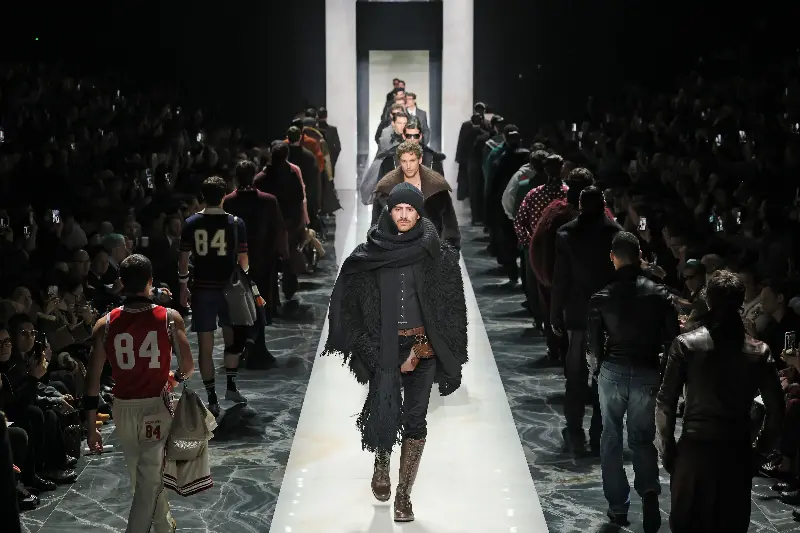
Fashion house Dolce & Gabbana has come under fire for a lack of diversity in its casting for the Fall-Winter 2026-2027 Menswear collection presentation at Milan Fashion Week on Saturday, with model Bella Hadid publicly calling out the brand for “years of racism, sexism, bigotry and xenophobia.”
Newsweek reached out to Dolce & Gabbana for comment via email.
Why It Matters
This isn’t the first time the Italian fashion house, founded by designers Domenico Dolce and Stefano Gabbana, has been called out online or embroiled in controversy.
In 2012, the brand was criticized for earrings worn by white models, which critics said resembled “Blackamoor” statues.
In an interview given to the Italian magazine Panorama in 2015, both designers publicly opposed the idea of gay couples having children. They said, “We oppose gay adoptions. The only family is the traditional one.” The following year, the brand was criticized for releasing a shoe named the “Slave Sandal.”
The brand was also criticized during President Donald Trump’s first term for dressing first lady Melania Trump, which, at that time, many designers were refusing to do. It responded to that criticism by releasing a video featuring a faux protest against the brand and launching a T-shirt reading “#Boycott Dolce & Gabbana,” which retailed for $245.
What To Know
Fashion commentator and visual arts creator @ly.as, whose real name is Elias Medini, shared a video on Instagram criticizing the casting, which has been viewed over 2 million times as of reporting.
In it, he shares headshots of the models and says, “Fifty shades of white. No one single Asian, not one single dark-skinned model, I believe not a single Arab or blond guy.”
Medini described it as “not normal.”
Hadid, 29, weighed in in the comments, writing, “Shocked people actually support this company still, it’s embarrassing.”
The model, who was named Model of the Year by the British Fashion Council in 2022, is half-Palestinian and has long been an outspoken advocate of Pro-Palestinian causes, followed up this comment, writing “Beeeen cancelled…. years of racism sexism bigotry xenophobia … how are we shocked still?”
And Hadid was not the only one to call out the brand and respond to the Instagram. Rapper and fashion designer Skepta commented “Zzzz” on the video, while the podcaster and content creator Evan Ross Katz commented, “Call it out, baby. Call. It. Out.”
“The reaction to Dolce & Gabbana’s latest show reflects a much wider shift in how fashion brands are judged today,” Dr. Kent Le, a fashion and luxury business consultant and lecturer at the University of East London, told Newsweek. “The public no longer evaluates luxury purely on aesthetics or craftsmanship; brands are increasingly assessed on their social values, cultural sensitivity, and ethical behavior.”
“Social media has fundamentally changed the power dynamic. Consumers, models, and commentators now have direct platforms to call out brands in real time, and figures like Bella Hadid amplify those concerns to global audiences within minutes. What might once have been a quiet industry critique now becomes a public reputational crisis almost instantly,” Le said.
Katharina Sand, a writer and professor who teaches at the University of Arts Linz in Austria and previously worked as an arts, culture and fashion correspondent in New York, told Newsweek, “I am especially taken aback because their casting is usually much more diverse, and because we need everybody to take a stand for diversity now, more than ever.”
Beyond this, Sand said that after a review of all the men’s fashion shows so far, “actually what we are lacking across the board is some body positivity for men.”
“That seems to be a long-overdue question,” she said.
What People Are Saying
Dr. Kent Le told Newsweek: “If Dolce & Gabbana continues to be perceived as exclusionary or culturally tone-deaf, it risks becoming irrelevant to younger, more diverse luxury consumers—particularly in North America and Europe.
“We are already seeing top models and influential creatives openly distancing themselves. Over time, that can affect talent pipelines, partnerships, and brand desirability. The danger is not an immediate sales collapse, but a slow repositioning of Dolce & Gabbana from a globally admired luxury house to a brand increasingly associated with controversy rather than creativity.”
Katharina Sand told Newsweek: “It is surprising, as D&G models have always represented a wider range of beauty ideals than most—not only in terms of nationalities but also in terms of age and body shape. I remember attending a show in 2017 for which they invited their customers on stage, and it was a very diverse mix.”
What Happens Next
Dolce & Gabbana has yet to respond to the criticism.