



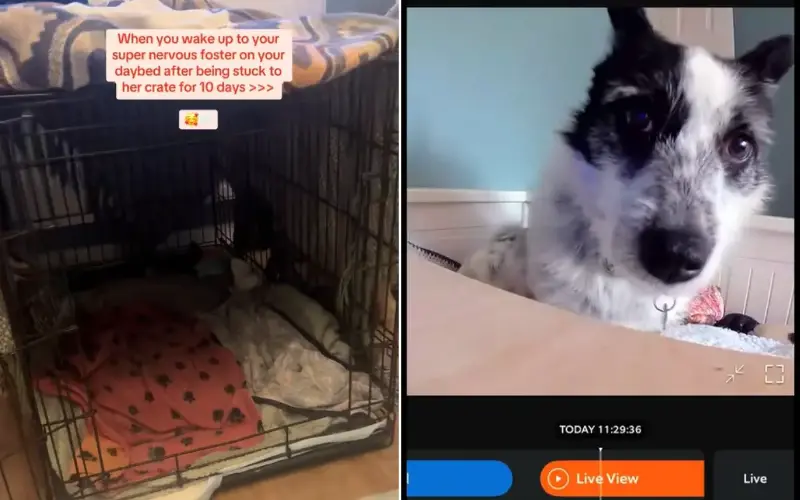
A newly fostered rescue dog spent 10 days hiding in a crate, fearful of her new surroundings—then something wonderful happened.
Rachel Fletcher, from Suffolk, in the U.K., has loved dogs for as long as she can remember. “As a child, I didn’t dream of a specific breed or a perfect puppy—I just wanted any dog to love,” Fletcher told Newsweek.
Her first dog, a 3-year-old Pomeranian, became Fletcher’s “whole world.” When he sadly passed away in 2024, she was left with a void that “felt impossible to fill.” That’s when she turned to Safe Rescue for Dogs, a nonprofit that takes in and rehomes dogs from the U.K. and abroad. It is there that she met and adopted Brooke.
The pup was terrified when Fletcher first took her home. “She hid in a bush on her first day, flinched at the sight of other dogs, and carried fear in everything she did,” Fletcher said. But, slowly, with patience and kindness, Brooke emerged from her shell to become the happiest of pups. “Watching her grow into a playful, brave, and loving dog was the most-moving experience of my life,” Fletcher said.
A little love can go a long way for a shelter dog. A 2018 study published in the journal Applied Animal Behaviour Science found just 15 minutes of one-on-one petting was enough to boost the overall well-being of a shelter pup. Seeing Brooke’s transformation was what convinced Fletcher to start fostering other canines through Safe Rescue for Dogs. That was what led her to Dottie.
Dottie was living in a shelter in the Romanian city of Botosani when Fletcher first found out about her situation. Though very little is known about the dog’s life prior, one thing Fletcher did learn was that she was not alone when she was first rescued. “Dottie had puppies at one stage in the Romania shelter,” Fletcher said. “When they visited earlier in the year they were together, but by the next time, they were there the puppies weren’t with her.”
Dottie is thought to be around 3 years old and struggled initially with the change. “We’re unsure whether her fear is due to past negative experiences with humans, or whether she simply has never had any human contact at all in her life and it’s just new for her,” Fletcher said. “Whatever had happened in her past, she was absolutely terrified of being touched or held on the lead which is why she hid in her crate.”
For the first 10 days in Fletcher’s care, Dottie took shelter in her crate. Then, when Fletcher checked in via a petcam the next morning, she got a surprise. “Dottie wasn’t in her crate or anywhere to be seen on the pet cam, which could really only mean one thing,” Fletcher said. Going downstairs to see for herself, the owner was surprised and delighted to find Dottie sitting on her daybed.
Fletcher recalls feeling “a mix of relief and awe” as well as excitement at seeing such a significant breakthrough. “I was so incredibly proud of her,” she said. “Because I know that was such a huge step for her to make. It felt like a victory for sure.”
A day earlier, Fletcher said she had actually been “worried” about whether Dottie was making any progress, after sensing she had become “even more flinchy.” This was proof at least that something was shifting. “Maybe, the environment felt predictable enough, she sensed patience, or the daybed looked too comfy,” Fletcher said.
“She at least felt safe enough to take that risk, and we left the crate open for her to change her mind but she didn’t. She found her new safe spot; hopefully, the number of safe spots she finds will continue to grow.”
Fletcher shared footage of the breakthrough to her TikTok @rachelcharlottee. She said she hopes her videos highlight the important role foster care plays in helping rescue dogs and the amazing things that can happen when these animals are placed in a loving, patient environment.
“Dottie’s grown braver, more curious, and much more at ease than when she first arrived. She’s still got a long way to go—the first stroke, the first tail wag, the easy trust—but, when she gets there, it’ll be because she felt safe enough to believe she could,” Fletcher said.
“Rescue dogs are often incredibly perceptive, resilient, and deeply attuned to the people around them. Many of them just need what we all need at times—a safe space, patience, and the freedom to move at their own pace. When you offer that kind of environment, it’s amazing what happens.”