



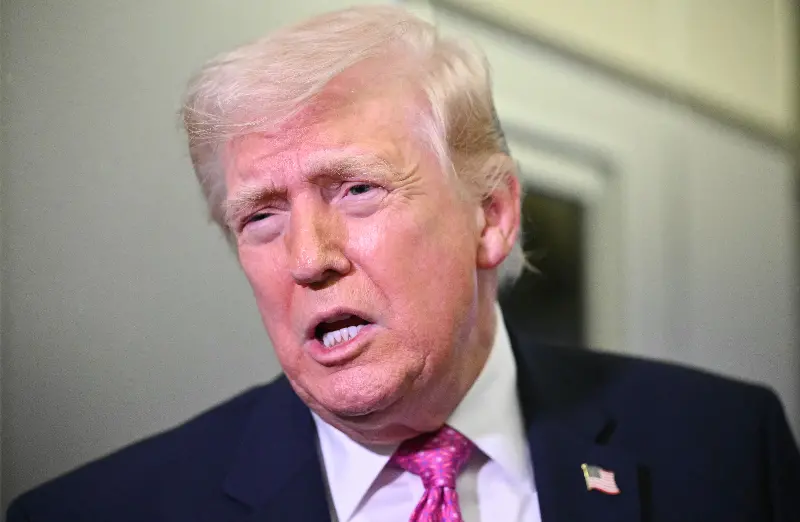
President Donald Trump praised the stock market for being the “highest ever” during a Wednesday address on the Iran war, but minutes later, stock market futures slid further amid economic uncertainty swirling after America’s attack on the Middle Eastern nation.
Within minutes of Trump’s remarks ending, futures tied to the Dow Jones Industrial Average, S&P 500 and Nasdaq all turned decisively negative, erasing earlier gains from the regular trading session and pushing markets toward fresh short-term lows. The stock market has taken a hit since the Iran war started, contributing to the economic pain Americans are feeling, and it took another blow when Trump announced he’d continue the war for at least another few weeks, despite speculation he could use the speech to declare victory.
Dow futures fell by roughly 0.8 percent after the speech while Nasdaq futures dropped around 1 percent, according to CNBC. Earlier in the day, the S&P 500 and Nasdaq composite gained 0.72 percent and 1.16 percent, respectively, on the back of optimism that the war could be ending.
During Trump’s national address, he said U.S. military objectives in Iran were “nearing completion” but warned that intense fighting would continue for another two to three weeks. Investors had hoped the speech would offer more definitive signals of de-escalation. Instead, analysts described it as extending the timeline for uncertainty just as markets were attempting to stabilize.
“We have no additional certainty or clarity around timeline from this address and this is what the market was looking for. The fact that we can expect 2-3 more weeks of action, boots on the ground were not ruled out and that threats to hit infrastructure were reiterated will put the market back on the defensive, particularly as we come into the long weekend,” Jon Withaar, senior portfolio manager at Pictet Asset Management, told Reuters.
At the same time, oil prices surged, intensifying fears of renewed inflationary pressure. Yahoo Finance reported that Brent crude jumped more than 4 percent, climbing back above $105 a barrel, while West Texas Intermediate crude rose near $104 a barrel after recovering from earlier losses. The gains came as Trump again avoided providing a clear plan for reopening the Strait of Hormuz, a critical global energy chokepoint that remains central to market concerns. During his speech, Trump said the strait would open up “naturally” once the conflict was over.
“They’re going to want to be able to sell oil, because that’s all they have to try and rebuild. It will resume the flowing and the gas prices will rapidly come back down, stock prices will rapidly go back up,” Trump said.
Affordability and economic concerns carry the potential to upend Republican gains in Congress and puts the GOP’s majority in the House and Senate at risk. Republicans have been warning Trump that if the war drags on and keeps hitting Americans’ wallets, Republicans could lose during the midterm elections, and if they lose their majority, Trump risks being unable to be an effective president in his final two years in office.
While Trump has tried to convince Americans that the economy is doing well, polling indicates that he’s losing more and more people. A recent Harvard/CAPS poll found 53 percent of respondents believe the economy is worse now than it was under former President Joe Biden. The poll also found that 62 percent blame Trump for the current state of the economy, while 38 percent blame the Biden administration.
Kush Desai, White House spokesperson, previously told Newsweek that Trump has “always been clear about short-term disruptions” as a result of the Iran war.
“America’s long-term economic trajectory, however, remains solid with the administration focused on implementing the president’s proven economic agenda of tax cuts, deregulation and energy abundance. Once Operation Epic Fury’s objectives have been achieved and these short-term disruptions are behind us, Americans rest assured that the president’s agenda will unleash the historic job, wage and economic growth they saw during the first Trump administration,” Desai said.
The late-session slide also pushed U.S. equity benchmarks closer to levels last seen earlier in the war, when doubts over a ceasefire triggered the steepest losses since the conflict began on February 28. Investors remain concerned that prolonged military operations could ripple into slower growth, higher energy prices and delayed interest rate cuts from the Federal Reserve.