



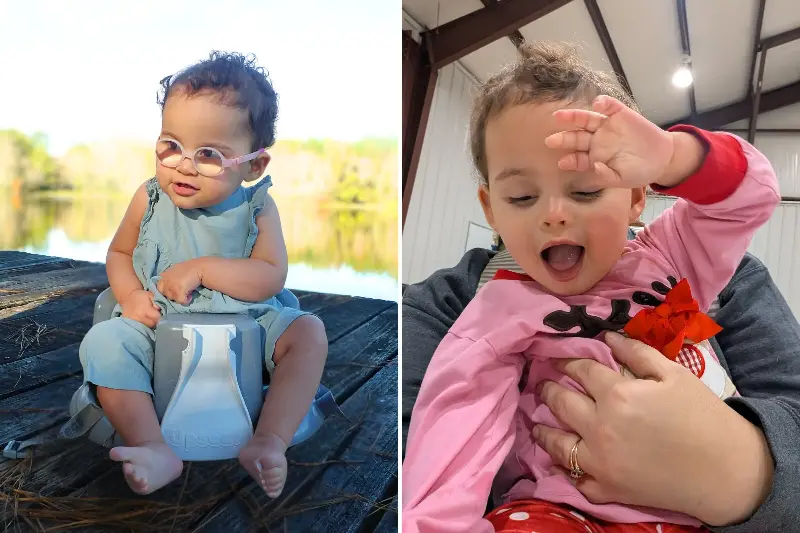
Parents can usually tell when their toddler needs a nap and they know roughly how long the child will sleep for. But naptimes look a little different for Melinda Collier, who doesn’t always know when her toddler is going to wake up due to a rare genetic condition that causes her to sleep for 24 hours at a time.
While she may just be 22 months old, Cecilia has already faced many challenges due to CDKL5 deficiency disorder, also known as CDD. It is a rare developmental epileptic encephalopathy, which can cause seizures and neurodevelopmental delay, as well as gastrointestinal and sleep disturbances. National Organization for Rare Disorders (NORD) says CDKL5 affects 1 in every 40,000 to 60,000 live births.
Cecilia was just a few weeks old when she was diagnosed. Her adoptive mom, Melinda Collier, 34, of Louisiana, told Newsweek that the condition has “impacted her differently over time,” and her development aligns with that of a 7-month-old.
“She cannot independently explore nor self-feed, and some of her biggest struggles have been regarding her low muscle tone in her core and shoulders,” Collier said. “She is just now able to sit unassisted for a few seconds at a time and is beginning to bear weight on her legs.”
Cecilia is living with developmental delays and learning disabilities, but, fortunately, she has been seizure-free since May 2025.
Around four times a month, Cecilia will take a “24-hour nap”; these are completely random and there aren’t any advance warnings. The only way Collier knows they are happening is when her toddler doesn’t wake up from her morning nap.
“Our day starts with waking up, changing her diaper, and taking medicine with her breakfast. She sometimes wants to take a morning nap after, which is normal, but she will wake up on her own after 30 minutes. I can usually tell it’s a 24-hour nap day when she immediately falls asleep after breakfast and doesn’t wake up after,” Collier said.
During those days, Collier and her husband try to go about their days as normal while keeping Cecilia close by to monitor her sleep. It is a useful time for Collier to catch up on housework, but, when she goes out, she will simply put Cecilia in the car seat and take her along while she is asleep.
Cecilia may wake up for around five minutes during a 24-hour nap, but typically she has to be woken up for feeding and changing.
“She doesn’t like being woken up and can be a bit of a grouch, but I laugh, give her a pep talk, and tell her she has to eat and be clean and then she can go back to sleep. Her 24-hour sleep days are great cuddle days, but they’re also great days to get housework done,” Collier continued.
When Cecilia eventually wakes from her slumber, she will stay awake for the next 24 hours as part of a cycle. Collier said that her toddler is usually very excited and well-rested initially, but she “starts to get cranky” around 16 hours in.
Cecilia may take the occasional five-minute power nap, but that is typically all she sleeps for during 24 hours. Toward the end, she becomes whiney and “fights sleep.” Collier said she doesn’t know how long these 24-hour naps and periods of wakefulness will continue, but she and her husband are learning as they go.
“CDKL5 impacts children in a variety of ways. A lot of children, like Cecilia, have ‘sleepy days’ and awake periods, while others have a different variation of the cycle. Some can walk eventually and meet milestones at a more-regular rate while others do not,” Collier said.
She continued: “It’s a good reminder that all abilities deserve compassion and understanding. For our family, our faith shapes how we approach these differences. We approach them with patience, hope, and the belief that every child is deeply valuable regardless of ability.”
Advocating for CDKL5 Children
For much of her young life, Cecilia has been pigeonholed and given little chance for progression due to her genetic condition. Indeed, a neurologist who said she would never drive “lit a fire” in Collier to keep fighting and advocating for the toddler.
As a result, Collier started sharing information about CDKL5 on TikTok (@melindacollier91) and many of the videos have gone viral.
Cecilia may live with challenges, but Collier said she hopes that her daughter still lives a fulfilling and prosperous life. She has also discussed the process and beauty of open adoption, as Collier has “a great relationship” with Cecilia’s biological mom and dad, whom she refers to as her first parents.
Through open adoption, Cecilia is loved by her adoptive parents and her biological parents, whom she still gets to see regularly.
Collier said: “I want parents to never lose hope. Cecilia’s life and her testimony are worth sharing and worth proving that you can’t and shouldn’t chalk up someone, let alone a child, as a lost cause.
“As a mom of two daughters with rare genetic disorders (my oldest is diagnosed with a milder form of Kleefstra Syndrome), don’t let anyone tell you your child can’t or won’t. You are your child’s best advocate and the one who is going to fight for them. I want people to be encouraged and know their duty as a parent is valued, even if their child can’t tell them,” Collier said.
Is there a health issue that’s worrying you? Let us know via [email protected]. We can ask experts for advice, and your story could be featured on Newsweek.