



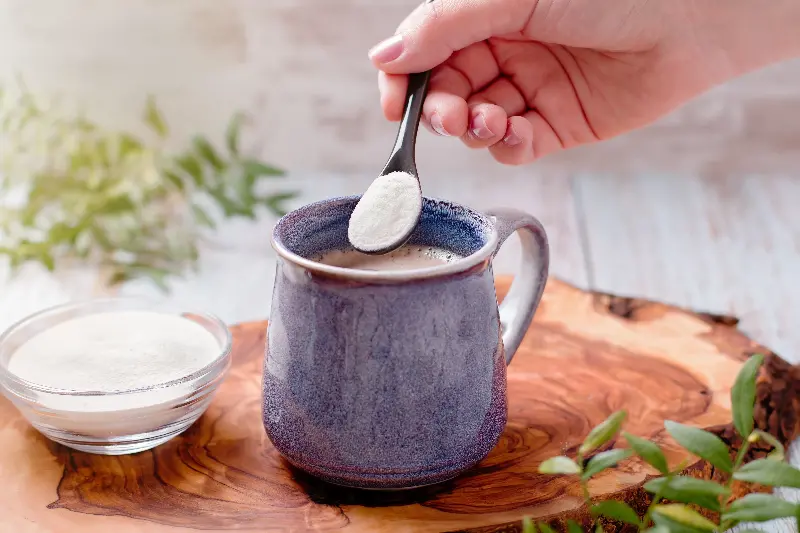
Collagen supplements can improve skin elasticity and hydration when taken consistently over time, but they do not stop wrinkles, according to a major new scientific review that assessed the strongest evidence to date on the trendy supplement.
Researchers say the products offer “legitimate” skin benefits yet should not be marketed as a quick fix for aging.
The findings come from an umbrella review led by researchers at Anglia Ruskin University (ARU) in England, which analyzed evidence from 16 systematic reviews covering 113 randomized controlled trials and 7,983 participants worldwide. Published in the Aesthetic Surgery Journal Open Forum, the study set out to capture the full range of health outcomes linked to collagen supplementation, from skin and joints to oral and cardiometabolic health.
What Is Collagen?
Collagen is a protein produced naturally in the body and plays multiple roles.
It supports fibroblast formation in the dermis, helps replace dead skin cells, gives structure, strength and elasticity to skin, protects organs and plays a key role in blood clotting. It also supports nails, bones and connective tissues such as tendons, cartilage and ligaments.
From early adulthood, however, collagen production declines and existing collagen breaks down faster. Smoking and sun exposure accelerate that process, and around the menopause women can lose about a third of their skin’s collagen, the researchers said.
Can Collagen Prevent Against Wrinkles?
To assess whether supplements can meaningfully counter these changes, the team reviewed studies indexed in PubMed, Embase, Scopus and Web of Science up to March 2025. They calculated effect sizes for each health outcome and used meta-analyses and meta-regression to explore differences between studies, grading the strength of evidence using established GRADE criteria.
For skin health, the results were consistent. Taken daily over long periods, collagen supplements were associated with improved skin elasticity and hydration. However, the review found no convincing evidence that they reduce wrinkles or significantly improve skin roughness, despite common marketing claims and how the supplement is often spoken about.
Researchers said they were highly confident in the modest skin benefits identified but stressed that collagen should not be seen as an anti-wrinkle solution. Instead, they suggest the supplements are better positioned as a form of foundational support that contributes to overall skin quality rather than altering surface lines.
“This new umbrella review from ARU is one of the most comprehensive analyses we’ve had so far, pulling together more than 100 randomized controlled trials,” Dr. Roxana Shirazi, a dermatologist with Virginia’s VCU Health and associate director of Cosmetic Dermatology and Laser Surgery, told Newsweek. “The strongest evidence was for improvements in skin elasticity and hydration, and the authors rated that evidence as high certainty. That’s significant, because declining elasticity is one of the main drivers of visible skin aging.
“That said, collagen is not a wrinkle eraser. The study did not show significant improvement in skin roughness, and it does not reverse established lines. The benefits seem to be gradual and depend on consistent use over time rather than dramatic short-term changes.”
What Else Can Collagen Supplements Do?
Beyond skin, the analysis found collagen supplementation was also linked to favorable outcomes for musculoskeletal health, particularly in people with osteoarthritis. Across the trials reviewed, supplements were associated with reduced joint pain and stiffness, supporting claims that collagen may ease age- or activity-related “wear and tear.” Evidence relating to oral health and cardiometabolic measures, such as cholesterol or blood sugar, was mixed and less conclusive.
Overall, the researchers concluded that collagen supplements support what they describe as an “inside-out” model of skin rejuvenation, acting on deeper tissue structure rather than providing superficial cosmetic effects.
Shirazi said: “In my view, collagen can play a supportive role for patients who are interested in maintaining skin quality as they age, particularly since our natural collagen production decreases over time. But it should not replace the fundamentals. Daily sunscreen, topical retinoids, and other evidence-based treatments remain the backbone of any anti-aging strategy. Collagen can be a nice add-on for some patients, but it’s not the foundation of good skin care.”
While collagen has become a staple of the wellness industry, stirred into creamy coffees, green juices or taken as daily sachets, the review suggests expectations need to be reset.
Do you have a tip on a health story that Newsweek should be covering? Do you have a question about skin health? Let us know via [email protected].
Reference
Ravindran, R. et al. (2026). Collagen Supplementation for Skin and Musculoskeletal Health: An Umbrella Review of Meta-analyses on Elasticity, Hydration, and Structural Outcomes. Aesthetic Surgery Journal Open Forum. https://doi.org/10.1093/asjof/ojag018.