



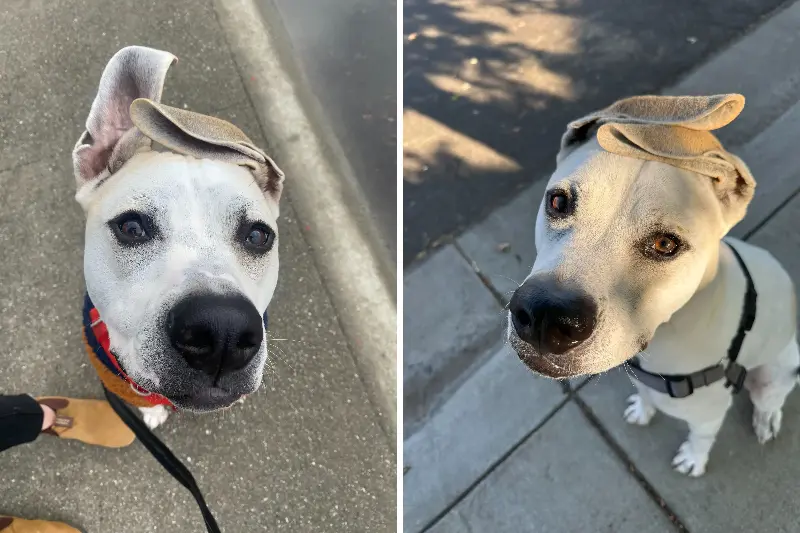
A crossbreed dog has stolen hearts online—not for a trick he can do or a costume he wears, but for a single feature that has left the internet utterly obsessed.
Five‑year‑old Hamm, a pit bull and Great Pyrenees mix, has the kind of ears you can’t help but stare at. Set wide and low on his head, they fold outward in a loose, relaxed shape, almost like tiny wings. Soft, slightly rounded, and fanning out to the sides, they give him a permanently whimsical, a look that fans say they’ve never seen before.
His owner Madison, 29, told Newsweek: “We often get asked if he has hearing problems because of their shape but his hearing is normal.
“He does like to pretend he can’t hear us, especially when we are asking him to do something he doesn’t want to do.”
Hamm was adopted at four months old after being born into an accidental litter. And his signature ears have been with him since day one.
Madison, from Minneapolis, Minnesota, said: “We thought he might grow out of it, but luckily for us, they stayed the same.”
A Dog Who Turns Heads Everywhere He Goes
While Hamm’s ears have gained attention on Instagram (@slices_of_hamm), they’re just as much of a conversation‑starter out in public.
“Occasionally we get a comment about his ‘eyeliner,’ but most questions start with his ears,” Madison said. “Questions like, ‘Are they always like that?’, ‘Why are they like that?’, ‘Do they ever flip down?’ are usually the ones we get off the bat.
“He loves meeting new people so when people stop to ask about his ears, he absolutely adores the attention.”
In one popular video, Madison describes his ears as “wild and free,” and they’re seen bouncing and flopping dramatically as Hamm runs. The comments quickly filled with admiration.
“I love his ears so much,” one user wrote.
Why Mixed‑Breed Dogs Like Hamm Stand Out
Research has found mixed‑breed dogs make up a large portion of pet dogs worldwide. In the United States alone, they account for roughly half of all owned dogs—about 53 percent, according to the American Veterinary Medical Association, or 44 percent per the American Pet Products Association. In Germany and the U.K., about one‑third of pet dogs are mixed breeds, while in Australia, the share rises to around half.
These figures only reflect owned dogs—those living in homes or counted in veterinary or industry surveys—meaning mixed breeds likely make up an even larger percentage of the global dog population.
Experts believe they are the majority worldwide, especially in free‑roaming or street dog communities.
And for dogs like Hamm, their mixed‑breed heritage often results in unique features that set them apart—sometimes so distinct they end up gaining popularity online.
Reference
Turcsán, Borbála, et al. “Owner Perceived Differences between Mixed-Breed and Purebred Dogs.” PLoS ONE, vol. 12, no. 2, Feb. 2017, p. e0172720. PubMed Central, https://doi.org/10.1371/journal.pone.0172720.