



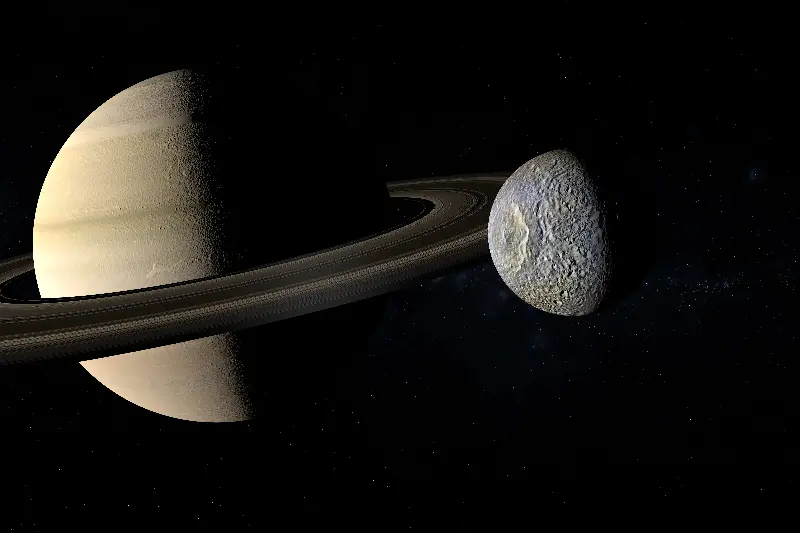
Saturn’s “Death Star”-like moon Mimas may have a boiling ocean under its icy shell.
The moon pitted with craters—including a very large one, giving it its nickname—may appear to be geologically dead, according to UC Davis researchers, but a “wobble” in its movement suggests an ocean is present.
We know that the outer planets of the solar system are surrounded by ice-wrapped moons, some of which, like Saturn’s moon Enceladus, have oceans of liquid water between the ice shell and rocky core. These could be the best places in our solar system to look for extraterrestrial life, according to the researchers looking inside icy moons.
In their new study, the team dug deeper into what could be going on beneath these surfaces, unearthing more information about how their diverse geologic features may have formed and why some oceans found there may boil.
Icy, ocean-bearing moons would be heated by the tidal forces from the planet they orbit—forces that can increase or decrease based on interactions with neighbouring moons. Higher levels of heating would melt the ice layer, while less would allow it to thicken.
While they had previously investigated what happens when the ice shell gets thicker—with freezing putting pressure on it and potentially causing certain features—they have now explored what happens when the ice shell melts from the bottom.
This could cause the ocean to boil, the team concluded.
Because Mimas’ ice shell is not expected to break as a result of thinning, a liquid water ocean underneath can be reconciled with a geologically dead surface, they explained.
If such moons are the right size—Mimas is just 250 miles wide—water could reach the triple point when it can exist as liquid, solid and gas at the same time, causing boiling.
“Not all of these satellites are known to have oceans, but we know that some do,” said study author Max Rudolph, professor of earth and planetary sciences at UC Davis. “We’re interested in the processes that shape their evolution over millions of years and this allows us to think about what the surface expression of an ocean world would be.”
In terms of oceans boiling, the researchers explained that such could occur because as ice melts into less-dense liquid water, pressure drops. They also calculated that at least on the smallest icy moons, the pressure could drop low enough to reach the triple point.
“Here we show that ice-shell thinning can lead to two possible outcomes, depending on the size of the icy body. For the smallest icy bodies, such as Mimas, Enceladus and Miranda, the pressure may become low enough that water reaches the boiling temperature, generating buoyant water vapor and exsolved gases,” they wrote in the paper.
Ocean boiling could explain the areas of ridges and cliffs detected in images of Miranda, for example.
On larger ice moons, however, the drop in ice would cause the shell to crack before the triple point for water is reached, the researchers calculated.
Newsweek has reached out to the study authors for additional comment.
Do you have a tip on a science story that Newsweek should be covering? Do you have a question about icy moons? Let us know via [email protected].
Reference
Rudolph, M. L., Manga, M., Rhoden, A. R., & Walker, M. (2025). Boiling oceans and compressional tectonics on emerging ocean worlds. Nature Astronomy. https://doi.org/10.1038/s41550-025-02713-5