



When video game technology talks about innovation, it usually gestures forward, toward disruption, toward what’s next and how everything has changed. The story of WOWCube does not begin there. It starts in 2016 with a 12‑year‑old kid, his father, an Arduino kit, and a shared love of puzzle games inspired by his grandfather.
Savva and Ilya Osipov spent their time tinkering together, learning sensors, linking small displays, and writing simple physics demos. What began as experiments soon evolved into 3D‑printed prototypes; by April 2017, they formally registered Cubios, Inc. The foundation of WOWCube was not a pitch deck or market research, but curiosity, patience, and play.
As the project matured into something that deserved to be in players’ hands, Max Filin joined as CEO to help commercialize the platform. The goal was not to sell another gadget, but to introduce a new category: an entertainment system. The result is a twistable, screen‑covered cube with 24 displays, eight CPUs, and motion sensors, built for a form of play that is unmistakably physical. The rebranded Rubik’s WOWCube launched in late 2025 alongside a growing ecosystem of apps accessed through a companion mobile application.
My 150‑Hour Test: How a Cube Teaches Thought
Spending 150 hours with the WOWCube came easily, and with noticeable results. I learned efficient methods for solving a 2×2×2 cube, cleared Cut the Rope with three stars, and chased high scores in Space Invaders. With a 2×2×2, any position can be solved in roughly nine to fifteen moves if you know what you’re doing. Embarrassingly, I never truly understood cube puzzles beyond the standard 3×3×3. After weeks of choosing the cube over doomscrolling, the logic finally clicked.
The WOWCube asks users to think differently from most modern games. Rather than funneling players immediately toward dopamine hits, it demands spatial reasoning, patience, and physical engagement. That friction is the point.
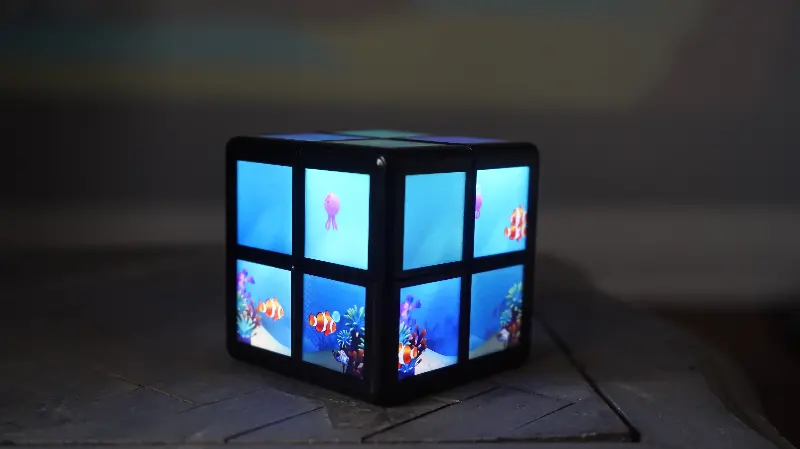
The device fits naturally into daily life as a fidget toy that satisfies ADHD tendencies in a healthier way than endlessly scrolling a feed. It is especially engaging while watching television. Even the first‑time experience communicates its broader potential. Some applications feel like starting points rather than finished ideas, particularly the aquarium app. Still, leaving it running as a night‑light, including lava‑lamp variants, has added a genuinely cozy atmosphere to my living space. As the app store grows and matures, its polish and depth should follow.
Interaction with the WOWCube happens in four primary ways: twisting the displays, tilting the cube to highlight selections, shaking it to return to the main menu, and tapping or patting to confirm choices. The physical sensation of a twist lands somewhere between winding a mechanical stopwatch and snapping a magnetic puzzle into place. This is not simulated tactility; it is the core mechanic.
Even repairability reflects that philosophy. Each cube module is individually replaceable, an unexpectedly refreshing design choice in an era of sealed hardware.
Not a Subscription Trap
Despite early speculation, there is no hidden subscription service attached to the WOWCube. Instead, the catalog blends free tech demos with paid experiences. I experienced roughly 45 games and nine utility apps, all managed through a Bluetooth‑connected phone companion.
Some experiences reveal their depth slowly. Space Invaders initially felt underwhelming, but its combination of gyroscope control and multiple displays creates a feedback loop that feels like true spatial computing. It is a concept translated into a form anyone can understand within minutes.
The “Doc Ock” Reality Check
What separates WOWCube from devices like the Nintendo Switch or Steam Deck is not processing power; it is accessibility. Its app ecosystem recalls the early days of the iPod Touch, when experimentation thrived and predatory design had not yet taken hold. Many of the best experiences subtly improve cognitive flow rather than fracture it.
That said, reality sets in when discussing price and positioning. At $399 during my hands‑on period, discounted from $499, the WOWCube occupies uncomfortable territory for something that can still feel like a proof‑of‑concept platform. It is also physically chunky, a consequence of its glass construction and internal computing power. The aesthetic is striking and borderline mad‑scientist chic, but it will prompt hesitation from mainstream consumers.
A Father–Son Blueprint for Accessible, Educational Play
From the beginning, the Osipovs were not chasing complexity; they were chasing fun. Ilya’s background in human‑computer interaction and puzzle design is evident in how intuitive the cube feels in hand. The team iterated steadily, moving from Arduino prototypes to higher‑resolution displays, sturdier connectors, and a custom operating system. They brought the device to maker fairs and academic venues, where children consistently reacted with the same words: “wow” and “cool.” The name stuck.
WOWCube’s educational positioning is not decorative branding. The system carries a STEM.org Trustmark and has long framed itself as a learning tool. Its packaging and documentation emphasize learning through play rather than treating it as an afterthought. In 2021, the project earned a special mention in TIME’s Best Inventions list, highlighting its potential as a more creative cube.
The Legacy of the Cube
This is a device for a specific audience, the kind of person who once treated the original Rubik’s Cube as a revelation while others chased Saturday‑morning cartoons. That lineage matters.
When Ernő Rubik created the cube in 1974 as a teaching tool for modeling three‑dimensional space, he could not have predicted its global impact. With 43 quintillion possible configurations, it became a meditative mathematical ritual and later a competitive sport. With WOWCube, that combinatorial logic expands into something programmable and infinite.
That connection became formal in 2024, when Cubios partnered with Spin Master, the owner of Rubik’s. The agreement allowed WOWCube to use Rubik’s colors and characters while benefiting from marketing support. Following hands‑on demos at New York Comic Con and CES, the Rubik’s WOWCube launched in October 2025, transitioning from curiosity to legitimate platform.
Why the WOWCube Matters, and Who It’s For
- A bridge between analog puzzles and digital play. It is tactile and screen‑based at once, lowering barriers while preserving depth.
- An education‑ready platform. The STEM positioning is supported by real classroom interest and cognitive design.
- A living homage to Rubik’s. Few devices respect a 50‑year legacy while still feeling genuinely new.
- Caveats remain. Price, battery life, and early platform clunkiness will limit mass adoption in the short term.
Verdict
I continue to use the WOWCube while waiting for its next evolution. It is the kind of device I wish my own grandfather had experienced. To him, Rubik’s Cubes existed only as distractions. Knowing his love for puzzles, math, and things that make education fun for children; I suspect the WOWCube would have revealed their deeper appeal far more clearly.
This is accessible spatial computing that respects the user’s time and intelligence, something many modern devices no longer attempt. Whether it becomes a household staple remains uncertain, but it is one of the most interesting portable gaming concepts since the original Game Boy. If you can stomach the price, its brilliance is difficult to ignore.