



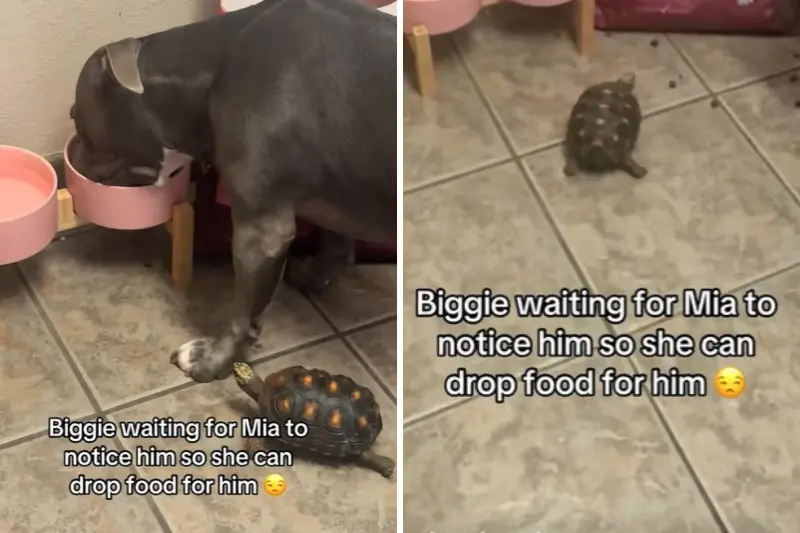
A viral video showing a pit bull calmly eating her kibble has melted hearts online—but it is not the dog’s manners that viewers can’t stop talking about.
Mia, a pit bull, is joined at mealtime by her unlikely companion: a 3‑year‑old tortoise named Biggie. As Mia tucks into her bowl, Biggie patiently waits nearby, watching closely.
The owner explained the unusual setup in text over the clip, writing, “Biggie waiting for Mia to notice him so she can drop food for him,” a moment that has since racked up over 371,000 views and more than 43,000 likes, at the time of writing.
Right on cue, Mia suddenly notices her reptile friend. She steps away from her bowl with her mouth full of kibble, allowing pieces of dog food to spill onto the floor in Biggie’s direction.
Viewers were quick to weigh in on whether the act was intentional. “Does she do this for him on purpose?” one user asked.
The owner was quick to clarify: “Yes!”
Another commenter joked: “She’s just feeding her pet.”
A third viewer added: “She’s doing it like it’s not on purpose. She’s like ‘oops oh my I’m such a messy eater pardon me.’”
Other eagle‑eyed users noticed that Biggie’s own food—some lettuce placed to the left of Mia’s bowls—had gone completely untouched, prompting further amusement over the pair’s apparent teamwork and bond.
A fourth user said: “I mean, if I could stand under someone and they drop packets of chips (or the human equivalent) over me like that, I’d ignore my own dinner too.”
While many viewers were charmed by the friendship, animal experts stress an important reminder: tortoises should never eat dog or cat food.
Why Dog Food Is Dangerous for Tortoises
Experts at Avonvale Vets, an RCVS‑accredited group of small animal practices in Warwickshire, England, say tortoises are strictly herbivorous. Its website explains that meat or processed foods can cause kidney damage, and items such as biscuits and cakes are also off‑limits.
Andy C. Highfield, the director of the Tortoise Trust charity in the U.K., previously told Newsweek: “Providing the wrong diet will invariably have catastrophic consequences. Vets encounter a huge number of sick tortoises with serious and often-irreversible growth deformities every year. This is one of the most-common health issues with tortoises vets see.”
In the wild, tortoises graze on a wide variety of leafy vegetation. By roaming across large areas and eating many different plants, they naturally obtain the essential minerals and trace elements needed for growth and healthy bone development.
Avonvale Vets experts warn that no commercially available “complete tortoise food” can replace a well‑balanced, varied diet of fresh leaves and vegetation.
Home‑grown leaves and edible weeds are considered far better than store‑bought fruit and vegetables, as they typically contain higher nutrient levels.