



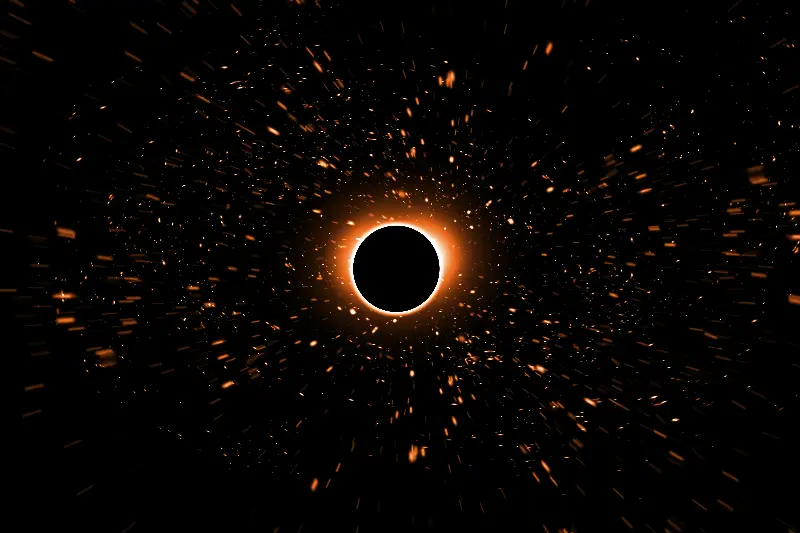
The expolision of a black hole could explain the origins of a mysterious high-energy neutrino detected in 2023, as well as shedding more light on the mystery of dark matter in the process.
In 2023, a neutrino—a type of nearly massless subatomic particle that travels at nearly the speed of light—crashed into Earth with an astonishing amount of energy, being some 100,000 times more powerful that the highest-energy particle produced by the Large Hadron Collider, the world’s most powerful particle accelerator.
Now, physicists at the University of Massachusetts Amherst suggest that the source of the neutrino might be the explosion of a rare type of black hole, known as a quasi-extremal primordial black hole (PBH).
PBHs are thought to have originated in the early universe, shortly after the Big Bang, and are much smaller and lighter than black holes formed by collapsing stars.
Over time, these black holes are thought to lose mass through a process called Hawking radiation, eventually heating up and exploding into a burst of energy.
“The lighter a black hole is, the hotter it should be and the more particles it will emit,” says Andrea Thamm, co-author of the new research and assistant professor of physics at UMass Amherst.
“As PBHs evaporate, they become ever lighter, and so hotter, emitting even more radiation in a runaway process until explosion. It’s that Hawking radiation that our telescopes can detect.”
The UMass team suggests that these explosions could happen with surprising frequency— perhaps once every decade or so—and that current instruments like the Cubic Kilometre Neutrino Telescope (KM3NeT), which lies at the bottom of the Mediterranean Sea, are capable of detecting them.
However, an experiment set up to capture high-energy cosmic neutrinos, IceCube, did not register any particles with similar energy levels. This raised an important question: If PBHs are indeed frequent, why have more of these neutrinos not been detected?
“We think that PBHs with a ‘dark charge’—what we call quasi-extremal PBHs—are the missing link,” says Joaquim Iguaz Juan, a postdoctoral researcher in physics at UMass Amherst and one of the paper’s co-authors.
The dark charge is essentially a copy of the usual electric force as we know it, but which includes a very heavy, hypothesized version of the electron, which the team calls a “dark electron.”
“There are other, simpler models of PBHs out there,” says Michael Baker, co-author and an assistant professor of physics at UMass Amherst; “our dark-charge model is more complex, which means it may provide a more accurate model of reality. What’s so cool is to see that our model can explain this otherwise unexplainable phenomenon.”
“A PBH with a dark charge,” adds Thamm, “has unique properties and behaves in ways that are different from other, simpler PBH models. We have shown that this can provide an explanation of all of the seemingly inconsistent experimental data.”
In addition to explaining the neutrino, the dark-charge model could also offer a solution to the mystery of dark matter, according to the physicists, who added that observation of galaxies and the cosmic microwave background suggest that some kind of dark matter exists, but it has yet to be directly detected.
“If our hypothesized dark charge is true,” adds Iguaz Juan, “then we believe there could be a significant population of PBHs, which would be consistent with other astrophysical observations, and account for all the missing dark matter in the universe.”
Barker added: “Observing the high-energy neutrino gave us a new window on the universe. But we could now be on the cusp of experimentally verifying Hawking radiation, obtaining evidence for both primordial black holes and new particles beyond the Standard Model, and explaining the mystery of dark matter.”
Do you have a tip on a science story that Newsweek should be covering? Do you have a question about PBHs? Let us know via [email protected].
Reference
Baker, M. J., Iguaz Juan, J., Symons, A., & Thamm, A. (2025). Explaining the PeV neutrino fluxes at KM3NeT and IceCube with quasi-extremal primordial black holes. Physical Review Letters. https://doi.org/10.1103/r793-p7ct