



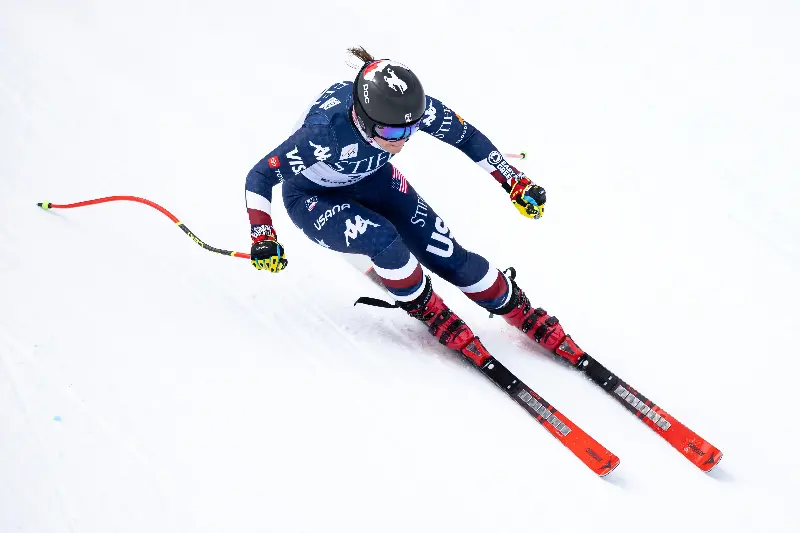
Team USA ski racer Breezy Johnson is heading back to Cortina d’Ampezzo in Italy’s Dolomites where her Olympic dream was upended four years ago.
One month ahead of the 2022 Beijing Games, Johnson crashed while training in Cortina, tearing her right knee and causing severe cartilage damage. The incident forced her to withdraw from the Winter Games and sent her on a monthslong recovery journey.
“My issue with Cortina has been that I can generate speed really quickly on that hill and it often gets out of my control,” Johnson tells Newsweek from nearby San Pellegrino.
The crash wasn’t her first career setback. Johnson had previously suffered several other knee injuries, including ACL, MCL and PCL tears, underscoring the brutal physical toll of elite ski racing. Despite each injury, Johnson has repeatedly found her way back to the start gate and was crowned the International Ski and Snowboard Federation women’s downhill world champion last year.
Born Breanna Noble Johnson in Jackson Hole, Wyoming, she was on skis by age 3. The nickname “Breezy” stuck early, a natural moniker for a racer whose personal motto is “like the wind,” a nod to the element she channels down the hill.
But speed, while required for downhill and super-G racing, isn’t Johnson’s favorite part of the sport—in fact, sometimes it’s the part she likes least.
“Those high speeds are what eat us up and spit us out,” Johnson tells Newsweek. “You’re pulling up to four gs of force, moving over these massive rolls and features of terrain, and you have giant knives on your feet,” she explains.
Picking up pace and, in super-G, snapping through turns to hit gates on time, “you get to this point where you’re like, oh my gosh, this is the edge of my abilities.”
Approaching Cortina, speed, more than fear, is top of mind for Johnson. She has always been quick to generate speed, sometimes carrying it when others bleed it off on flatter parts of the track. At the 2025 Alpine Ski World Championships in Saalbach, Austria, she topped out at 86 miles per hour on her way to gold in the women’s downhill, described as among the fastest-ever speeds recorded in a women’s Alpine race.
As she heads back to the mountain that previously ended her Olympic hopes, Johnson says she keeps reminding herself to “stay over yourself and execute your plan. You can be very fast on this hill, you just need to rein it in.”
Recovery and Retraining
Johnson’s long list of injuries has kept her off snow for months at a time, forcing her to retrain both her body and mind. “[What’s] funny about skiing is that it’s very counterintuitive…there’s a lot of things that are backwards in skiing,” she says.
In a turn, for instance, racers have to override their natural instincts and keep their weight stacked over the outside ski, instead of leaning into the corner the way their body wants to. And when speed really ramps up, nonskiers’ reflex is to lean back, but they need pressure on the tips of their skis so they will bite and turn.
Recovering from injury also requires a kind of mental retraining as skiers rebuild instincts, overcome fear and return to speed after long stretches off snow. For Johnson, that psychological grind can be harder than rebuilding the physical strength and skills.
“In all of those [recovery training] steps you have fear, and you have to break through that because if you let fear start running the show, you can just forget how to ski at all,” she explains.
“I don’t think I would say that I’m grateful for any of the injuries that I’ve had, but I have learned things in all of them and, like, come out the backside and take in everything that I could from them,” the 30-year-old says.
What they’ve given her, she adds, is a clearer sense of the sport’s finite nature, which has sharpened the way she approaches inspection before a race, using that slower, deliberate look at the course to build a plan she can execute at speed. The injuries have honed her sense of risk and reward—the constant calculus of downhill—and, in the process, helped her “find time” on the track.
That’s part of what Johnson loves most about the sport—skiing is both “very physical and very cerebral.” It demands split-second adjustments and constant changes while hurtling down a mountain at more than 75 miles per hour amid changing conditions.
However, injuries continue to creep up for Johnson. In a December social media post she revealed she had hurt her back, which put her in the “worst pain of my life.”
Back to Cortina
Johnson will be part of Team USA’s push for medals in Cortina, alongside Alpine headliners Mikaela Shiffrin, 30, and Lindsey Vonn, 41. Vonn came out of retirement in 2024 following a partial knee replacement and has won two World Cup downhill competitions this season, becoming the oldest-ever downhill skiing World Cup winner.
As well as having the support of her teammates, Johnson will be backed by many of her friends and family, who are expected to be on the mountain watching her. The skier will also bring her rituals, including knitting a new Olympic-themed headband or hat for the finish line. And as she faces down the mountain that she was once injured on, Johnson will enjoy the same prerace treat she always does—a handful of blue Sour Patch Kids.