



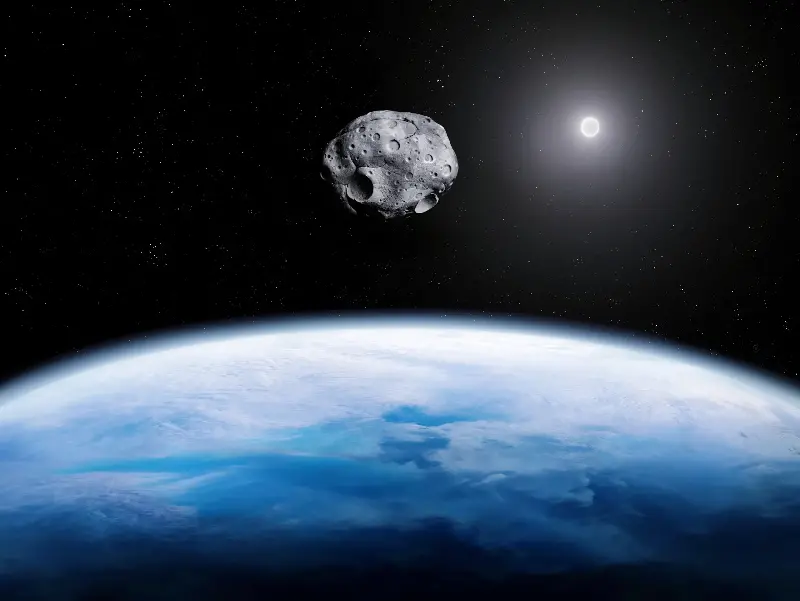
NASA is monitoring an asteroid that will be at a “very rare” close distance to the Earth in an event that happens only every few thousand years.
With a mean diameter of 1,115 feet and a long axis that is at least 1,480 feet long, the asteroid known as Apophis is due to come close to the Earth in just under three years.
NASA says, “Near-Earth asteroid Apophis is a potentially hazardous asteroid that will safely pass close to Earth on April 13, 2029,” marking “the closest approach to Earth by an asteroid of this size that scientists have known about in advance.”
The space rock will be around 20,000 miles from the surface of the Earth, which is “closer than the distance of many satellites in geosynchronous orbit (about 22,236 miles, or 36,000 kilometers, in altitude),” the agency said, noting that “an asteroid of its size passing so close to our planet is a very rare event.”
According to NASA, a space rock as large as this passes this close to Earth only every few thousand years, on average, making it likely that “an event like this has not happened at any time in recorded human history.” The agency added: “Without a doubt this is the first time it’s happened when humans have had the technology to observe it.”
While it is designated as a “potentially hazardous” asteroid, “Apophis does not pose any immediate risk to Earth,” NASA said, and scientists will use this opportunity to study Apophis in more detail.
Back in 2024, when Apophis was first discovered, it was believed that the asteroid might impact Earth in 2029, 2036, or 2068. However, following further observations of the space rock, NASA concluded that there is no risk of Apophis hitting Earth for at least 100 years.
The agency said: “There is no danger to Earth, to anyone or anything living on it, or to astronauts or satellites in space. But the event is an amazing and totally unprecedented opportunity to learn much more about Apophis and similar near-Earth asteroids.”
On April 13, 2029, Apophis and Earth, while each following its own orbit around the sun, will pass each other at a close distance of only 20,000 miles.
Apophis will be “pulled, twisted, stretched, and squeezed by the gravity of Earth as it goes by, in a way that happens only during a very close encounter,” NASA says.
The overall pull is expected to make Apophis’s orbit slightly larger, giving it a longer orbital period, while the twisting will likely affect the way it rotates, speeding up or slowing down its spin and changing its orientation.
The stretching and squeezing “may possibly cause some small landslides or other movement of surface material on the asteroid, most likely in places that are already steeply sloped,” NASA added.
The space agency said: “Exactly how Apophis responds to these disturbances will depend on its internal structure and the materials it’s composed of. So by observing and measuring those responses, scientists will be able to work backwards and figure out what is going on inside the asteroid.”
Do you have a tip on a science story that Newsweek should be covering? Do you have a question about asteroids? Let us know via [email protected].