



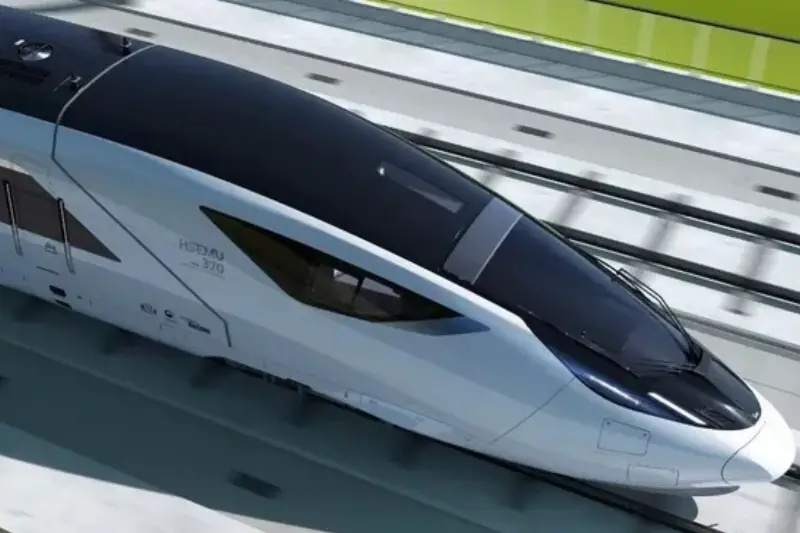
South Korea has unveiled its next-generation high-speed train, representing a major technological advancement with a commercial operating speed of 370 kilometers per hour (230 mph).
Why It Matters
This development positions South Korea to have the world’s second-fastest high-speed train, surpassed only by China’s CR450. Beyond domestic travel, the project enhances South Korea’s standing in the global rail industry, promising to reduce intercity travel times, facilitate balanced economic development, and drive future export opportunities for Korean rail technology.
What To Know
The Ministry of Land, Infrastructure, and Transport (MOLIT) announced the completion of core technologies for the EMU-370, following a four-year national research and development project that began in April 2022 and ended in December 2025.
Korea Railroad Research Institute (KRRI) led the project with participation from seven public and private organizations, including Hyundai Rotem, and involved a total investment of 22.5 billion KRW (about $15.54 million USD).
The EMU-370 promises to cut the Seoul-Busan journey down to approximately 110 minutes and connect all major Korean cities within two hours.
It builds upon the KTX-Cheongryong (EMU-320), surpassing it by 50 km/h in commercial operating speeds and introducing several major innovations:
- High-efficiency 560kW traction motors: Each trainset has 24 motors, delivering a 47.4 percent increase in output compared to the EMU-320’s 380kW motors.
- Improved aerodynamics: Adjustments to the train‘s nose, bogies, and reduction of rooftop equipment cut air resistance by 12.3 percent.
- Enhanced stability and comfort: Optimization of suspension systems with air springs and dampers reduces lateral vibration by 33 percent, improving passenger experience by creating a smoother ride at high speeds.
- Lowered interior noise: Upgraded aluminum body structures and composite sound insulation reduce interior noise levels by around 2 dB (68-73 dB range).
- New ultra-high-speed standards: Safety criteria for speeds up to 400 km/h were developed, surpassing existing European standards, which cap at 350 km/h.
What People Are Saying
Kang Hee-up, vice minister for transport, said: “Through the joint efforts of the government, public institutions, and private companies, we have independently secured the technology for high-speed operation at 370 km/h, becoming the second country in the world to do so just 20 years after introducing high-speed railways.
“Starting next year, the government will spare no efforts to support the development of core technologies for third-generation high-speed trains capable of running at 400 km/h, enabling Korea to leap forward as a global leader in railway technology.”
What Happens Next
The government intends to place the initial orders for the EMU-370 in the first half of 2026 and commence production that year. Test operations are scheduled to begin on the Pyeongtaek-Osong section by 2030, with full-scale commercial service expected after 2031.