



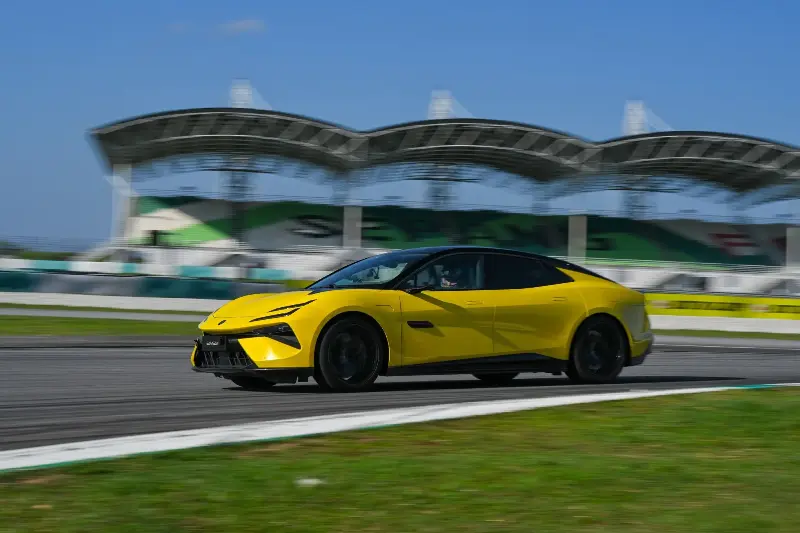
Sepang International Circuit is not a track that forgives mediocrity. Designed by Hermann Tilke and opened in 1999, the 5.5-kilometer Sepang circuit has long tested the limits of Formula 1 and MotoGP machines through its demanding combination of high-speed straights, changes in elevation, and corners that arrive without warning. Now, a production-spec Lotus Emeya 900 went around it in 2:20.317, erasing the previous EV benchmark by more than seven seconds.
That previous record, a 2:27.790, had been set only weeks earlier in June by Ee Shedden piloting the Exotic Mods Tesla Model 3 Performance – a car that had shed around 60 kilograms through fibreglass door replacements, stripped rear seating, and a substantial round of suspension and brake upgrades. The Emeya that beat it arrived from China in left-hand drive, standard production specification, with no race-specific modifications.
What the Emeya 900 Actually Is
GT racer Daniel Lu, who competes for Absolute Racing in the GT World Challenge Asia championship, handled the driving duties, organized by Lotus alongside Malaysian distributor Karrus Automotive Group. Even the opening timed lap, completed before Lotus engineers had fitted new tyres or serviced the brakes, posted a time of 2:22.770 – a result that would have been sufficient on its own to claim the record. The headline 2:20.317 came after that optimization work.
The car Lu drove is now marketed as the Emeya 900 following Lotus’s 2026 model year rebrand away from alphabetical trim designations. It runs a dual-motor setup producing 905 horsepower and 985 Nm of torque, covers 0–100 km/h in 2.78 seconds, and hit 248.8 km/h during the record lap. The 102 kWh battery operates on an 800V architecture, with 10-piston carbon-ceramic front brakes helping haul everything back down from those velocities.
Active aerodynamics – including a deployable rear spoiler – and Lotus’s “porosity” philosophy, which channels airflow through the body structure itself rather than just over and around it, contribute to keeping a near-2.6-tonne car stable under circuit conditions.
“The Emeya carries that same philosophy into the electric era,” said Chong Yok Meng, Senior Director for Chassis and Vehicle Dynamics at Lotus. “It has been developed with the same DNA that has defined Lotus for more than 75 years. This record is more than a lap time – it validates our engineering philosophy and proves that electrification enhances, rather than compromises, the Lotus driving experience.”
For context, Lotus’s own petrol-powered Emira lapped Sepang in 2:27.932 back in 2025 with Malaysian motorsport figure Tengku Djan Ley driving. The Emeya 900 came in roughly 7.6 seconds quicker than that. The electric car is now faster around one of Asia’s most demanding circuits than Lotus’s own combustion-engined sports car.
Malaysian customers don’t yet have access to the Emeya 900, with the local lineup currently limited to the 600 Series, which produces 603 horsepower and carries a starting price of RM489,000. UK pricing for the 2026 range runs from £86,305 up to approximately £146,805 for the 900 Sport Carbon. In practical terms, this is a car that Lotus positions as a daily-usable grand tourer, not a track tool. The Sepang time is the company’s argument that those two things aren’t mutually exclusive.