



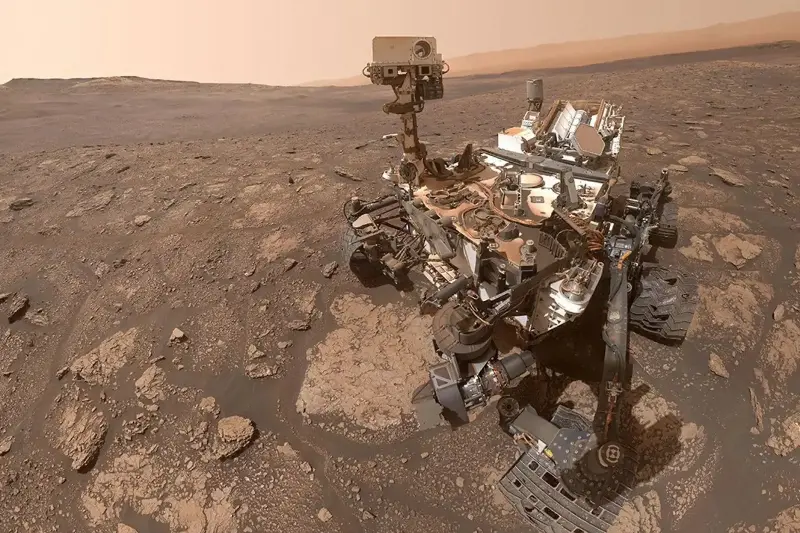
NASA’s Curiosity rover has uncovered the most diverse set of organic molecules ever detected on Mars, including seven compounds never before observed on the planet, according to new research published Tuesday in Nature Communications.
The findings come from a rock sample drilled in 2020 and analyzed through years of laboratory work, offering the strongest chemical evidence yet that ancient Mars had the ingredients necessary to support life.
Several of the newly identified molecules, including a nitrogen heterocycle, a structural precursor to RNA and DNA, are considered foundational to life’s chemistry.
“This collection of organic molecules once again increases the prospect that Mars offered a home for life in the ancient past,” the mission’s project scientist, Ashwin Vasavada of NASA’s Jet Propulsion Laboratory in Southern California, said in the releaseissued Tuesday.
Why It Matters
The results validate Curiosity’s most advanced chemical techniques and pave the way for next‑generation instruments on upcoming missions, including ESA’s Rosalind Franklin rover and NASA’s Dragonfly mission to Titan. It expands the catalog of carbon‑containing molecules preserved in Martian rocks despite billions of years of radiation exposure.
While the findings do not confirm past life, they reinforce that Mars once hosted environments capable of supporting it.
What To Know
The rock sample, nicknamed “Mary Anning 3,” was collected from a clay‑rich region on Mount Sharp, formed by ancient lakes and streams. Clay minerals are especially good at preserving organic compounds. Of the 21 organic molecules identified, seven were new to Mars, including the nitrogen heterocycle.
Lead author Amy Williams called the detection “pretty profound” because such structures can be precursors to more complex, nitrogen‑bearing biomolecules.
What Did the Rover Find?
The haul includes a nitrogen heterocycle, a molecule considered a chemical precursor to RNA and DNA, marking the first confirmed detection of this compound on Mars or in Martian meteorites. The rover also found benzothiophene, a carbon‑ and sulfur‑bearing molecule commonly seen in meteorites thought to seed prebiotic chemistry across the early solar system.
Scientists say the combination of molecules, preserved in clay‑rich rock formed by ancient lakes and streams, suggests that Mars once had the right chemical conditions to support life, even though the findings do not indicate biology.
“These structures can be chemical precursors to more complex nitrogen-bearing molecules,” Williams said in the press release. “Nitrogen heterocycles have never been found before on the Martian surface or confirmed in Martian meteorites.”
The discoveries were made using Curiosity’s Sample Analysis at Mars (SAM) instrument, a miniature laboratory inside the rover that heats rock powder to release gases for analysis.
For this sample, SAM used one of its rare tetramethylammonium hydroxide (TMAH) “wet chemistry” cups, a powerful solvent that breaks apart large molecules into identifiable fragments.
To validate the technique, scientists performed the same TMAH process on a piece of the Murchison meteorite, known for its rich organic inventory. The experiment produced some of the same molecules found in the Martian sample, confirming that larger, more complex compounds may be present on Mars.
What Happens Next
Scientists will continue examining Curiosity’s latest TMAH‑based data, with a peer‑reviewed paper expected in the future.
The new findings will inform the design and operation of upcoming instruments, including the Mars Organic Molecular Analyzer on ESA’s Rosalind Franklin rover and the Dragonfly Mass Spectrometer headed to Saturn’s moon, Titan.
NASA says the results strengthen the scientific case for future sample‑return missions, which could determine whether Mars’ ancient organics were produced by life or by geology alone.