



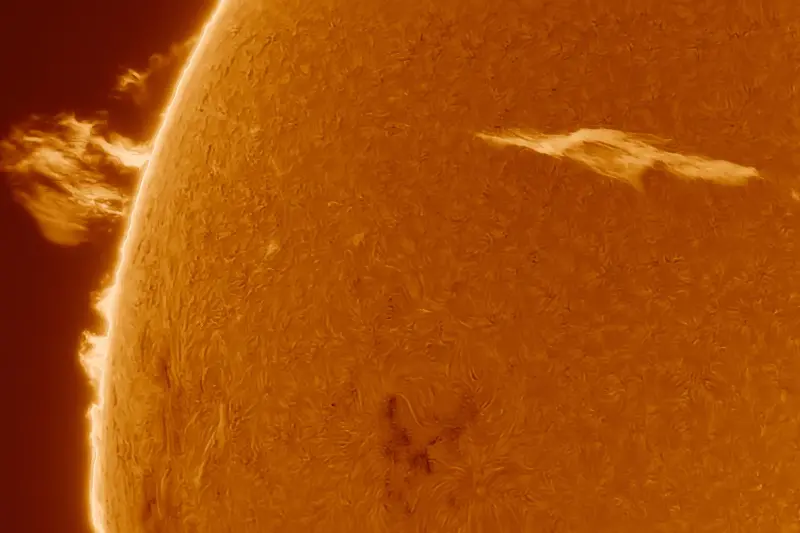
An intense solar flare erupted from a spot on the sun on Sunday, triggering radio blackouts across the South Pacific Ocean—and now scientists are warning of geomagnetic storms in the coming days.
The release of the powerful X8-class flare also released a coronal mass ejection (CME)—a large burst of plasma and magnetic field that is expected to deliver a glancing blow to the Earth on Feburary 5–6.
Rapid growth is making sunspot 4366 unstable; in fact, on Sunday, it releases a total of 4 X-class flares as well as 23 weaker M-class flares.
The giant sunspot, which did not exist until a few days ago, is now reportedly a “behemoth almost half the size of the great Carrington sunspot,” which in 1859 caused the Carrington Event—the biggest solar storm ever recorded.
Extreme ultraviolet radiation from the X8-class flare ionized the top of Earth’s atmosphere on Sunday, causing a shortwave radio blackout across the South Pacific Ocean. This has led to ham radio operators in Australia and New Zealand experiencing loss of signal below 30 MHz for hours after its peak.
NASA explains that a solar flare is a powerful flash of radiation produced when magnetic energy linked to sunspots is suddenly released. These eruptions are among the most energetic events in the solar system, and they appear as bright patches on the sun which can persist for minutes or even hours.
Scientists detect solar flares through the light they emit across nearly the entire electromagnetic spectrum. Observations focus mainly on X-rays and visible light.
Solar flares are also regions where particles—such as electrons, protons, and heavier ions—are rapidly accelerated.
The most intense of these events are called X-class flares, a term from a system that ranks solar flares by their power.
At the low end are A-class flares, which are close to background levels, followed in order by B, C, M, and X. Much like the Richter scale used for earthquakes, each step up in this system represents a tenfold rise in energy.
This means an X-class flare is ten times stronger than an M-class and one hundred times stronger than a C-class. Each category is further divided using a scale from 1 to 9.
Do you have a tip on a science story that Newsweek should be covering? Do you have a question about solar flares? Let us know via [email protected].