



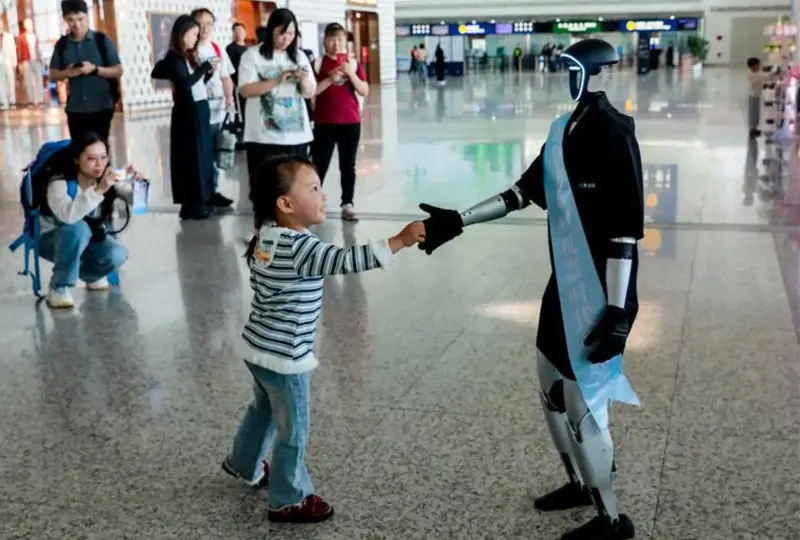
In the future, many significant but repetitive tasks currently done by humans at airports could be completed by robots that utilize artificial intelligence.
For years, airports across the world have been using robots for menial but important service tasks. Three years ago, Incheon International Airport in South Korea launched a robot-led service that guided passengers to their gate or a restaurant.
A strategic partnership announced in 2025, between the airport and Hyundai Motor Group, has paved the pathway for AI-based electric vehicle automatic charging robots to be deployed as part of a demonstration project. These robots can connect electric vehicles to car charging units.
Automated cleaning robots are employed at airports big and small, like London’s Heathrow Airport and Fort Wayne International Airport in Indiana. Heathrow hosts 80 million passengers annually. Fort Wayne’s traffic is less than one-eightieth of that.
In 2024, Ireland’s Dublin Airport introduced “Sir Bot a Lot” and “Handler Bing,” two luggage-carrying robots designed to assist passengers, especially those with disabilities, with their carry-on bags while guiding them through Terminal 1.
Rapid advances in AI and robotics technology over the last half-decade have led to the debut of next-generation robots, those that use AI to perform tasks with more importance and direct impact for large groups of travelers.
This week at CES, a consumer electronics trade show in Las Vegas, Oshkosh Corporation debuted robot technology designed to optimize the turn time from aircraft touch down to push back between flights.
As plane passengers can witness out their windows, upon landing gate crews begin rushing to the area where the plane will park, ready to guide it in, unload/load bags, plug the aircraft into ground power, clean and refuel it, and perform other tasks as passengers exit and enter, preparing the plane for the next trip.
Oshkosh’s modular, commercial robotic platform is purpose built to assist with many of these tasks. Their robots are designed to complement ground support equipment workers, and have the ability to handle multiple ramp and airfield operational tasks in all kinds of weather, day or night.
The robots were originally created for the defense industry and have been modified to fit air field tasks. They use a combination of autonomous mobility, AI-driven perception and situational awareness and task-configurable hardware.
The airline industry, like the car industry, is at an inflection point where testing is underway to determine if and when assistive robots will be ready to roll out en masse. Some automakers, like Mercedes-Benz and Hyundai Motor Group, are making large investments into the technology, with plans to install thousands of humanoid and dog-like robots at manufacturing facilities worldwide in the coming years.