



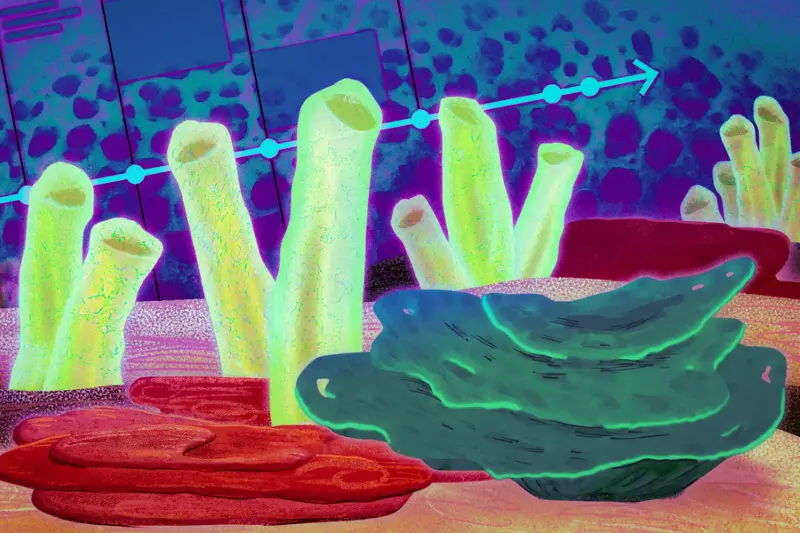
The first animals to inhabit the Earth may have been sea sponges, a new study by geochemists from the Massachusetts Institute of Technology (MIT) has suggested.
In their work, the researchers linked so-called ‘chemical fossils’ found in ancient rocks to the ancestors of a class of modern-day sea sponges known as demosponges.
These chemical fossils—the molecular remnants of once-living organisms that have been buried, transformed, and preserved in sediment over time—were discovered in rocks that date back to more than 541 million years ago, during the Ediacaran Period.
The fossil chemicals in question are a special types of steranes, which are the geologically stable form of sterols, like cholesterol, that are found in the cell membranes of complex organisms.
Demosponges are soft and squishy filter feeders and their ancestors likely shared similar characteristics.
“We don’t know exactly what these organisms would have looked like back then, but they absolutely would have lived in the ocean, they would have been soft-bodied, and we presume they didn’t have a silica skeleton,” said paper author and MIT paleobiologist Roger Summons in a statement.
The study builds on work from 2009, when the same team found 30-carbon (C₃₀) steranes in rocks from Oman. These rare steroids were linked to ancient sponges, but the findings sparked debate, with some suggesting alternative origins, including non-biological processes.
In the new study, the team discovered a rarer 31-carbon sterol (C₃₁). When they tested ancient rock samples, they found both C₃₀ and unexpectedly high levels of C₃₁ steranes, the fossilized forms of these sterols.
“These special steranes were there all along,” Shawar said. “It took asking the right questions to seek them out and to really understand their meaning and from where they come.”
To confirm the source, researchers analyzed living demosponges and found that some still produce the C₃₁ sterols—strong evidence linking the ancient steranes to modern sponges.
“It’s a combination of what’s in the rock, what’s in the sponge, and what you can make in a chemistry laboratory,” Summons said. “You’ve got three supportive, mutually agreeing lines of evidence, pointing to these sponges being among the earliest animals on Earth.”
“In this study we show how to authenticate a biomarker, verifying that a signal truly comes from life rather than contamination or non-biological chemistry,” Shawar added.
Do you have a tip on a science story that Newsweek should be covering? Do you have a question about sea sponges? Let us know via [email protected].
References
Love, G. D., Grosjean, E., Stalvies, C., Fike, D. A., Grotzinger, J. P., Bradley, A. S., Kelly, A. E., Bhatia, M., Meredith, W., Snape, C. E., Bowring, S. A., Condon, D. J., & Summons, R. E. (2009). Fossil steroids record the appearance of Demospongiae during the Cryogenian period. Nature, 457(7230), 718–721. https://doi.org/10.1038/nature07673
Summons, R. E. (2025). Chemical characterization of C31 sterols from sponges and Neoproterozoic fossil sterane counterparts. Proceedings of the National Academy of Sciences, 122(41). https://doi.org/10.1073/pnas.2503009122