



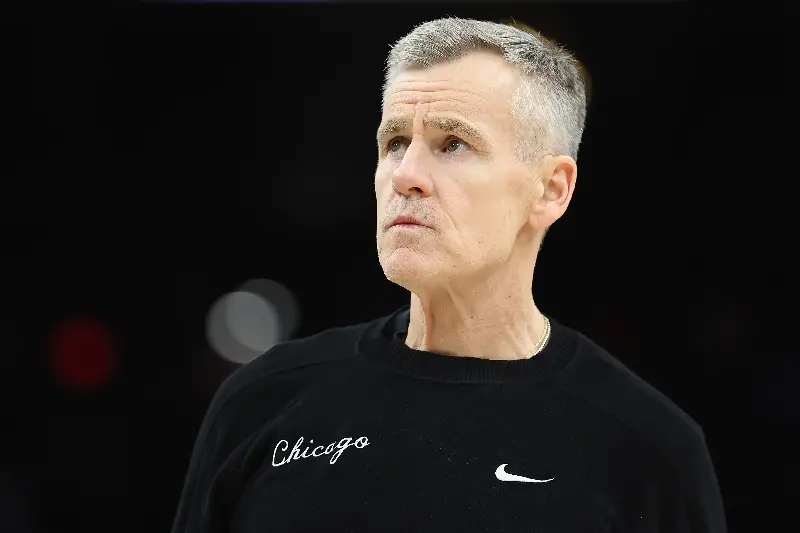
The Chicago Bulls dropped a bombshell Tuesday, announcing that Billy Donovan stepped down as head coach after six seasons, walking away in the middle of a full organizational reset.
His exit, paired with recent front office firings, including executive VP Artūras Karnišovas and GM Marc Eversley, signals a top-to-bottom overhaul in Chicago, not just a coaching change.
But within hours, the conversation shifted from Donovan’s departure to something much bigger: Michael Wilbon publicly torching the franchise’s direction.
In his view, Chicago drifted from iconic to irrelevant, and the most important hire moving forward isn’t on the bench, it’s in the front office.
“When I was a kid, the Bulls were relevant. They didn’t win, but they were 50-win-plus teams,” Wilbon said. “Then you had, of course, the Jordan years, where they were the most relevant franchise, maybe in any sport in the world. Then, you go through a few lean years, but you get Derrick Rose. And it looks like, ‘Oh my God, you’ve got a young star who’s an MVP at 21 years old.’ Derrick, of course, gets hurt. And since then, it’s just been in the wilderness.”
“Lately, it has just been despair. And they are as irrelevant as any big market team in sports,” he added. “So, (with) the next hire, the most important hire isn’t the coach. The hire is who’s going to run this thing. That’s another place where the Bulls have not had a big swing.”
The Bulls experienced one of the most dramatic boom-and-bust cycles in professional sports history.
Founded in 1966, they were immediately competitive, making the playoffs in their inaugural season and remaining a solid, defense-oriented team through the early 1970s, though they struggled to advance deep into the postseason.
By the late 1970s and early ’80s, the franchise slipped into mediocrity, lacking star power, but everything changed in 1984 when they drafted Michael Jordan. His arrival transformed the Bulls from a struggling team into a rising contender, though early playoff exits showed they still needed a stronger supporting cast.
The 1990s marked the peak. Behind Jordan, Scottie Pippen, and coach Phil Jackson, Chicago won six championships (1991–93, 1996–98), becoming a global sports powerhouse and defining an era of NBA basketball.
After the dynasty ended in 1998, the Bulls collapsed into a prolonged rebuild, missing the playoffs frequently. A revival came with Derrick Rose, whose 2011 MVP season and 60-win team restored contender status, until devastating injuries derailed both his career and the franchise’s momentum.
Since then, Chicago cycled through partial rebuilds and short-lived competitive windows, including the recent core of Zach LaVine and DeMar DeRozan. However, inconsistent results and limited playoff success defined the post-Rose era, culminating in the current reset following Billy Donovan’s departure, leaving the franchise searching for a new identity.
More news: The Clippers Can’t Afford Another SGA Mistake With Bennedict Mathurin
Chicago is the third-largest market in the U.S., yet the Bulls haven’t won a playoff series since 2015 and cycled through multiple front office resets.
From a competitive standpoint, they’ve been stuck in the NBA’s middle (or more often, the bottom tier) for more than a decade.
Ultimately, a relevant Bulls team is good for the NBA. When Chicago is competitive, ratings climb, rivalries carry more weight, and national interest follows.
Right now, though, that spark is gone.