



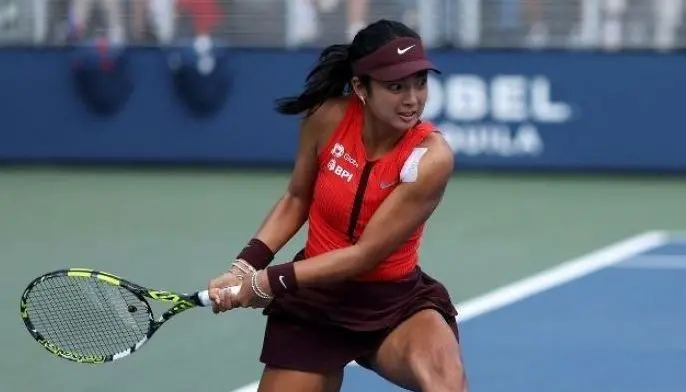
CORON, Palawan — In a country dominated by basketball and boxing, Alex Eala is the latest athlete making huge waves for the Philippines in a sport capturing more attention each day.
The 20-year-old has made a name for herself in the tennis world after a stellar run in last year’s Miami Open, where she defeated the likes of Iga Swiatek and Madison Keys. A year of successful runs later, Eala has already broken into the Top 50 of the Women's Tennis Association rankings.
Being dominant in tennis is no easy feat according to Dr. Carlo Angelo V. Borbon, a Sports Medicine Specialist and Orthopedic Surgeon from Makati Medical Center, as he considers tennis one of the most difficult games to master.
“It is a highly physical, full-body sport that demands not only speed but agility to run forward, backward, laterally, and diagonally for hours on end,” the doctor explained. “Hand-eye coordination to hit a moving ball with a racquet is a must, as well as the strength to receive the impact of a ball hurtling towards you at an estimated 70-90 mph.”
Playing tennis does have its benefits though. It is good for cardiovascular health as it lowers blood pressure and keeps the heart strong. Playing the sport makes one lean and fit while toning the arm, back, shoulder, core, and leg muscles. It also fortifies bone density and even improves one’s self-esteem.
On the flipside, however, are common injuries resulting from repetitive motions and sudden starts or stops, where even the best players are not immune from getting hurt.
'Tennis elbow'
The most well-known among these is tennis elbow, which is chronic pain and weakness on the elbow’s outer side because the forearm’s muscles and tendon are overused.
Dr. Borbon suggested those suffering from tennis elbow to rest the injured arm for a few weeks then approach a physical therapist or sports doctor for exercises to strengthen the arm, avoiding the risk of injuring it again.
Multiple Grand Slam champion and Eala’s mentor, Rafael Nadal, has had to skip numerous major tournaments because of injuries in the wrist, which could range from microscopic tears in the wrist tendon to a sprained wrist and a pinched nerve.
All of those lead to soreness, swelling, and weakness of the hand, all because of overuse, though playing with a new racquet and a change of grip can be a source of wrist injuries.
Dr. Borbon advised wearing a wrist brace for support to help with pain, and investing in a more suitable racquet, as well as modifying one’s grip that help minimize the risk of injuries returning.
Further down the body are knee injuries like spraining the meniscus or cartilage, tearing the anterior cruciate ligament, inflammation of the patellar tendon, or simply wearing down.
“Our knees bear the brunt of high-impact moves,” Dr. Borbon explained, reiterating the sprints, pivots, jumps, and sudden starts and stops of tennis. “I would suggest wearing shoes designed specifically for tennis because they are built with adequate cushioning and foot support.”
He also suggested playing on shell or clay courts (like the ones used for the French Open, which Nadal won a record 14 times) because these surfaces are easier on the hips, knees, and feet than hard courts.
Icing the spot that feels sore, taking pain relievers, and dialing back on playing helps with recovery. If pain persists, however, one should consult a doctor before picking up a racquet again.
How to avoid injury
Another common tennis injury is in the rotator cuff, located in the shoulder, resulting from continuous forehands, backhands, and serves. Dr. Borbon said these repetitive motions stretch and tear the shoulder’s muscles and tendons, causing pain and weakness.
Serving can also lead to injuries in the back, particularly in the lower area. This as the hyperextended back during the ball toss is followed by a twisting torso and a forward bend.
“Over time, this could lead to chronic back pain and even stress fractures that take months to heal,” Dr. Borbon said. “A tennis coach can polish your serve style to ease pressure off your back.”
The trick to avoiding tennis injuries, the doctor added, is to “not do too much too soon.” This means warming before playing and cooling down when finished.
Other practical moves are investing in a good pair of shoes and a stable racquet, alternate tennis with strength-training to develop the shoulder, arm, core, and leg muscles, and of course, an ample amount of rest.
Injuries that no longer respond to conservative treatment may require surgery. The doctor noted that surgery is not only expensive but the recovery period takes time.
“In the first sign of injury, scale back and treat immediately. That way you’ll enjoy many years in the sport,” he ended.