




MANILA, Philippines — Romance and family drama may be the Philippines’ strongest storytelling suits, but Netflix is betting that Filipino audiences — and creators — are ready to push even further.
As the international streaming platform looks forward to 2026, the message from Netflix is clear: stories that travel best are those that are deeply, proudly local and not “engineered” for a global audience.
This was underscored by Malobika Banerji, senior director for Content, Southeast Asia at Netflix, during a conversation with The Philippine STAR on the sidelines of the Jogja-NETPAC Asian Film Festival (JAFF) in Yogyakarta, Indonesia, where she offered insights into Netflix’s Philippine content strategy.
“What makes this exciting is that there’s a surge of interest in stories coming from this region,” Banerji said, noting how global viewing hours of Southeast Asia content grew by almost 50 percent from 2023 to 2024 as locally made titles are finding fans worldwide.
When asked how the SEA region compares to more established content exporters like South Korea or Latin America, Banerji was quick to clarify that Netflix does not view storytelling as a competition between territories.
“We focus more on what is the language of the content and is there like a consistent demand?” she said. “Like, for instance in APAC, if you see that Korean content, like, it’s viewed across the region, it also has fans beyond the region. But then Korean content also has a very long history of exporting.”
Different content languages, she explained, are simply at different stages of their global journey.

“Where I would say that Southeast Asia is doing really, really well is that we have been able to kind of showcase a lot of stories,” Banerji said. “In the past three, four years, at least 100 titles have made it to the global Top 10 at some point or the other. And just this year we have had 40 which was kind of unheard of five years back.”
Rather than chasing other markets, Netflix measures success internally.
“So you see, again, like, we don’t compete with, like, I want to become better than Korean language or Japanese language or US. No, we compete with ourselves, like, incrementally every year,” she said.
“Are we able to bring better stories, which are resonating more with the audiences? And that’s the scale of success.”
That mindset, she added, is embedded in Netflix’s culture.
“We don’t have targets, but we want to get better. So, you know, we describe ourselves as a sports team. If you look at the Netflix culture deck, we are a sports team,” Banerji said. “So we challenge ourselves to be incrementally better every year.”
Under her leadership, Netflix Southeast Asia has brought regional titles such as “The Believers,” “Mad Unicorn” and “The Elixir” to global audiences. Before joining Netflix, Banerji spent over 15 years as a legal professional specializing in intellectual property and media, with stints at Wong Partnership, Baker & McKenzie and A+E Networks Asia.
An intentional Philippine slate
For the Philippines, Banerji acknowledged that Netflix is still in a relatively earlier stage compared to some neighboring markets — but not for lack of belief in Filipino talent.
“We do have big plans for the Philippines as well,” she said. “We are slightly in our earlier stages than the other markets and that’s not because we don’t believe in the Philippines’ talent. The reason for this is that the majority of, you know, content consumption is still very Hollywood.”
Because English-language content is easily accessible in the country, Netflix has had to carefully define how local originals can stand out.
“So we have been trying to really figure out what differentiation can we bring into the local content space, which is not seen on TV or in the theaters,” she explained. “And that’s really hard, right? Because a lot of the best in class is already happening in romance, family drama.”
This thinking led Netflix to explore projects that felt fresh to Filipino audiences.
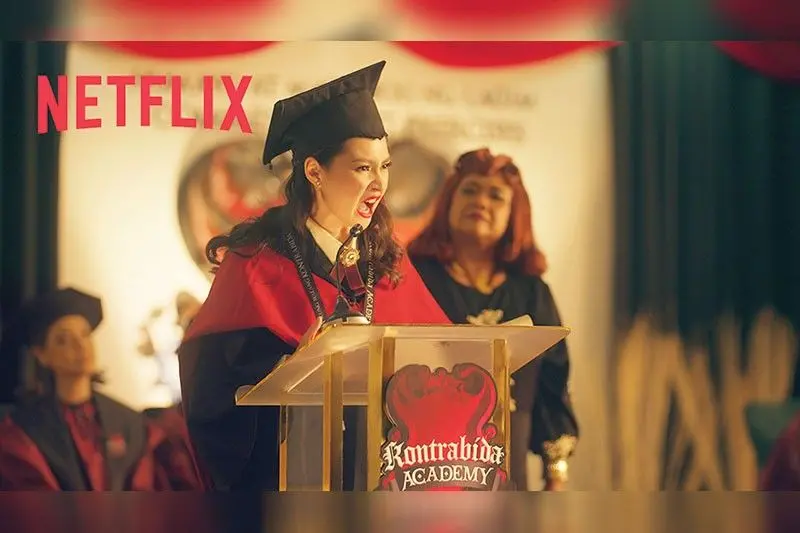
“So what can we bring? So that’s what kind of led to, you know, choosing (the zombie-themed family drama) ‘Outside’ because that is something new for the market,” Banerji said, citing titles like the metafictional comedy-drama “Kontrabida Academy” and the culinary-themed romantic drama “Replacing Chef Chico.”
“We have to be very thoughtful and intentional about how are we bringing something different so that the creators are also excited and the audience members also feel like… The smile you had when I said ‘Kontrabida Academy,’ we want more of those.”
Netflix’s Philippine strategy, she said, is zeroing on “two pillars.”
“So we will be doing more. We do have a balanced slate,” she said. “One is to bring the familiar, but in a way which has not been seen before.”
That includes continuing romance and family dramas but with a twist.
“We are still be doing romance and family drama and all the familiar emotions,” Banerji said. “But we will kind of give a twist to it, which audiences may not be expecting.”
The second pillar focuses on genres that are less commonly explored locally.
“And on the other side, we will also be deep diving into some genres which are rarely seen or very far and few like horror, black comedy, thrillers so that we can create a variety of slate.”
Why authenticity matters
Asked what Filipino creators should keep in mind if they hope to reach audiences beyond the Philippines, Banerji was careful not to frame her response as advice.
“It’s not my place to give an advice,” she said. “But what we have learned at Netflix is authenticity is key, right?”
She pointed to global hits like “Squid Game,” “Kingdom,” “The Naked Director” and “Hunger.”
“They have one thing in common, that they were very deeply local stories,” Banerji said.
Attempts to “engineer” a global hit, she added, often miss the point.
“There is nothing called a global hit,” she said. “When it resonates very deeply in the local market, then there is like an amplified effect because one platform is available in many countries.”
For Filipino storytellers, leaning into their own cultural strengths can actually widen their reach.
“So what I would say is just trusting the instinct and being proudly Filipino will be the way for it to actually reach massive audiences,” Banerji said. “A great Filipino teleserye, if made authentically local, can still speak to audiences in LATAM.”
What Netflix does not want, she stressed, is content “designed” to please everyone.
“But we wouldn’t want to engineer a teleserye and try to make it, you know, appeal to audiences everywhere,” she said. “So local authenticity and really being proud of who we are and the story we are telling is going to be the way for us to scale our stories globally.”

What’s coming next
While she declined to reveal specific titles, Banerji confirmed that several Philippine projects are already in the pipeline.
Announced so far, as unveiled at JAFF, is the “BuyBust: The Undesirables,” the expanded or nine-episode series version of the 2018 Erik Matti action-thriller film.
“We do have several projects in, like, all the way from, like, you know, big stage to prep scripts, post production,” Banerji teased.
“What to focus on, it’s variety,” she added. “So you’ll have a mix of series and films and across a variety of genres.”
When it comes to deciding which projects get the green light, Banerji said there is no formula.
“It’s a very hard question because there is no, like, science to it,” she explained to The STAR. “What we really try to look at is what is the clarity of vision of the creator and why do they feel the need to tell the story now?”
Conviction, she said, makes the difference.
“Are they telling this story because they feel, oh, this is another good story in a familiar genre, or there is a strong conviction in them that, no, I have to tell the story because of these reasons?”
Ultimately, Netflix’s “guiding principle” remains unchanged.
“The content strategy for us across the world is local for local,” Banerji said. “Because for us, like if the recipe is, if it doesn’t work in the local market, it’s not a success.”
For the Philippines, that means going deeper before going wider.
“I think we still need to go deeper in first pleasing Filipino audiences and really earning their trust that we can create new stories and push boundaries,” she said.