



The Himalayas are often seen as one of Earth's great natural barriers, separating the heavily populated and industrialized regions of South Asia from the remote Tibetan Plateau. But new research, published in Geophysical Research Letters, suggests that this mountain range is not an impenetrable wall for air pollution.
Scientists have found direct evidence that pollution from coal combustion can travel across the Himalayas during the summer monsoon, reaching the southern Tibetan Plateau. By analyzing moss growing along a mountainside, the team was able to distinguish between pollution produced by nearby industrial activities and fine particles carried hundreds of kilometers through the atmosphere.
The findings suggest that even some of the world's most isolated high-altitude environments are affected by emissions generated far beyond their borders.
Mosses as pollution recorders
Unlike most plants, mosses absorb nutrients and water directly from the atmosphere rather than through roots. This means they also collect tiny airborne particles, making them effective natural recorders of air pollution over time.
Xiaoyu Jiao, of the China University of Geosciences, and colleagues measured concentrations of several potentially harmful metals, including zinc, lead, arsenic, nickel and cobalt. The researchers also examined stable zinc isotopes, slightly different forms of the same element that can act as chemical fingerprints because different industrial processes produce distinct isotope signatures.
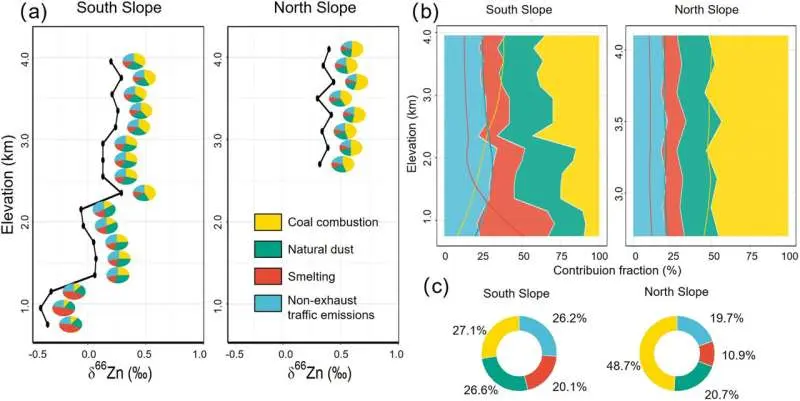
Coal combustion tends to produce relatively "heavy" zinc isotope signatures, while high-temperature metal smelting releases isotopically "light" zinc. By measuring these subtle differences, the researchers could estimate where the pollution originated and how the dominant sources changed across an elevation transect (750–4,100 meters above sea level) in the Yarlung Tsangpo Grand Canyon.
A changing pollution signature
On the southern side of the Himalayas, the pattern was clear. At lower elevations, mosses contained relatively high concentrations of heavy metals alongside lighter zinc isotope signatures. The analysis suggested that between 42% and 50% of the pollution in these areas came from metal smelting, consistent with nearby industrial emissions transported into the region.
As the researchers moved higher into the mountains, overall metal concentrations declined, while the zinc isotope signatures became progressively heavier. This shift pointed to an increasing contribution from coal combustion, which accounted for 35% to 50% of pollution sources at higher elevations.
North of the Himalayan crest, overall pollution levels were generally lower. However, mosses collected above 3,500 meters consistently showed the heavier isotope signatures associated with coal combustion.
According to the team's analysis, coal burning contributed between 43% and 54% of the pollution reaching these high-altitude sites, while direct industrial emissions from smelting played only a minor role.
The results indicate that although the Himalayas block much of the larger, heavier pollution emitted close to the ground, fine particles produced by coal combustion are able to travel much farther through the atmosphere.
How pollution crosses the mountains
The study points to the Indian summer monsoon as the main driver of this long-distance transport. During the monsoon season, air masses move northward from South Asia and are funneled through deep valleys, including the Yarlung Tsangpo Grand Canyon, before crossing the mountain range.
The researchers found that this atmospheric circulation allows fine coal-derived particles to reach high elevations, where they can be deposited by clouds, fog and rainfall.
By contrast, pollutants released by metal smelting are generally associated with larger particles that remain closer to the ground and are more readily removed from the atmosphere before they can cross the mountains.
Additionally, local geography and vegetation influence where pollutants accumulate. Dense forests on the southern slopes intercept airborne particles and wash them onto mosses during rainfall, while the drier northern slopes receive less rainfall and have sparser vegetation, meaning mosses there more directly reflect atmospheric deposition.
Implications for the Tibetan Plateau
The Tibetan Plateau is often described as the "Third Pole" because it contains the world's largest store of ice outside the polar regions and plays a major role in regulating Asia's climate and supplying freshwater to billions of people. While it remains far less polluted than many industrial regions, the new findings suggest that it is not isolated from human activities.
Heavy metals such as lead, arsenic and nickel can accumulate in soils, vegetation and waterways, where they may persist for long periods and enter food chains, affecting both wildlife and local populations.
Although this study did not assess their environmental impacts directly, demonstrating that coal-derived pollution reaches the Tibetan Plateau highlights the need to better understand how these contaminants may affect its fragile ecosystems and the communities that depend on them.
The findings could also help scientists improve models of how pollutants move through the atmosphere. Better understanding when and how emissions cross the Himalayas may lead to more accurate assessments of air quality and contaminant deposition in high-mountain environments, particularly as energy use, industrial activity and climate change continue to alter atmospheric circulation across Asia.
Written for you by our author Hannah Bird, edited by Sadie Harley, and fact-checked and reviewed by Robert Egan—this article is the result of careful human work. We rely on readers like you to keep independent science journalism alive. If this reporting matters to you, please consider a donation (especially monthly). You'll get an ad-free account as a thank-you.
Publication details
Xiaoyu Jiao et al, Zinc Isotopes Reveal Cross‐Border Transport of Coal Combustion Pollutants Across the Himalayas During the Summer Monsoon, Geophysical Research Letters (2026). DOI: 10.1029/2026gl122536



© 2026 Science X Network
Citation: Coal pollution reaches one of Earth's most remote mountain regions (2026, June 26) retrieved 26 June 2026 from https://phys.org/news/2026-06-coal-pollution-earth-remote-mountain.html
This document is subject to copyright. Apart from any fair dealing for the purpose of private study or research, no part may be reproduced without the written permission. The content is provided for information purposes only.