



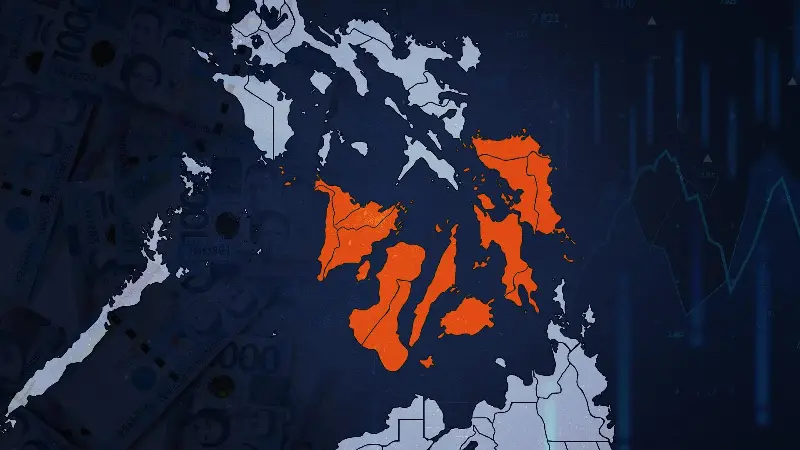
CEBU, Philippines – Western Visayas was the Philippines’ fastest growing regional economy in 2025 followed by Caraga in Mindanao, and Negros Island Region (NIR), latest data from the Philippine Statistics Authority (PSA) showed.
At a press conference on April 23, PSA Central Visayas Regional Director Wilma Perante told reporters that Western Visayas grew by 6.4% at constant 2018 prices. Caraga Region and NIR followed at 5.7% and 5.69%, respectively.
The other regions in the top 10 fastest growing regional economies in 2025 are:
- Davao Region, 5.15%
- Calabarzon, 5.1%
- BARMM, 5.0%
- Northern Mindanao, 4.9%
- Soccsksargen, 4.8%
- Ilocos Region, 4.52%
- Central Luzon, 4.46%
These regions had growth rates that were higher than the 2025 national level growth rate of 4.4%. The PSA reported that in 2025, the majority of the regions were predominantly services-based and only one region, Calabarzon, was predominantly industrial.
As of 2025, there were no regions predominantly engaged in agriculture, forestry, and fishing.
Top performers
PSA Western Visayas data showed that the region’s growth rate jumped from 4.4% in 2024 to 6.4% in 2025.
In 2023, Western Visayas recorded a gross regional domestic product (GRDP) of P615.29 billion, which grew to P642.47 billion in 2024. In 2025, Western Visayas’ GRDP was at P683.44 billion.
“The economy of the [Western Visayas] region is a composite of three major industries: agriculture, forestry, and fishing; industry; and services,” PSA Western Visayas Director Nelida Amolar said in a report on April 23.
For the year 2025, the region’s agricultural sector grew by 9.5% from negative 7.4% in 2024. Industry grew from 4.1% in 2024 to 4.3% in 2025.
Agriculture contributed 14.9% to the region’s economy while industry made up 18.6%. Services had the highest share — 66.5% — of Western Visayas’ economy at P454.19 billion in 2025.
Despite this, the region’s services sector grew by only 6.3% in 2025, slower than its 7.5% growth in 2024.
According to Department of Economy, Planning, and Development (DEPDev) Western Visayas Director Arecio Casing, the “moderation” in the services sector growth could be attributed to emerging cost pressures, particularly in fuel transport and operations.
“Growth within this sector was proudly supported by both market-driven and public-oriented services. Tourism and IT–BPM continued to expand, reinforcing the region’s position as a key services and tourism hub,” Casing said in an April 23 report.
The DEPDev Western Visayas director added that the region’s medium-term strategy, aligned with the Western Visayas’ Regional Development Plan 2023-2028, is to upgrade the service sector by funneling investments into sustainable tourism development, expansion of IT–BPM and digital services, and strengthening health, education, and other social services.
Much like Western Visayas, the NIR’s services sector contributed a majority share of 64.6% to its 2025 GRDP of P671.68 billion. Industry followed with a 22% share while agriculture was at 13.4%.
In 2023, the NIR’s GRDP was at P601.02 billion while in 2024, it was P635.47 billion. According to PSA NIR Director John Campomanes, the region was able to sustain its 5.7% growth rate for both 2024 and 2025.
The NIR’s agricultural sector made a rebound from negative 10.7% in 2024 to 8.5% in 2025, which DEPDev NIR Director Jam Colas-Villaber attributed to higher sugar cane and palay (unhusked rice) production owing to improved agricultural output and favorable production conditions.
Villaber also mentioned that the NIR’s public administration sector significantly accelerated from 5.2% in 2024 to 10.6% due to the institutional build-up in the region, particularly the establishment of new government offices in addition to election-related expenditures.
Below average
Due to multiple local disasters and higher US tariffs, the Philippine Statistics Authority (PSA) reported Central Visayas’ economy grew by only 3.7%, 3.7-percentage points lower than its 7.4% growth in 2024, and slower than the 2025 national growth rate of 4.4%
This is also below the region’s recorded growth rate of 5.5% in 2021 — when the Philippines entered its second year of the coronavirus pandemic
DEPDev Central Visayas Director Jennifer Bretaña said that Central Visayas “took a beating” in 2025 due to a series of unfortunate events.
“Tariffs imposed by the United States, low tourist arrivals, the flood control scandal, persistent impact of the African swine fever, the destructive Northern Cebu earthquake and the back-to-back flash floods caused by Typhoon Tino (Kalmaegi) and Typhoon Verbena (Koto),” Bretaña explained.
Despite the headwinds faced by Central Visayas in 2025, Bretaña noted, the region still managed to come up with P1.32 trillion for its gross regional domestic product (GRDP) and remained the nation’s fourth largest economy for that year.
In 2023, the region’s GRDP was P1.19 trillion. In 2024, Central Visayas’ GRDP grew to P1.28 trillion.
According to Bretaña, higher tariffs on products entering the US affected the export of products like intermediate, electronic, and semiconductor inputs that are made in the Philippines, especially in Central Visayas.
The DEPDev director said that as demand dropped on exports due to the tariffs, factories in the region began to adjust to the weaker demand, resulting in a reduction in operations and more lay-offs.
Besides the manufacturing sector, tourism also took a great hit after a magnitude 6.9 earthquake shook Cebu on September 30, 2025. The Department of Tourism (DOT) in Central Visayas and the Mactan-Cebu International Airport (MCIA) noted a decline in domestic passenger traffic to the province.
The earthquake, followed by the impact of Typhoon Tino (Kalmaegi) — which hit Cebu and Bohol in early November 2025 — also brought severe damage to major agricultural production and business continuity in the region.
But compared to Central Visayas, Eastern Visayas suffered a greater decline in economic growth in 2025.
Eastern Visayas recorded a 1% regional growth rate, which is only second to the last among the country’s regions with the lowest economic growth in 2025. The region with the lowest economic growth is the Bicol Region.
“The economy of Eastern Visayas grew by 1.0% in 2025, a slowdown from the 6.1% growth recorded in 2024,” the PSA in Eastern Visayas reported on April 23.
Data from PSA showed that Eastern Visayas’ agricultural sector’s growth dropped from 3.9% in 2024 to negative 1.3% in 2025. Growth in its industries sector also fell from 5.7% in 2024 to negative 3.8% in 2025.
The DEPDev in Eastern Visayas attributed the downward trend to copper refinery Philippine Associated Smelting and Refining Corporation’s (PASAR) transition to a “care and maintenance” status earlier in 2025 amid a severe pricing crisis. PASAR’s shutdown in February led to the displacement of 3,000 workers and negatively impacted the manufacturing sub-sector.
Despite this, DEPDev Eastern Visayas Director Meylene Rosales said the region remains “well-positioned to sustain growth.”
In 2025, the Board of Investments approved three renewable energy projects in Eastern Visayas with a combined investment value of P33.39 billion.
Additionally, Rosales pointed out, the Energy Development Corporation (EDC) announced plans to invest P30 billion to rehabilitate and expand the Leyte Geothermal Production Field.
“Government measures to cushion the impact of high fuel prices [in 2026] such as targeted subsidies, social protection programs and efforts to stabilize transport and logistics cost will help support domestic demand especially among vulnerable groups,” Rosales said. – with reports from Gwyneth Antonio/Rappler.com
Gwyneth Antonio is a Cebu-based Rappler intern and a senior anthropology student at University of San Carlos.