



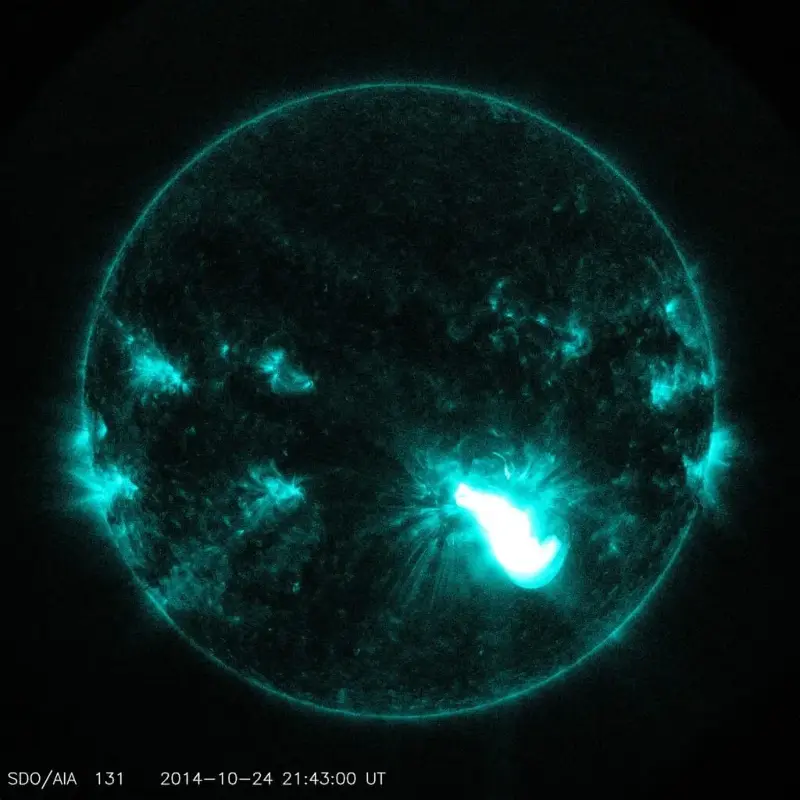
On 10 September 2026, the Max Planck Institute for Solar System Research announced a new empirical ceiling for solar flares, and it is anchored to a dark patch that crossed the Sun’s face nearly eighty years ago. In April 1947, a sunspot group catalogued at the Royal Greenwich Observatory as RGO 14886 grew until it covered roughly 0.6 per cent of the visible solar disk, a structure about 40 Earth diameters across. Writing in Philosophical Transactions of the Royal Society A, a team led by Natalie Krivova of MPS, working with colleagues at the University of Colorado, calculates that a magnetic region that large could in statistically rare cases release bolometric flare energies of order 10^34 erg.
That number matters because of where it sits. Roughly 10^34 erg is the threshold often used to separate ordinary stellar flares from superflares on Sun-like stars, the class of event observed on other stars by planet-hunting telescopes and estimated, from stellar statistics, to occur something like once per century per Sun-like star. The Sun has not been caught doing it. In about seventy years of the space age, with direct measurements of flare energy across the spectrum, nothing solar has approached that mark. The 1947 spot did not produce a recorded superflare either. What the new work argues is narrower and harder to dismiss: the Sun has grown magnetic structures big enough that such an event is not excluded by anything we can measure about it.
The largest spot on the modern record
The April 1947 group reached its greatest extent around 8 April, and it remains the largest sunspot area in the continuous photographic record kept at Greenwich and its successor stations. Sunspots are places where the Sun’s convective surface is throttled by magnetic field strong enough to suppress the upwelling of hot plasma; they look dark only because they are cooler than the roughly 5,800 kelvin photosphere around them. Their area is a proxy, crude but durable, for how much magnetic flux has surfaced in one place, and how much free energy is stored in the field arching above.
Scale is worth pausing on. A spot spanning 40 Earth diameters is not an Earth-sized blemish; it is a magnetic complex tens of thousands of kilometres wide in which sunspot umbrae and penumbrae tangle into each other, and the twisted field overhead has room to store energy on a scale the Sun rarely assembles. Observers in 1947 watched it with the instruments of the era, white-light photoheliographs and spectrohelioscopes, and logged flares. None of them recorded anything resembling a superflare, and the new paper makes no claim that one occurred. The 1947 region is being used as a physical benchmark for size, not as a witness to an event.
That distinction runs through the whole result. The team is asking what the largest spots the Sun is known to make imply about the largest flares it could in principle produce, given how flare energy actually scales with region size in the era when both quantities can be measured well.
Six years of flares, scaled upward
The calibration comes from NASA’s Solar Dynamics Observatory. The researchers took roughly 300 of the strongest flares recorded between 2010 and 2016, a stretch covering the rise and peak of solar cycle 24, and matched each to the area of the active region and sunspot that produced it. SDO’s continuous, full-disk coverage makes that pairing possible: the flare energy can be integrated across wavelengths rather than inferred from a single soft X-ray channel, and the parent region can be measured on the same images.
The relationship that emerges is not a tight line. Big regions produce mostly modest flares and occasionally large ones; small regions almost never produce large ones. The informative quantity is therefore the upper envelope, the energy that the most productive regions of a given size manage to reach. Krivova and colleagues fit that envelope and extrapolated it to the areas of the largest historical sunspots, 1947 among them.
For a region of the 1947 group’s size, the best-estimate 95th-percentile envelope sits near 2.31 × 10^33 erg, already several times the energy of the strongest flares in the modern instrumental record. Push out to the 95 per cent and 99 per cent prediction intervals, the statistical tails that account for the scatter in how individual regions behave, and the range runs from about 6.59 × 10^33 up to roughly 1.25 × 10^34 erg, with the paper quoting a few times 10^34 erg at the extreme. That is the locked figure: in rare cases, of order 10^34 erg, which is to say inside the superflare regime.
These are envelopes, not forecasts. A prediction interval describes how far the observed spread of flare energies could plausibly extend for a region of a given area; it says nothing about whether such a region will appear next solar cycle, or what it would do if it did.
Then and now
The value of the 1947 spot is that it is real. Arguments about solar superflares have leaned heavily on stellar surveys, on Kepler and TESS light curves of other Sun-like stars where flare energies are inferred from brightness jumps and stellar parameters carry their own uncertainties, and on the radiocarbon and beryllium spikes preserved in tree rings and ice that mark extreme particle events in the deeper past. Those approaches reach far in time but come with substantial inference. The Greenwich record instead offers direct, measured areas for the Sun’s own largest magnetic regions, and the SDO archive supplies the modern scaling law to apply to them.
Put together, the two datasets close a gap between stellar statistics and solar observation without requiring the Sun to have done anything unrecorded. Seventy years of bolometric measurement has seen no solar superflare. Eighty years of sunspot records include a region large enough that, on the empirical evidence, the energy would have been available in rare circumstances. The result is a statement about capability rather than occurrence, and it is the harder of the two statements to argue with.