



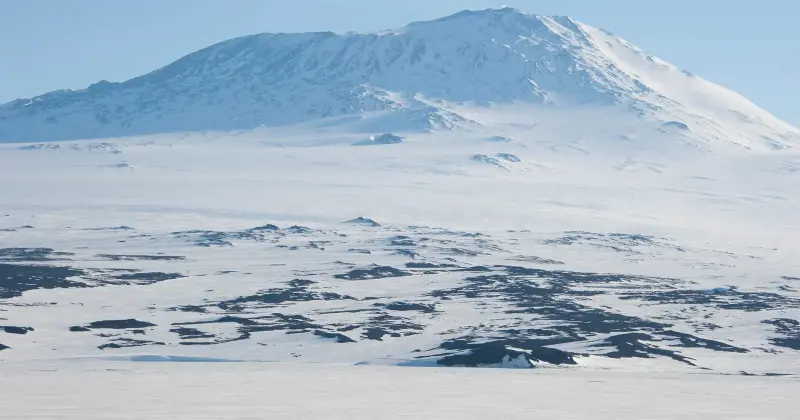
Antarctica is the largest desert in the world. Not the largest cold desert, or the largest unusual one, but the largest desert of any kind, ahead of the Sahara by several million square kilometres. The reason it qualifies has nothing to do with sand or heat. A desert is defined by how little water falls from the sky, and almost none falls on Antarctica.
The continent covers about 14.2 million square kilometres, and across nearly all of it the air delivers less moisture than reaches much of the Sahara.
What actually makes a desert
The standard threshold is precipitation. A region that receives less than about 250 millimetres, or 10 inches, of precipitation a year is classed as a desert, whether that precipitation would arrive as rain, snow, mist or fog. Heat does not enter the definition.
Antarctica clears the bar easily, and then keeps going. According to the figures collected in the overview of the continent, precipitation averages over 200 millimetres along the coast but falls away sharply inland. The high interior plateau receives only around 25 to 50 millimetres of water-equivalent a year, and the driest stretches near the pole get closer to 10. The continent-wide average, often given as roughly 166 millimetres, is itself comfortably below the desert threshold, and the interior is among the driest places anywhere on Earth.
The ranking most people get wrong
The common assumption that the Sahara is the world’s largest desert is half right. The Sahara, at about 9.2 million square kilometres, is the largest hot desert. It is only the third largest desert overall.
The two larger ones are both polar. Antarctica is first. The Arctic, a polar desert spanning parts of Canada, Greenland and Russia, is second at roughly 13.7 to 13.9 million square kilometres, as the comparisons of desert area show. Deserts, in other words, are not a category of hot places. They are a category of dry ones, and the two driest large regions on the planet are frozen.
Why a frozen continent is so dry
Cold air is the main reason. The colder air gets, the less water vapour it can hold, so at the interior temperatures of around minus 50 degrees Celsius there is very little moisture available to fall in the first place. Antarctica is also the highest continent on average, with the ice sheet sitting around 2,300 metres above sea level, and higher means colder and drier still. Persistent high pressure over the interior pushes the moisture-bearing weather systems away before they reach the centre.
What snow does fall mostly stays. It does not melt and run off. It accumulates, compacts and is gradually buried, building the ice sheet over very long spans of time.
A desert made of water
This is where the description starts to sound contradictory, because the largest desert on Earth is also where most of the planet’s fresh water sits. Antarctica holds something like 90 per cent of the world’s ice and on the order of 70 per cent of its fresh water, enough that if all of it melted, global sea level would rise by close to 60 metres.
There is no contradiction once the definition is kept straight. A desert is about how much water arrives, not how much is present. The ice is not recent weather. It is the slow accumulation of sparse snowfall over hundreds of thousands of years, which is precisely why deep ice cores can read the atmosphere back across that span.
The clearest illustration of the dryness is the McMurdo Dry Valleys, a set of ice-free valleys swept bare by wind, counted among the driest places on Earth and used as a stand-in for Mars. By some estimates parts of them have gone without meaningful precipitation for something close to two million years, though that figure is an estimate rather than a measurement.
What scientists track on the continent is the balance between the little that falls and what is removed by wind, by sublimation straight from ice to vapour, and at the edges by melting and the calving of ice into the sea. That balance, not the temperature, is what makes Antarctica a desert, and it is the same dryness that has preserved its ice long enough to become a record of the planet’s past.
The post Antarctica is the largest desert on the planet, because a desert is defined by how little water falls from the sky rather than by heat, and almost nothing falls on the frozen continent. appeared first on Space Daily.