



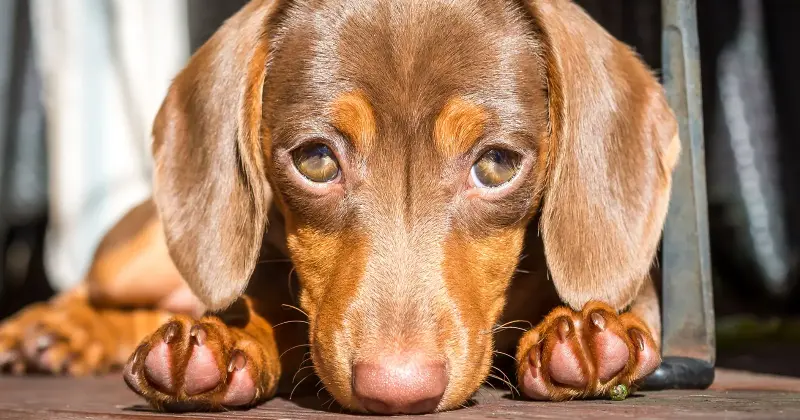
The chemical mechanism that binds a human mother to her nursing infant appears to also bind a human to their family dog — and, on the available experimental evidence from the 2015 Nagasawa study, does not appear to work the same way between humans and the closest genetic relative of the modern dog. Oxytocin — the peptide hormone produced in the hypothalamus and released by the posterior pituitary gland, sometimes described in popular science coverage as the “cuddle hormone” or “love hormone” — has been established across approximately 60 years of accumulated behavioural endocrinology research as one of the substantially most important biochemical regulators of mammalian social bonding. In the human mother-infant relationship, the hormone functions in a closed positive feedback loop: the mother’s oxytocin levels rise in response to physical contact with, eye contact with, and vocalisations from her infant; the elevated maternal oxytocin drives affiliative maternal behaviour (holding, gazing, vocalising back, breastfeeding); the infant’s oxytocin levels rise in response to that maternal behaviour; and the elevated infant oxytocin drives further attention-seeking gazes and vocalisations that continue the cycle. The reciprocal reinforcement is what neuroendocrinologists refer to as an “oxytocin-mediated positive feedback loop.” It is one of the more fundamental biological mechanisms underlying the human mother-infant attachment relationship.
According to Nagasawa and colleagues’ original 2015 Science publication of the oxytocin-gaze positive loop findings, the substantive experimental result of the Azabu study was that the same mother-infant biochemical mechanism appears to operate — with essentially identical directionality and comparable magnitude — between dogs and their human owners. The Nagasawa team measured urinary oxytocin levels in both dogs and their owners immediately before and immediately after 30-minute interaction sessions in which the pairs were left alone in a controlled room. The dog-owner pairs who spent longer periods in mutual eye contact showed substantially higher post-session oxytocin increases in both species than the pairs who exchanged shorter gazes. The magnitude of the increase in the owner correlated with the duration of the dog-to-owner gaze. The magnitude of the increase in the dog correlated with the magnitude of the increase in the owner. In experiment 2 of the same study, the researchers administered intranasal oxytocin directly to the dogs and observed that the treated dogs subsequently gazed at their owners for substantially longer periods, whose oxytocin then also rose. The feedback loop was functionally identical to the human mother-infant version.
What the wolves did not do
The comparative arm of the study involved 11 wolves that had been hand-reared from puppyhood by the same human handlers who participated in the experiment. The wolves had been substantially socialised to human contact, were comfortable in the presence of their handlers, and had formed the kind of stable interspecies bonds that had allowed the researchers to conduct the same 30-minute observation sessions with them that had been conducted with the domestic dogs. As detailed in a Frontiers in Psychology commentary on the Nagasawa study by Marie-Josée Beaudin-Bourgeois and Sylvain Fiset, the wolves did not show the same oxytocin increase in response to human interaction that the dogs had shown. The wolf handlers similarly did not show the oxytocin increases that the dog owners had shown. The dog-to-owner mutual gaze that had produced the dog oxytocin loop was, by every available behavioural measure, essentially absent between the wolves and their human handlers. Wolves, in the Nagasawa observations, largely avoided direct sustained eye contact with the humans who had raised them.
The Nagasawa interpretation of the result was that the dog-human oxytocin loop is a specific evolutionary product of the approximately 15,000-to-40,000-year process of dog domestication from grey wolf ancestors — that at some point during this process, ancestral proto-dogs that gazed at humans in a manner triggering the human parental oxytocin response were substantially more likely to be fed, protected, and reproductively successful than ancestral proto-dogs that did not, and that this selection pressure progressively produced the modern domestic dog’s specific behavioural and neuroendocrine ability to engage the human mother-infant bonding machinery in a way that essentially no other non-human species can. The evolutionary framework the Nagasawa team proposed — that dogs have, in essential respects, “hijacked” the human parental-bonding system — has, in the eleven years since the paper’s publication, been substantially influential in the broader academic literature on human-animal bonding.
What the subsequent literature complicated
The substantive scientific caveats to the Nagasawa result are, on the available subsequent peer-reviewed evidence, non-trivial. As detailed in a critical Frontiers in Neuroscience commentary by Zsolt Kekecs, Bence Szaszko, and colleagues published in the year following the original Nagasawa paper, the 2015 experimental design contained several methodological confounds that complicate the interpretation of the wolf-negative finding. The dog and wolf arms of the experiment involved different owner-sex ratios (dogs had substantially more female owners; wolves had substantially more male handlers) — and the existing literature on human oxytocin responses to animal interaction had previously established that female humans show substantially larger oxytocin increases than male humans in essentially all comparable studies. Re-analysing the Nagasawa data by owner sex, the Frontiers commentators found that oxytocin increases were evident in the female owners of both dogs AND wolves, and were absent (or slightly negative) in the male owners of both — suggesting that the apparent species-specific loop might actually reflect an owner-sex difference rather than a dog-vs-wolf difference. The wolf sample of 11 individuals was, additionally, substantially smaller than the dog sample of 30, and the statistical power to detect an effect in the wolves was correspondingly limited.
Per the Semantic Scholar summary of the Nagasawa paper and the accumulated citation record of the subsequent decade of follow-up research, the broader research programme has, in the eleven years since 2015, produced substantially mixed results. Some subsequent studies (Handlin et al. 2012, Grigg et al. 2022, Gnanadesikan et al. 2024) have partially confirmed the dog-human co-modulation finding. Others (Schöberl et al. 2012 and 2017, Harvie et al. 2021, Holder et al. 2024) have failed to detect the loop. A 2022 study by Wojtaś and colleagues reported partial evidence for a similar effect in cats and their humans — potentially undermining the specific “dog domestication” evolutionary argument the Nagasawa team had proposed. The current state of the scientific consensus, as reflected in the accumulated 2015-2026 peer-reviewed literature, is that the substantive claim of the original Nagasawa paper — that dogs and their humans engage in a reciprocal oxytocin-mediated positive feedback loop during mutual eye contact — has been substantially supported, but that the more ambitious secondary claim — that this loop is specifically absent in wolves and therefore represents a unique product of dog domestication — remains substantially unresolved. The dogs in the original study, however, gazed at their humans in the specific patterns that Nagasawa’s team predicted they would; and the wolves did not.
The post When a human and a dog gaze into each other’s eyes, both of them release oxytocin — the same hormone released between a human mother and her infant during nursing — and Japanese researchers reported in 2015 that this cross-species chemical feedback loop appears to be unique to dogs and their humans and does not occur in wolves appeared first on Space Daily.