



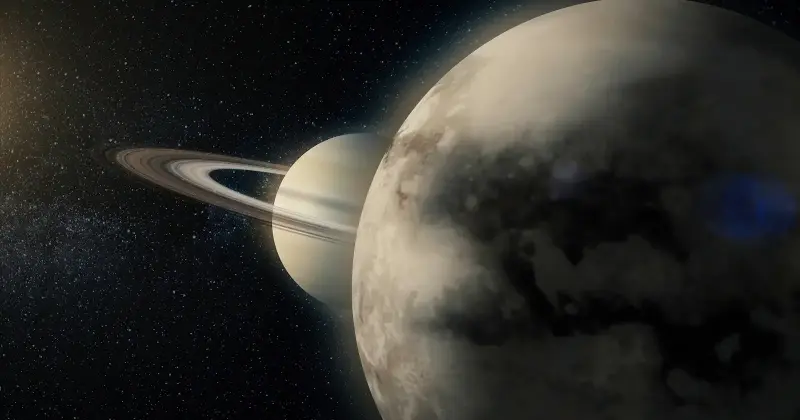
Titan, the largest moon of Saturn, is the only world besides Earth known to have rivers, lakes, seas, clouds and rain. The catch is what does the flowing. On Titan the rain is methane, the seas are methane and ethane, and the whole system runs across a surface frozen to about minus 179 degrees Celsius.
It is, in shape, the most Earth-like place in the solar system, and in chemistry one of the least. In June 2026 a group of researchers met in Colorado for the first Humans to Titan Summit, to begin working out what it would take to send people there. The idea is a long way from a mission. It is not too early, the organisers argue, to start thinking about the problems.
An alien Earth
Titan is wrapped in a thick nitrogen atmosphere, the only moon in the solar system with a substantial one, and at the surface that air is denser than Earth’s. Within it runs a full weather cycle, the same kind of loop that moves water around our own planet, except that the working fluid is methane. Clouds gather, rain falls, rivers cut channels through the terrain, and the runoff collects in lakes and broad seas, the largest of them, Kraken Mare and Ligeia Mare, lying near the north pole.
Almost everything known about this came from the Cassini spacecraft, which studied Saturn and its moons from 2004 to 2017, and from the Huygens probe it carried, which parachuted onto Titan’s surface in 2005. Between them they turned Titan from a haze-shrouded mystery into a mapped world, one with a familiar-looking geography built from thoroughly unfamiliar materials.
Why anyone would think about going
Titan has a strange set of advantages for human visitors, and they are the reason the summit exists at all.
The thick atmosphere is a natural shield against cosmic radiation, the hazard that makes long stays on the Moon and Mars so difficult; on Titan’s surface, that problem largely takes care of itself. Because the surface pressure is about half again as high as Earth’s, an astronaut would not need a rigid suit pressurised against vacuum, the kind that makes a spacewalk so exhausting. And with gravity about a seventh of Earth’s, combined with that dense air, a person could in principle strap on a pair of wings and fly under their own muscle power.
In those respects, Titan is gentler than Mars.
That is the appeal the planners are starting from.
The Humans to Titan Summit
The meeting was held on 11 and 12 June 2026 in Boulder, Colorado, the first of its kind, bringing together engineers, scientists and mission planners. Its purpose was not to propose a launch but to keep Titan on the long-range map, before the plans for the Moon and Mars absorb all the attention, and to set out honestly what a crewed mission would demand.
Much of the discussion was about the obstacles rather than the appeal, because the obstacles are formidable.
What a crewed mission would actually need
Start with the cold. At minus 179 degrees, the design problem for suits and habitats is not holding pressure in but holding heat in, and keeping everything warm enough to work at all. The air carries no oxygen, being mostly nitrogen with a few per cent methane, so every enclosed space and every suit would need its own oxygen supply. And because methane burns readily in oxygen, any leak becomes a fire risk that has to be engineered against from the outset.
Then there is power. Saturn receives roughly one per cent of the sunlight that reaches Earth, so solar panels are close to useless that far out, and a crew would depend on nuclear power for warmth and electricity alike. The methane rain and the steady fall of organic haze particles would coat and clog equipment over time. And because Titan is a place of real interest to astrobiologists, there is the matter of planetary protection, of not contaminating an environment that people want to study precisely because it has been left alone.
Above all there is distance. Saturn sits roughly 1.4 billion kilometres from Earth, and reaching it with any propulsion now available is a journey of many years, far longer than a trip to Mars. That single fact shapes everything else, from the supplies a crew would carry to the years they would have to survive in transit.
How real this is
It is worth being plain about the status of all this. There is no crewed mission to Titan planned, funded, or on any space agency’s schedule. This is long-range, exploratory thinking, of the sort that has to begin decades before anything flies, if it ever does.
The actual near-term mission to Titan is robotic. NASA’s Dragonfly, a nuclear-powered rotorcraft about the size of a small car, is due to launch around 2028 and to reach Titan in the mid-2030s, where it will fly from site to site sampling the surface and studying the moon’s rich chemistry. What Dragonfly finds will do far more than any summit to shape whether people could ever sensibly follow.
What to watch
The concrete milestones are Dragonfly’s launch and its arrival the following decade. The crewed idea, by contrast, has no timeline and may never acquire one, and it would be a mistake to read the summit as the start of a countdown.
What the meeting produced was not a mission but a list: the cold, the missing oxygen, the power, the distance, the risk of contamination, each a problem that would have to be solved before anyone could stand beside Titan’s methane seas. For now, the only things heading that way carry no crew at all.
The post Titan is the only world besides Earth known to have rivers, lakes, seas, clouds and rain — except its “water” is methane and ethane, flowing across a surface frozen to minus 179 degrees Celsius. And in June 2026, scientists held the first Humans to Titan Summit, beginning to map what a crewed mission to Saturn’s largest moon would actually require. appeared first on Space Daily.