



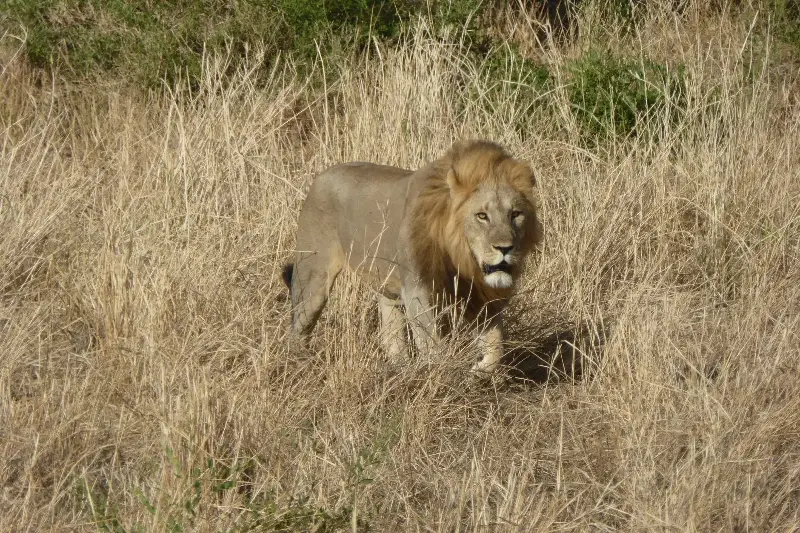
In the 1970s, Africa still held on the order of 90,000 lions. Today only about 20,000 to 25,000 remain, a collapse of roughly three-quarters in half a century, and the species now survives on a small fraction of the land it once roamed, by some measures less than 8 per cent of its historic range. The lion, the animal that more than any other stands for wild Africa, has quietly become a rarity across most of the continent.
The figures come with real uncertainty, because lions are genuinely hard to count. But every serious estimate points the same way, and steeply downward.
The numbers, and their uncertainty
A 2022 study that set out to reconstruct a realistic baseline estimated that around 1970 the continent held somewhere between roughly 83,000 and 101,000 lions, a more careful figure than older guesses of 200,000. Set against today’s estimates of about 20,000 to 25,000, that works out to a decline of around 72 to 77 per cent over about fifty years, or close to three-quarters.
It is worth being honest that these are estimates. Counting lions across vast, remote and often unstable landscapes is difficult, and different methods give different totals. What is not in doubt is the direction and the rough scale of the change. The International Union for Conservation of Nature lists the lion as Vulnerable, and by most reckonings the majority of its populations are still shrinking.
A shrinking map
The other half of the story is geography. Lions once ranged across almost the whole of Africa, and well beyond it, through the Middle East and into India. That range has since contracted dramatically. On the African continent, lions now occupy only a small share of their former territory, commonly put at around 8 per cent of the land they historically roamed.
What is left is not one continuous kingdom but a scattering of pockets, most of them inside national parks and reserves. The animal that once patrolled savannahs from coast to coast now holds isolated fragments of its old domain.
Not evenly spread
The collapse has not fallen evenly, and this is an important qualification. West and Central Africa have been hit hardest, with lions there pushed to the brink; the West African lion in particular is considered critically endangered, clinging on in a handful of sites. East and Southern Africa, which hold most of the world’s remaining lions, have also seen sharp declines, with southern populations falling from tens of thousands to around ten thousand, and East African numbers dropping similarly.
Yet there are exceptions that matter. In some well-managed reserves in southern Africa, often fenced and intensively protected, lion numbers are stable or even rising. So the picture is not a uniform slide toward zero. It is a continental collapse with a few genuine bright spots, which is both a warning and a source of hope.
Why lions are disappearing
The causes are tangled together, and all of them trace back to the pressure of a growing human population sharing the same land. The first is habitat loss, as savannah and woodland are converted to farms, grazing and settlements, shrinking the space lions have to live in.
The second is the loss of their prey. The wild grazing animals lions depend on are themselves hunted out for meat, so that even intact habitat can become an empty larder. The third is direct conflict with people. Lions that stray onto farmland and kill livestock are often killed in return, either in retaliation or to prevent future losses, and that steady toll falls hardest exactly where lions and people overlap. Trade in lion parts and other pressures add to the total.
Why it is hard to reverse
Lions are difficult to conserve precisely because of what they are. They need large territories and plenty of prey, which means they need space, the one thing an expanding human population is least able to spare. They are also dangerous and expensive neighbours, capable of killing the cattle that a rural family’s livelihood depends on.
That makes lion conservation as much a human and economic challenge as a biological one. Fencing and heavy protection can work, as the stable southern reserves show, but fencing is costly and carves continuous populations into isolated islands. Lasting recovery depends on giving local communities real reasons, and real compensation, to tolerate living alongside a large predator.
What to watch
The question now is whether the bright spots can be widened. Watch whether protected areas and community-based conservation schemes can hold the remaining range and expand it, whether recovery in managed reserves can be matched elsewhere, and whether the near-total collapse in West and Central Africa can be halted before those lions vanish entirely.
The lion is not yet on the edge of global extinction, and where it is properly protected it can clearly bounce back. But its survival across most of its remaining range now rests on deliberate human choices, on funding, land and a willingness to coexist. A creature that once ruled a continent increasingly persists only where people decide it should.
The post In the 1970s, Africa still held around 90,000 lions. Today, only about 20,000 to 25,000 remain — a collapse of roughly three-quarters in half a century — and the species now survives in less than 8% of the land it once roamed. appeared first on Space Daily.