



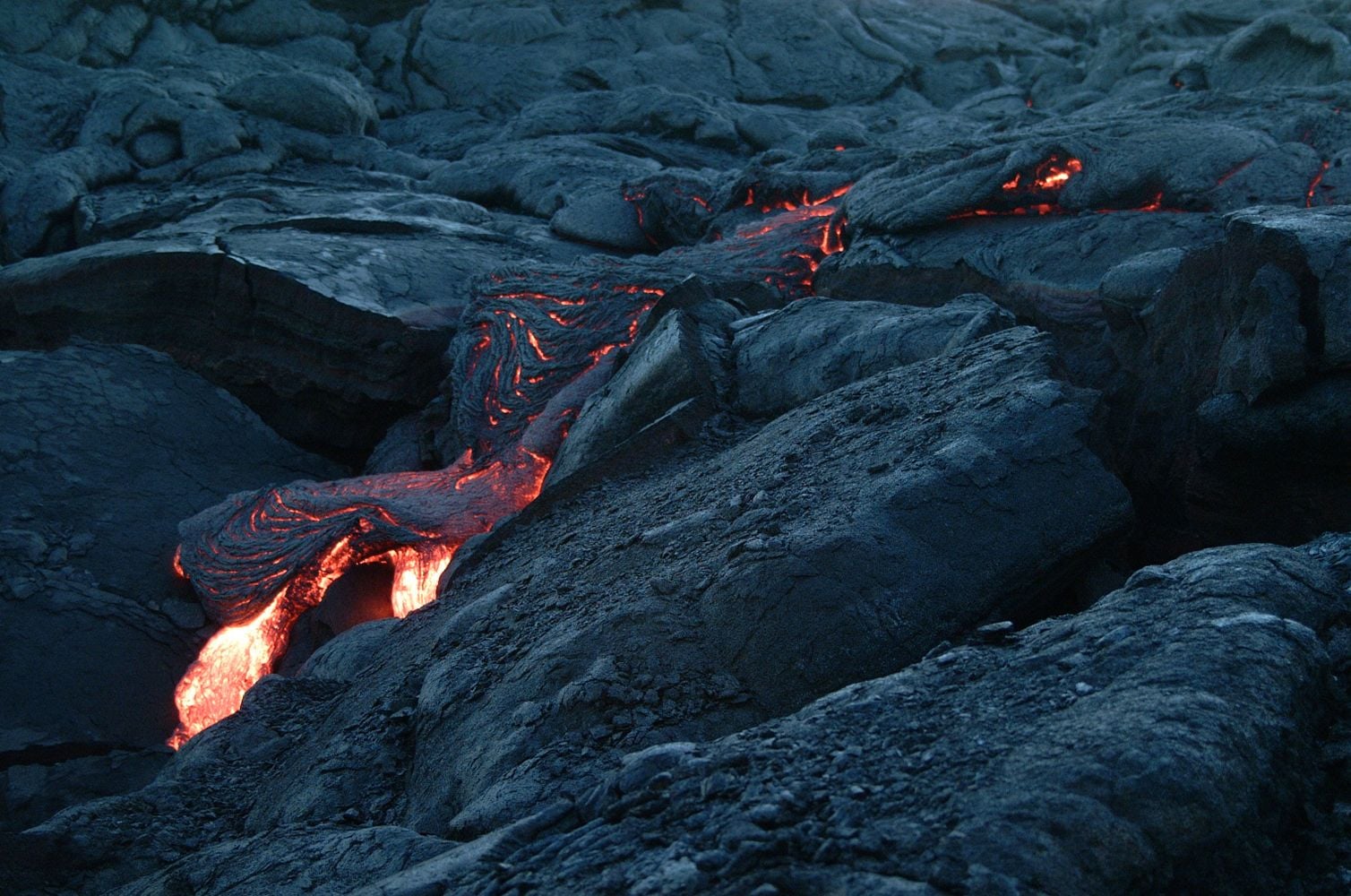
Geochemists at the University of Göttingen have found chemical evidence that material from Earth’s core is mixing into the mantle plume that feeds Hawaii’s volcanoes, a boundary long assumed to be effectively sealed. The study, led by Nils Messling with senior author Matthias Willbold, was published in Nature on 21 May 2025.
This is one study, built around one isotopic signal in one volcanic system, and it should be read that way rather than as a settled account of how the deep Earth works.
Why almost all of Earth’s gold is out of reach
The context for the finding is older and well established. When Earth was still molten, more than 4.5 billion years ago, dense metals including gold, platinum and ruthenium sank toward the centre as the planet separated into layers, a process known as core-mantle differentiation. By most existing estimates, more than 99.999 percent of the planet’s gold ended up locked in the core, roughly 3,000 kilometres down, sealed beneath the mantle. This is why gold is comparatively scarce in the crust we can actually mine, not because the planet is short of it.
What was actually measured
The Göttingen team did not detect gold itself in Hawaiian lava. What they measured was an isotope of ruthenium, a platinum-group metal, called ruthenium-100, in basalts collected in Hawaii, including from an active lava lake at Kilauea. Earlier research had already established that the core carries a slightly different ruthenium-100 signature to the mantle, a difference left over from a late stage of Earth’s accretion when incoming material altered the mantle’s isotopic make-up but did not reach the core. That gives researchers a chemical fingerprint that distinguishes core material from ordinary mantle rock.
The Hawaiian basalts showed a consistent elevation in that core-like ruthenium-100 signature, alongside anomalous tungsten isotope values, another marker associated with core material. In the study’s own language, this combination is “diagnostic of a core contribution” to the rock feeding Hawaii’s volcanism.
It is the isotopic pattern that points to core material, not a direct sighting of gold.
Hawaii was a deliberate choice of testing ground rather than an incidental one. Its volcanism is thought to be fed by one of the clearest examples of a deep mantle plume, a column of hot rock rising from close to the core-mantle boundary with comparatively little contamination from ordinary, shallow mantle rock on the way up. That makes any core-derived signal easier to isolate than it would be in volcanic rock produced by shallower, more common processes.
Two ways the signal could be getting up there
Messling and Willbold model two ways this could happen. In the first, core metal mixes directly into the base of the mantle, with roughly 0.25 percent of the plume’s source material coming from the core. That figure runs into a problem: it should also raise the concentration of other siderophile, or “iron-loving,” metals such as gold and platinum in the same rocks, and it does not.
The second model fits the data better. As the core slowly cools, it may crystallise thin layers of metal oxides at its outer edge, layers enriched in elements like tungsten and ruthenium but not in gold or platinum, which stay bound elsewhere. Material from that layer, rather than raw core metal, would then work its way into the base of the mantle plume. That would explain why the isotopic fingerprint of the core turns up in the lava while gold and platinum do not show any matching increase.
What this does and does not mean for gold
Willbold has described the implication plainly: “the Earth’s core is not as isolated as previously assumed.” The same plumes that carry this core signature also carry an enormous amount of material outright, on the order of several hundred quadrillion metric tonnes of rock rising from the core-mantle boundary to build ocean islands like Hawaii over millions of years.
None of this makes Hawaiian lava a gold source. The amounts of core-derived material reaching the surface are, by the researchers’ own account, tiny, and gold itself was not found in measurable excess in these rocks. Messling has been careful to frame the result as evidence of an ongoing process rather than a discovery of an accessible deposit, describing it as the planet “very slowly regifting its buried treasure,” and cautioning that whether this exchange has been happening throughout Earth’s history, or is something particular to the present, remains to be shown.
Where this goes next
The more interesting question the paper raises is not about gold at all. It is about how leaky the core-mantle boundary really is, and whether the same signature turns up in basalts from other deep mantle plumes, such as the one recently proposed beneath East Africa. If it does, the Hawaiian result stops looking like a local curiosity and starts looking like a general feature of how Earth’s interior moves material around, gold and all, on timescales that make any of it useless as a mining target but useful as a window into the planet’s inner workings.