



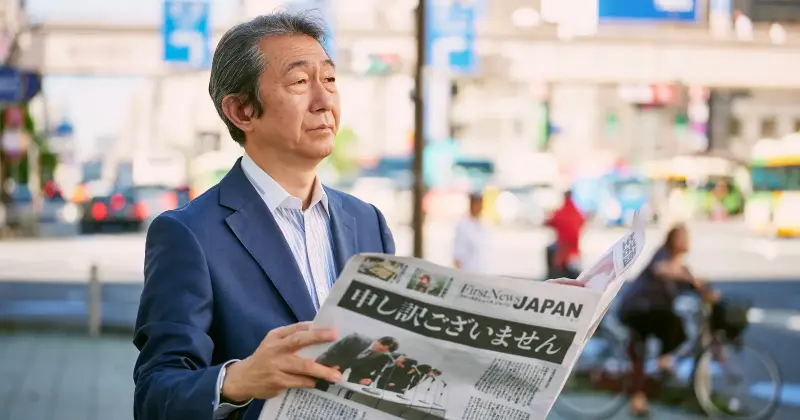
The specific literacy skills required to read the front page of a standard Japanese-language newspaper in the year 2026 include, at minimum, the specific ability to recognise approximately 2,136 individual Chinese-derived logographic characters (each with two or more possible pronunciations depending on the specific compound context in which it appears, and each representing a specific meaning-unit rather than a phonetic component); the specific ability to recognise and phonetically decode approximately 46 curved-line syllabic characters representing the specific set of Japanese vowel-and-consonant sound combinations that constitute the phonological building blocks of the Japanese language; the specific ability to recognise and phonetically decode approximately 46 angular-line syllabic characters representing the same set of phonological building blocks but rendered in a substantially different visual form; and the specific ability to switch fluently between the three systems within the same sentence, since Japanese newspapers (like essentially every other substantive category of Japanese written media) do not, in fact, use the three writing systems separately — they use them simultaneously, within the same sentence, in patterns that the specific reader must decode in real time based on the specific type of information each system encodes. The three systems have specific names: kanji (漢字), hiragana (ひらがな), and katakana (カタカナ). A fourth system, romaji (ローマ字), is also present in modern Japanese written communication, though not typically in newspaper prose.
The specific fact that essentially every non-Japanese-speaking learner of the Japanese language eventually confronts, at approximately the specific moment they attempt to read their first authentic Japanese newspaper article, is that the specific quadrilateral writing-system architecture of the Japanese language is not the substantially most complicated writing system currently in daily use anywhere in the recorded history of the modern world by accident. It is the specific cumulative product of approximately 1,500 years of progressive linguistic borrowing, script development, and educational reform, and each of the four current systems reflects a specific historical layer of Japanese cultural interaction with the substantially different linguistic and cultural traditions that have influenced the Japanese archipelago across the specific interval between approximately 500 CE and the present. As detailed in Nihongo Career’s comprehensive institutional guide to the specific structure and function of the Japanese writing systems, the specific chronological order in which the four systems were progressively adopted into the Japanese written vocabulary is: kanji first, in approximately the fifth to sixth centuries CE, when Buddhist scholars and diplomatic emissaries from the Korean Baekje kingdom introduced Chinese logographic writing to a Japanese archipelago that had, up to that point, no substantive written language of its own; hiragana and katakana subsequently, in approximately the ninth and tenth centuries CE (during the specific Heian period of Japanese cultural flowering), as Japanese scholars and (particularly in the case of hiragana) court women progressively developed phonetic simplifications of Chinese characters that could represent the specific grammatical particles, verb endings, and native-vocabulary elements that Chinese logographic writing could not adequately capture; and romaji last, in approximately the sixteenth century (through Portuguese Jesuit missionary contact) but not in substantial daily use until the specific Meiji-era modernisation programme following the 1868 restoration of imperial rule progressively integrated Western educational systems into Japanese schools.
How kanji actually works
The specific complication that kanji introduces into the specific literacy requirements of modern Japanese is that essentially every individual kanji character can, in principle, be pronounced in at least two substantively different ways depending on the specific linguistic context in which it appears. As described in Migaku’s institutional summary of the specific structure and pronunciation rules of the Japanese writing systems, the specific dual-reading structure of kanji reflects the specific historical fact that Japanese speakers, upon adopting Chinese logographic characters in the fifth and sixth centuries CE, had a substantial pre-existing native Japanese vocabulary that already had words for the same concepts the Chinese characters represented. The Japanese linguistic solution to this specific conflict was to give each kanji character two separate pronunciations: the on’yomi (音読み, “sound reading”) — the specific approximation of the original Chinese pronunciation, used primarily in compound words borrowed from Chinese — and the kun’yomi (訓読み, “meaning reading”) — the specific pre-existing native Japanese word for the same concept, applied to the specific Chinese character that represented it. The specific kanji character 山, for example, means “mountain” in both Chinese and Japanese; its on’yomi is “san” (approximating the Chinese pronunciation) and its kun’yomi is “yama” (the specific native Japanese word for mountain). The specific reader of a Japanese newspaper must, in real time, determine which pronunciation is contextually appropriate for each specific instance of each kanji character encountered. The specific total inventory of kanji characters designated by the Japanese government as required for functional adult literacy — the specific set known as the jōyō kanji (常用漢字, “regular-use kanji”) — currently stands at 2,136 characters. The specific total inventory of kanji characters that exist in comprehensive Japanese dictionaries is approximately 50,000.
The 46-character syllabaries
The specific pair of Japanese-developed syllabic writing systems (hiragana and katakana) that supplement the specific Chinese-derived kanji script provide the substantial phonetic infrastructure that essentially every element of Japanese grammar depends on. As reported in the Coto Academy Japanese language school’s institutional summary of the specific functional roles of the four Japanese writing systems, hiragana serves as the specific written vehicle for essentially every grammatical particle that indicates the specific relationship between different words in a Japanese sentence (は for topic marking, が for subject marking, を for direct object marking, and so on), for the specific verb and adjective endings that indicate tense, politeness, and negation, and for the specific set of native Japanese vocabulary items that either lack corresponding kanji or use kanji that are considered too rare for standard newspaper prose. Katakana, by contrast, serves the specific function of marking words that have entered the Japanese language from non-Chinese foreign sources — primarily English but also including French, German, Portuguese, Dutch, and (increasingly) essentially every other language that Japanese consumer culture has progressively imported vocabulary from across the past 150 years. The specific reader encountering the katakana character sequence コーヒー (kōhī) in a newspaper article immediately recognises the specific word as an imported term from English “coffee.” The specific reader encountering the katakana sequence パソコン (pasokon) recognises the specific word as an imported abbreviation of English “personal computer.” The specific visual distinction between the curved hiragana and the angular katakana serves as a substantive real-time marker to the Japanese newspaper reader about the specific linguistic origin of each individual vocabulary item on the page.
How romaji fits in
The specific fourth Japanese writing system — romaji (ローマ字, literally “Roman letters”) — is, per Pep Talk Radio’s institutional summary of the specific relationship between the four Japanese writing systems and their contemporary uses, a substantially newer addition to the specific written-Japanese landscape. Romaji uses the specific 26-letter Latin alphabet familiar from English and most other European languages, applied to the specific transliteration of Japanese sounds according to the standard Hepburn romanisation system (developed by the American missionary James Curtis Hepburn in 1867) or the alternative Kunrei-shiki system (developed by the Japanese government in 1937). The specific practical function romaji serves in the specific modern Japanese literacy environment is essentially universal: it is the specific input method that essentially every Japanese person uses to type Japanese text into computers, smartphones, and other digital devices. Japanese speakers type the phonetic romaji representation of the specific word they want to write (say, “sushi”), and the specific Input Method Editor (IME) software running on the device converts the romaji input into hiragana (すし), which the user then either accepts as-is or converts to the substantially more likely kanji form (寿司). The specific Japanese schoolchild currently learning to use a computer keyboard in 2026 must therefore master, in addition to the three traditional Japanese scripts, the specific 26-letter Latin alphabet that essentially every other technologically-developed nation in the world uses as its primary writing system — meaning that the specific total inventory of distinct written characters that a functionally literate Japanese adult can be expected to recognise and correctly reproduce in 2026 is approximately 2,136 (kanji) + 46 (hiragana) + 46 (katakana) + 26 (romaji) = 2,254 individual visual characters, plus the substantial additional context-dependent pronunciation rules that determine how each character is actually meant to be read.
The post To read a newspaper in Japan, a person needs to know three completely different writing systems used simultaneously — hiragana for native Japanese words, katakana for foreign loan-words, and kanji for concepts borrowed from Chinese roughly 1,500 years ago — plus romaji, the Latin alphabet Japanese schoolchildren learn to type their language into computers and phones appeared first on Space Daily.