



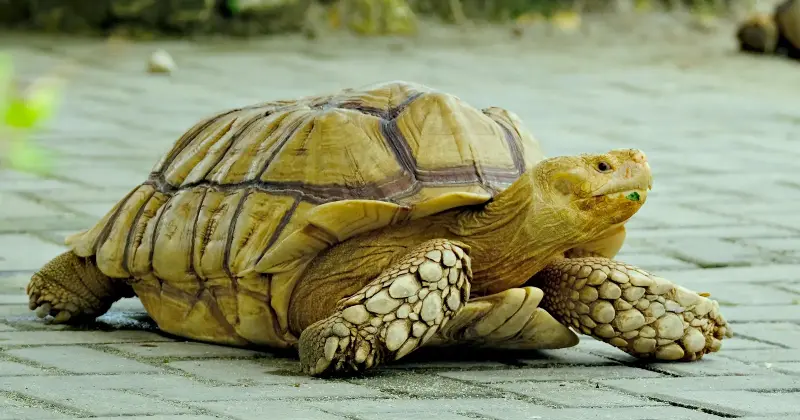
The gopher tortoise (Gopherus polyphemus) is a medium-sized terrestrial reptile with a heavily domed carapace, powerful front limbs modified for digging, and a range that extends across the Coastal Plain of the southeastern United States from southern South Carolina through Georgia, Florida, Alabama, Mississippi, and into eastern Louisiana. Adults reach approximately 15 inches in shell length, weigh between 8 and 15 pounds, and live for as long as 60 to 80 years in the wild. Population densities across the range are highly variable, from as low as 0.04 tortoises per hectare in fragmented or fire-suppressed habitat to as high as 26 tortoises per hectare in intact longleaf pine sandhill communities under active management.
The species has been listed as federally Threatened under the U.S. Endangered Species Act in the western portion of its range since 2011. A separate listing decision covering the eastern distinct population segment was withdrawn by the U.S. Fish and Wildlife Service in 2022 and is currently being challenged in federal district court. What makes the species ecologically consequential across all of this range is not its individual biology but the structure it builds beneath the ground.
The burrow
An adult gopher tortoise excavates a burrow using its powerful forelimbs, angling downward into loose sandy soils at approximately 20 to 30 degrees below horizontal. The completed burrow typically extends between four and twelve metres along its horizontal axis and reaches depths of up to three metres below the ground surface. The tunnel width closely matches the width of the individual tortoise that dug it, allowing the burrow to be occupied only by that tortoise and by other species small enough to enter alongside or behind it. Burrows may take several weeks to several months to complete and can remain functional for years or decades after their original excavation, whether continuously occupied or subsequently abandoned. A single adult tortoise typically maintains multiple burrows across its home range of roughly two to four hectares.
The internal microclimate of a completed burrow is thermally and hygrometrically extraordinarily stable. Temperatures remain within a narrow band year-round, humidity holds near saturation, and the enclosed space is buffered against the extreme surface fluctuations characteristic of the sandhill and pine flatwoods habitats above. These are the properties that transform the burrow from a residence for one reptile into an ecological refuge for an entire vertebrate and invertebrate community.
If you’re enjoying this article, check out this video on how a bison does a very similar and equally important job:
The commensal community
According to the Florida Fish and Wildlife Conservation Commission’s technical documentation on gopher tortoise commensal species, drawing on the state agency’s own Gopher Tortoise Management Plan, more than 350 other species have been recorded using gopher tortoise burrows for shelter, foraging, or reproduction. The list is dominated by invertebrates, with approximately 300 documented burrow-associate species including beetles, crickets, spiders, mites, and various dipteran and hymenopteran taxa. Approximately 60 vertebrate species have also been recorded, including reptiles, amphibians, mammals, and birds. Some of these species use burrows opportunistically. Others depend on them for survival at population-relevant scales.
The vertebrate species most tightly associated with the burrows include several that are themselves of conservation concern. The eastern indigo snake (Drymarchon couperi), a federally Threatened species and the second-longest snake native to the United States, uses gopher tortoise burrows for overwintering refuge across the northern portion of its range and has been documented nesting inside them. The gopher frog (Lithobates capito) relies on burrows for shelter from predation and desiccation between its ephemeral pond breeding sites, and newly metamorphosed juveniles are particularly dependent on burrow access for post-metamorphic survival. The Florida mouse (Podomys floridanus), the only vertebrate mammal considered an obligate commensal of the species, constructs its own smaller burrow chambers directly off the sides of the main gopher tortoise tunnel. Additional priority commensals include the state-Threatened Florida pine snake (Pituophis melanoleucus mugitus) and the eastern diamondback rattlesnake (Crotalus adamanteus), the largest venomous snake in North America.
Why fire matters
The wider ecological importance of the burrow becomes apparent in the context of fire. The longleaf pine ecosystem in which the gopher tortoise reaches its highest densities is a fire-adapted community that requires regular low-intensity ground fires to maintain the open understory and diverse herbaceous ground cover on which the tortoise and its dependent species collectively rely. Historical fire return intervals across the longleaf ecosystem were approximately every one to three years, driven by frequent lightning strikes and by indigenous burning practices. Modern conservation management maintains this fire regime through prescribed burns, which land management agencies conduct on a rotating schedule across the remaining fragments of intact longleaf habitat.
During these fires, whether prescribed or wildfire, the surface temperature of the sandhill ecosystem briefly reaches levels lethal to most vertebrates. The burrow interior, insulated by up to three metres of sandy soil, remains at ambient subsurface temperatures. Any animal small enough to fit inside can survive the fire by retreating underground for the duration of the burn and re-emerging afterwards. Without the burrows, most of the species dependent on the longleaf ecosystem would not be able to persist through the fire regime that maintains the ecosystem itself. With the burrows, the fires can be tolerated, the community can regenerate, and the ecosystem can function as it evolved to function.
Conservation implications
According to a peer-reviewed study published in January 2025 in the journal Community Ecology by researchers from Virginia Tech’s Department of Fish and Wildlife Conservation, led by George C. Brooks and Carola A. Haas and drawing on more than 2,000 camera-trap days conducted at gopher tortoise burrows on Eglin Air Force Base in the Florida panhandle between 2016 and 2018, the diversity of commensal species associated with a given burrow is a strong function of the quality and structure of the vegetation community surrounding it. The Brooks et al. study documented 48 vertebrate burrow-associate species at intact forested longleaf pine sandhill sites, compared with only 31 species at otherwise-comparable burrows located on treeless military test ranges within the same installation. Both site types held comparable densities of gopher tortoise burrows themselves. What differed was the structural complexity of the surrounding habitat, and with it the community of vertebrate species that the burrows were able to support.
The finding has direct implications for gopher tortoise conservation policy across the species’ range. Simply maintaining tortoise populations, or maintaining physical burrow densities, is not sufficient to preserve the wider ecological function that gopher tortoises provide to the longleaf ecosystem. What must also be preserved is the vegetation composition, the fire regime, and the habitat structure that together allow the full commensal community to persist alongside the tortoises themselves. On land managed for intact longleaf pine sandhills with regular prescribed burning, gopher tortoise burrows continue to serve as the physical infrastructure that keeps the wider community functional. Where the surrounding habitat has been simplified or degraded, the tortoises may remain, but the ecological role they play in supporting hundreds of associated species progressively diminishes with the loss of the vegetation matrix around them.