



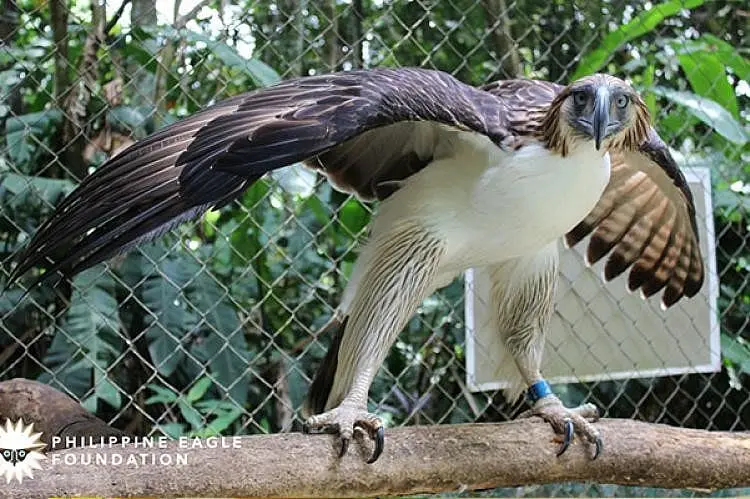
IN A recent scientific study, Philippine Eagles inhabiting the Greater Mindanao Faunal Region (Mindanao, Samar, Leyte) show little genetic variation, confirming that the country’s national bird is close to extinction, highlighting its status as a critically endangered species.
Low genetic variation limits a certain species ‘ ability to adapt to changes in the environment, like disease or climate change. It makes a particular species susceptible to being wiped out by a single threat.
A mitochondrial genome study of Philippine Eagles from the Greater Mindanao Faunal Region (GMFR) was conducted by scientists from the University of the Philippines Mindanao–Philippine Genome Center (PGC) and the Philippine Eagle Foundation (PEF).
The study analyzed mitochondrial genomes from 32 Philippine Eagles housed at PEF’s two facilities in Davao City – the Philippine Eagle Center (PEC) in Malagos, Davao City, and the newly-established National Bird Breeding Sanctuary (NBBS) located in Barangay Eden, also in Davao City.
Despite the little genetic variation between the eagle species, the results also have encouraging news as the PEF’s collection of captive Philippine Eagles, which consists of rescued birds and eagles bred in captivity, still retains a high diversity of maternal lineages (haplotypes), including rare bloodlines possessed by eagles that were bred and hatched in the center.
The captive-bred Philippine Eagles carry all 17 haplotypes detected in the study, showing that the current breeding stock holds much of the remaining known genetic variation of the species.
The study found two main genetic clusters of Philippine Eagles, and identified three particularly distinct haplotypes—one from Samar Island Natural Park. Results from the species in Samar, along with key biodiversity areas such as in Mount Busa in Kiamba, (Sarangani Province), Mt. Kampalili-Puting Bato (Davao del Oro/Davao Oriental), Mt Pantaron, showed genetic distinctiveness.
Mitochondria are tiny energy-producing parts of a cell, often called the cell’s powerhouse. They have their own separate DNA (mitochondrial DNA or mDNA) passed from the mother to her offspring. The mDNA changes slowly over time and is widely used to trace bloodlines or gene families.
This mDNA helps scientists identify many unique maternal lineages that remain in an endangered species and is especially important for breeding critically endangered species such as the Philippine Eagle. PIA DAVAO