



Instead of static stays in a single destination, the so called "island hopping" formula offers dynamic, tailor-made itineraries that are deeply rooted in nature. If an island symbolises escape, adding several of them to the same journey multiplies that sense of freedom.
According to figures from Spanish tour operator Atlantida Travel, which specialises in tailor-made trips, interest in these routes has been growing steadily for several years, with a surge after the pandemic. Today’s traveller is looking for wide-open spaces, privacy and direct contact with the natural environment, without giving up excellent service.
The most exclusive version of island hopping includes transfers by private yacht or catamaran, overwater villas, dives in protected marine reserves, private dinners on untouched beaches and scenic flights by seaplane. Each leg is adapted to the traveller’s pace, blending exploration and downtime with a high level of sophistication.
But beyond the luxury, movement is the key. These trips take time. They are not a weekend break. The ideal format is between 10 and 15 days, the minimum needed to link three or four islands without rushing, soak up their contrasts and avoid turning transfers into a race against the clock. In more distant destinations, the experience can stretch to as much as three weeks.
Greece and Croatia: Europe’s benchmarks
Within Europe, Greece tops the island-hopping rankings. The Cyclades archipelago has become the most sought-after destination for this kind of trip. Islands such as Santorini, Mykonos and Paros combine historical heritage, crystal-clear beaches and a vibrant food scene. Alternating iconic hotspots with quieter stops offers a more complete view of the Aegean.
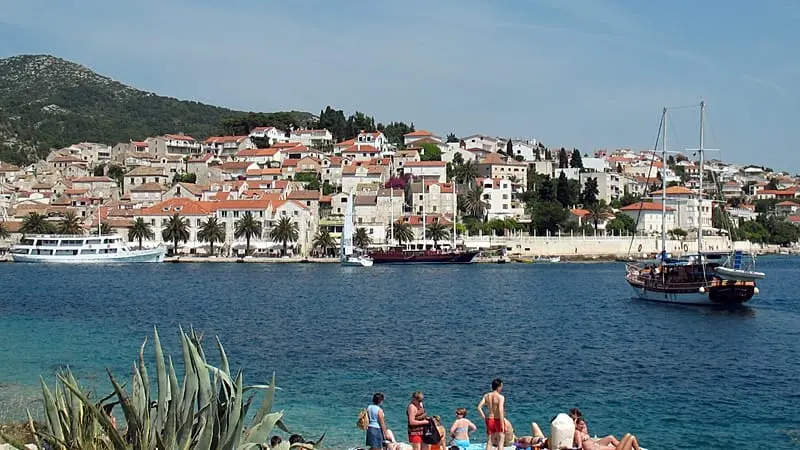
Croatia, long established as a leading nautical playground, also holds a privileged position. Sailing between Hvar, Brač or Korčula on board a private gulet has become one of the Adriatic’s signature experiences. Hidden coves, medieval towns and a lively cultural scene turn each crossing into a journey within a journey.
Spain: The Mediterranean dream of the Balearics and Macaronesia
Spain is not far behind. In the Mediterranean, the Balearic Islands offer one of Europe’s best-known island-hopping routes: Ibiza and Formentera. In high season, the two are linked by dozens of daily crossings, making it easy to plan day trips or longer combined stays. The itinerary can be extended to Mallorca or Menorca for those with a full two weeks to spare.
In the Atlantic, the Canary Islands make it possible to design highly varied volcanic and scenic routes. The La Palma-La Gomera-Tenerife itinerary combines laurel forests, sheer cliffs and star-studded skies. Here, the gentle pace and relatively short distances lend themselves to stays of 10 to 12 days.
Italy and Greece: The classical world in a week and a half
Italy offers a volcanic journey between Sicily and the Aeolian Islands. Flying into Catania or Palermo and continuing on to Lipari, Vulcano, Stromboli or Salina means discovering black-sand beaches and landscapes shaped by volcanic activity.
France also has strong contenders. Combining Corsica and Sardinia brings together two of the most spectacular islands in the western Mediterranean, famed for their cliffs and turquoise waters. On France’s Atlantic coast, small islands such as Belle-Île or Île de Ré offer landscapes made for cycling and fishing villages full of charm.
Portugal, Scotland and the wild Atlantic
Portugal is carving out a strong position thanks to the Azores. São Miguel, Terceira, Pico and Faial offer immersion in volcanic lagoons, vineyards listed as World Heritage sites and whale-watching routes. Madeira is also ideal for combining rugged nature, hiking and the sea.
Further north, for lovers of nature in its purest state, Scotland unveils a mosaic of wild islands. Skye, Mull, Iona, Harris, Lewis, Barra and Coll offer dramatic cliffs, deserted beaches and an almost mystical atmosphere. Here, journeys may be longer and changeable weather conditions call for careful planning.
How much does it cost?
The public opting for island hopping is diverse, according to Atlantida Travel: couples aged between 30 and 45, well-off senior travellers and multigenerational families. What they have in common is a desire for active itineraries that combine relaxation with nautical and cultural activities. "It is an appealing formula for travellers with an explorer’s mindset who value the freedom to move around," says Francesc Escánez, director of Atlantida Travel.
In Europe, a 10 to 15-day trip staying in boutique hotels typically comes in at between €3,000 and €4,500 per person. Premium versions with a private yacht in the Mediterranean increase the budget considerably. Expert planning is essential to optimise connections and balance the number of islands – three or four is usually ideal – so that too many transfers do not detract from the experience.
"Island hopping can be practised all year round thanks to tropical destinations such as the Maldives, Seychelles, the Caribbean or Thailand during the European autumn, winter and spring," Escánez concludes. In a context in which travellers seek memorable, personalised experiences, hopping from island to island is emerging as a richer, more complex way to travel. It is also a new way to rediscover the Old Continent, surrounded by the sea.