



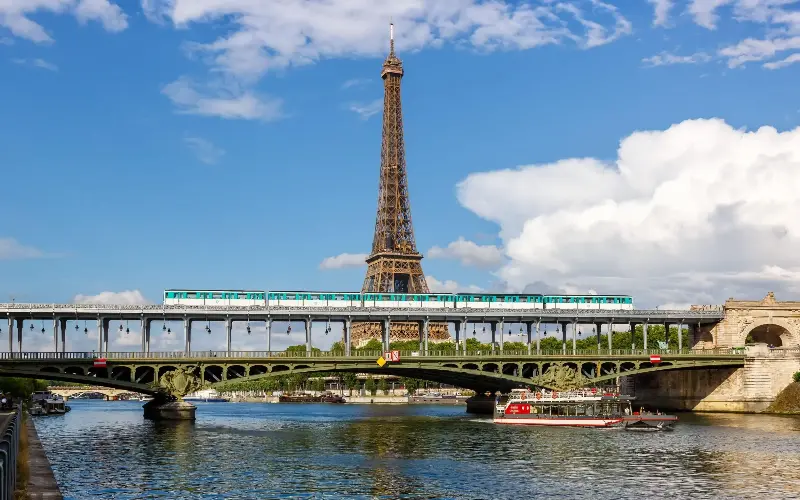
They are the functional chunks of transport infrastructure that make major cities go round. And they can be fraught with frustrations, hold-ups, and the regular spectre of “weekend engineering work”. But metro networks will also give you as revealing a glimpse of the metropolis you are visiting as a skyscraper observation deck or a lofty viewpoint.
The following tube systems are all the stuff of travel dreams:
1. London Underground
Opened: 1863
Size: 11 lines; 272 stations
Whether you consider it to be the best metro network, London’s Tube is certainly the original – the planet’s first underground railway system.
Here in the 21st century, it has expanded far beyond the city, its branches forging all the way out into adjacent Buckinghamshire, Hertfordshire and Essex – but its spider web of track still contains the route which started it all. What is now the Metropolitan Line was unprecedented when services began on January 10 1863; ride it between Paddington and Farringdon, and you are echoing the steam-drawn movements of thousands of astonished Victorians 163 years ago.
A similar element of time travel is involved if you catch a train between Stockwell and (effectively) Bank on the Northern Line. This seven-station trip traces the path of the old City and South London Railway, the first ever electrified underground line (in 1890).
Best bit
The series of modernist and art deco stations crafted by the venerated architect Charles Holden during the 1920s and 1930s. The Piccadilly Line is particularly blessed on this score: stops including Arnos Grove, Acton Town, Boston Manor, Bounds Green, Cockfosters, Northfields and Oakwood were all touched by Holden’s remarkable genius.
2. Paris Métro
Opened: 1900
Size: 16 lines; 321 stations
It took the French capital almost four decades to mimic its British rival, but when it did, the Paris Métro was built in a blur; the crux of the existing network was laid out between 1900 and 1920. This has made for problems in the present. There is an over-abundance of stations (the Parisian system has 49 more stops than London, but only 60 per cent of the track). Plenty of them, more than a century old, have accessibility issues. And carriages can be horribly crowded.
The flipside to these woes (some of which will be alleviated by the four new lines – 15, 16, 17, 18 – that are due to be completed by 2031) is the romance of it all. Trains carry you around the city, to the majority of the greatest landmarks (Anvers for the Sacré-Coeur, Bir-Hakeim for the Eiffel Tower, Charles de Gaulle-Étoile for the Arc de Triomphe), in what feels a matter of moments – and with a lingering Belle Epoque finesse. Witness the art nouveau station entrances – crafted in iron and glass by the architect Hector Guimard in 1900 – that still stand as the Métro’s most iconic image.
Best bit
The southbound part of Line 6 between Passy and Bir-Hakeim where the train bursts from between the buildings to reveal the Eiffel Tower on the far side of the Seine.
3. Berlin U-Bahn
Opened: 1902
Size: Nine lines; 175 stations
The theory that every key period of turbulence in the 20th century was scratched into the surface of Berlin is firmly grounded in the case of its subway. Expansion of the network stalled during the First World War, and the German economic crisis which came after it. Reichskanzlerplatz station (now Theodor-Heuss-Platz, on the U2 line) was renamed “Adolf-Hitler-Platz” in 1933. And the system was split into two halves by the Cold War.
The division was particularly visible on lines U6 and U8, which continued to serve West Berlin after the building of the Berlin Wall in 1961, even though their tracks ran into the east side of the city. For almost three decades, trains did not stop at the stations on the “other” side of the Iron Curtain – and the only “passengers” waiting on the platforms at the likes of Schwartzkopffstrasse and Jannowitzbrücke were East German border guards.
Best bit
The sections of U1 and U3 where trains glide across the River Spree via the Oberbaumbrücke. Take a one-stop journey from Schlesisches Tor station to Warschauer Strasse and you are crossing what was the heavily fortified line between West and East.
4. Rome Metro
Opened: 1955
Size: Three lines; 77 stations
It should be no surprise that the subway system in the Italian capital is so small – and, comparatively, so young. You can barely take a step in Rome – let alone drive a series of tunnels through the topsoil – without finding an ancient treasure, and the development of the light-rail system has been torturously slow in a city that is famous for its traffic jams.
But all that history counts for a lot. Recent expansion work has led to the creation of two new “museum stations” – where, rather than being a hindrance to public transportation, the various layers of the past uncovered by the earth-movers have been repackaged as an added element of the journey. As of last December, both Colosseo (on Lines B and C) and Porta Metronia (on Line C) are home to sizeable archaeological areas where priceless artefacts are displayed in the very locations where they had lain hidden for two millennia.
Best bit
Colosseo. As its name suggests, this key station serves the city’s incomparable amphitheatre. Tourists can now admire a series of ancient well-shafts and the foundations of a lost bathhouse on their way upstairs to pose for photos with the cosplay gladiators.
5. Moscow Metro
Opened: 1935
Size: 16 lines; 300 stations
One of the least important side issues of Vladimir Putin’s assault on Ukraine is that it leaves Russia off-limits to Western tourists – and with this, denies curious eyes the chance to gaze upon what may be the planet’s most spectacular subway system.
The Moscow Metro (known officially, but not snappily, as the “Order of the Red Banner of Labour V.I. Lenin Metro”) was a relative latecomer, with ground not being broken until 1933. But it grew quickly – at 333 miles in total, it is the eighth longest underground network in the world, the longest in Europe, and the only one of the 12 lengthiest tube systems not found in China. In other words, it is quite the feat of engineering.
Park Pobedy, which sits on both Line 3 and Line 8a, is a case in point. Lying 276ft (84m) below the surface, it is the deepest station on the network and the eighth deepest on earth (for the record, the deepest is Hongyancun station, which is hidden at 381ft/116m, again in China – in Chongqing).
Best bit
The Moscow Metro is renowned for the cathedral-like beauty of its stations, with their high ceilings and grand decor. Komsomolskaya, Novoslobodskaya and Kurskaya (all Line 5), as well as Mayakovskaya (Line 2), all call out to the camera lens.
6. Stockholm Metro
Opened: 1950
Size: Three lines; 100 stations
The majority of tube systems effectively disguise the fact that they skulk underground behind shiny tiling, strip-lit corridors and wall-to-wall advertising. In the Swedish capital, the metro’s subterranean DNA is openly, even brazenly, applauded. At several stations – particularly along the arterial Blue Line (Blå Linjen) – the bedrock that was roughly exposed by mechanical force eight decades ago has been left on show, to dramatic effect.
Best bit
The main hub, T-Centralen, where a mural of the workmen who built the station is daubed onto the very stone where their chisels landed. Stadion, on the Red Line (Röda Linjen), is also eye-catching, thanks to the painted rainbow which arcs over the platforms.
7. Beijing Subway
Opened: 1971
Size: 30 lines; 400 stations
If you needed an indication of how rapidly China has accelerated in the last half-century, consider this: the metro system in its capital did not exist until 56 years ago, and even in 2002, had just two lines. Now it is the planet’s longest, its tracks extending to 554 miles.
Its modernity is such that the latest addition to the network, Line 18, was inaugurated on December 27 (2025) – construction on each of its 11 stations having only commenced in April 2023. Nor will the work stop there. Further expansion – “Phase 2” – will take the system to 620 miles by the end of this decade, while “Phase 3” has already been green-lit.
Best bit
The system is so state of the art that it includes that emblem of futuristic rail travel: a maglev line. Line S1 is the electromagnetic wonder in question, with eight stations, and trains capable of 65mph (although the operating speed is generally 50mph).
8. Buenos Aires Subte
Opened: 1913
Size: Seven lines; 90 stations
The urban rush of a tube network feels an awkward fit with a continent which is so given over to rainforest and mountains. And indeed, you can find only four South American entries in the list of the planet’s 100 longest metro systems: two in Brazil (São Paulo and Rio), one in Venezuela (Caracas) – and in the Argentine capital (in 100th place exactly).
But the Buenos Aires Subte is a jewel. Inaugurated in 1913, it is the oldest metro on the continent, in the Southern Hemisphere, and in the Spanish-speaking world – preceding its sibling in Madrid, the city from which Argentina once took its orders, by six years.
It wears this air of heritage with discernible pride. The original wooden-carriage rolling stock (genteel Belgian-built “La Brugeoise” cars) was only retired from the oldest line, Line A, in the centenary year of 2013 – and is still used for occasional “museum trains”.
Best bit
Several Subte stations double as de facto art galleries. San José de Flores (Line A) boasts a wealth of work by city-born painter Guillermo Roux. Tronador-Villa Ortúzar (Line B) is home to a swathe of stained glass that tells the tale of the surrounding district.
9. New York City Subway
Opened: 1904
Size: 36 lines; 423 stations
You could never describe New York’s metro system as beautiful. Its appearance in too many grimy 1970s film dramas – The Warriors, Death Wish, The Taking Of Pelham One Two Three – sealed its cinematic image long ago. But its safety record has improved significantly since the turn of the millennium, and it remains a network of impressive heft and scale, uniting four of the famous “five boroughs” (Staten Island, alas, is beyond its reach) in 248 miles of track.
It is also an indelible element of the city’s character and demeanour, referenced in songs by Big Apple musical alumni such as the Beastie Boys, Velvet Underground and the New York Dolls. It is not a network where you hang around to inspect the (largely uninspiring) architecture, but New York would not be New York without that telltale rumble of wheels beneath its sidewalks.
Best bit
The parts of Lines B, D, N and Q that cross the Manhattan Bridge, offering an incomparable view of the skyscrapers of the Financial District, and the Brooklyn Bridge.
10. Tokyo Metro
Opened: 1927
Size: Nine lines; 180 stations
The image of the subway system in the Japanese capital is almost as calcified as that of its counterpart in New York – a hideously busy labyrinth where white-gloved railway staff are employed to shove as many people as possible into already crammed carriages. But while there is no doubting the crowdedness of the Tokyo Metro – with an average 6.52 million journeys made every day, it is the globe’s fifth most used tube network (the top four are all in China) – the cliché does not necessarily represent reality.
True, you can still see oshiya (train pushers) prodding commuters through half-closed doors, but two other Japanese stereotypes – efficiency and punctuality – ensure minimal delays and discomforts. Instead, the Metro whizzes you around the metropolis in that Blade Runner blur for which Tokyo is also known – all neon shop signs and an air of the distant future.
Best bit
The Ginza Line (Line 3) – the original kernel of the network, which will reach its centenary next year. The oldest metro line in Asia, never mind Japan, it connects key corners of the city centre – Shibuya, Chūō, Chiyoda, Taitō – with an enduring reliability.