



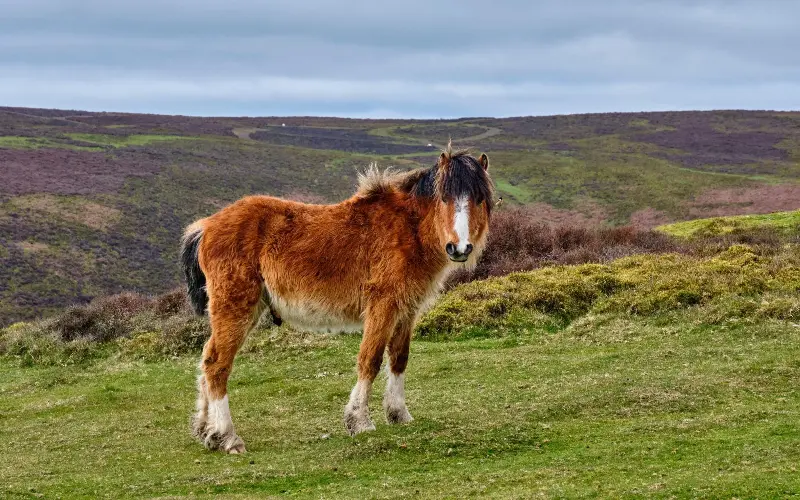
The iconic Dartmoor pony has been a feature of southern Devon since before Stonehenge was built; they have been there before the first sheep arrived on these shores.
Indeed, they were managing invasive vegetation and promoting biodiversity long before conservation was even a word. Robust and in tune with their landscape, these days they also bring cultural delight to millions of locals and visitors.
Recent years have not been kind to them. From a population as high as 30,000 in the 1950s, they have sunk to around 1,500 today, a period during which the biodiversity and bio-abundance of Dartmoor has been steadily reducing.
Now it appears that things are going to get even worse: Natural England, the gatekeeper for all agricultural subsidies, has a plan that will lead to a likely cull of the ponies. The quango has said that it will be imposing much reduced stocking densities on individual farmers. This will mean fewer ponies, not just cattle and sheep. The number of livestock on Dartmoor have been restricted since 1994, but until now this has not included ponies. That is set to change.
The devil, as always, will be in the detail, but a 75 per cent reduction in livestock grazing seems on the cards.
Unsurprisingly, the farmers and commoners are both alarmed and angry, with heated words, press releases and petitions being traded. Natural England has replied with a “clarifying” blog which, judging from the comments that followed, clarified precisely nothing.
For a start, whilst insisting that they, Natural England, had no powers to order a cull, they gave no reassurance at all that culling wouldn’t be the outcome. This has prompted the Prime Minister’s spokesman to insist that a cull will not be allowed.
The problem, say the farmers, is this: any reduction in grazing density is most likely to affect the ponies (who are technically not “livestock” but “leisure animals”) rather than sheep and cattle, and that, if they have to bring the ponies off the hill in consequence, the likelihood is that they will then have to be culled.
Figures as high as 90 per cent have been quoted. “Exmoor will be next,” they add. In reality, it is probably not quite as simple as that, not least because there is a vibrant market out there for Dartmoor ponies in conservation projects in other parts of the country, which would presumably give them somewhere to go other than the slaughterhouse.
As with all our dealings with nature, this is an issue that is both nuanced and layered. On the one hand, there is a widely accepted requirement to reduce the national grazing herd, and not just because of emissions. It is not tenable to argue that ponies don’t contribute to grazing pressure, even the photogenic ones that bring busloads of tourists to come and admire them.
On the other hand, ecologists specialising in large herbivores will tell you sheep create the damage, not ponies. With just 1,500 of them, ponies represent just 3 per cent of all livestock pressure on Dartmoor.
Good ecological outcomes are best achieved by a “diverse herbivore assemblage”, where the actions of many different species, and not just one, combine to get the best results.
Create even more pressure on the already depleted pony population, and the result will not be a conservation job done well but the loss of an important cultural feature of the landscape and the genetic bottleneck that inevitably comes from unsustainably small populations.
And once the pony has gone, who is going to eat all that rampant Molinia grass and promote all that native heathland vegetation?
Whilst the new stocking density levels are at an early stage (and are broadly supported by Dartmoor Nature Alliance), they come with the air of something being imposed from afar. They curiously pre-empt the Dartmoor Land Use Management Report, on which two years work has been done trying to come up with answers to precisely these questions.
The proposals may be academically well meaning but they will end up doing more harm than good to a landscape that has survived pretty much unchanged for centuries.
There is no easy answer, but there is an apparent lack of wider logic in what Natural England is proposing, for it is precisely in the 70 years during which the Dartmoor pony population has crashed by up to 90 per cent that the ecological health of the moor itself has also declined – during which time sheep numbers have risen from 45,000 to 145,000.
If the aim is to save the character of Dartmoor, applying further pressure on the beleaguered ponies will create more problems than it solves, cull or no cull.