



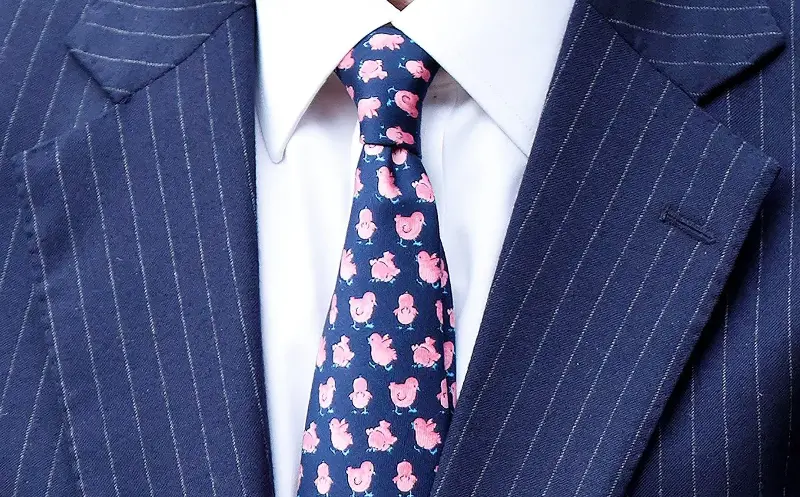
Older men should wear ties to look younger because they work like Spanx, an etiquette expert has said.
Men who are advancing in years should wear the neckwear because they conceal telltale signs of ageing such as puckering and sagging jowls.
Spanx, the popular form of figure-hugging underwear, “streamline bulges into tautness”, according to Mary Killen, the Gogglebox star and self-professed etiquette expert.
Writing in The Oldie, she said: “Male oldies, take particular note – the tie is also one of the best devices for knocking years off you.
“The tie should be pulled tight, right up to the Adam’s apple, hiding the top button.”
Ms Killen said that ties, unlike other forms of men’s accoutrements such as top hats, “have not yet been consigned to fuddy-duddy ignominy”.
The expert, who writes regularly on etiquette and appearance, said that the decline of the tie reflected a broader erosion of standards in public life.
She said that the tie was not merely decorative but central to the structure of classic menswear, helping to create balance, proportion and a sense of order in an outfit.
“Now is the time for oldie men to spearhead the revival of tie-wearing,” she said.
“Much has been made of the recent ‘slopification’ of culture.
“Slobification of our personal presentation goes hand in hand with the slopification of our brains.”
Some figures in British society are well-known for their neckwear choices, including Jon Snow, who has a penchant for colourful ties (and socks).
The former Channel 4 News presenter once launched an exhibition called Jon Snow: Colour is My Brand in the Design Museum, London, in 2017 showcasing his vibrant and varied necktie collection.
But Ms Killen pointed to another figure as the standard-bearer for tie-wearing grace, the novelist Tom Wolfe.
He was a model of sartorial discipline, she says, and famously wore a suit and tie at all times, partly, he said, to conceal what he called his “barber’s wattle”.
Ms Killen advised older men to pay attention not only to their ties but also to their collars and undershirts, warning that many continued wearing collar sizes that no longer fit their changing physiques as they age.
She said that a dry cleaner could discreetly shrink a collar with a small pleat at the back, helping improve the overall line of a shirt.
She singled out Hermès ties, first launched in 1949, as a benchmark of quality, though she suggested that vintage versions were superior to modern ones and increasingly sought after by collectors.
Ms Killen recommended sourcing second-hand ties online, where the finest examples can fetch hundreds of pounds.
As for knots, she advised men to opt for a half-Windsor, describing it as “always small and tightly bound; never symmetrical”.
She also encouraged the creation of a subtle dimple beneath the knot, which she said reflected light upwards and flattered the face.
Ms Killen urged older men to lead the revival of tie-wearing, arguing that even “smart casual” represented a departure from the golden ratios of menswear.
Quoting Hardy Amies, designer to Queen Elizabeth II, she said: “The way you dress is a mark of the respect in which you hold those people you are going to meet that day.”
“Ties languish in drawers,” she said. “Let them see the light of day.”