



Pelicans have been a fixture of St James’s Park since the reign of Charles II, when the Russian ambassador gave the King a pair of the birds.
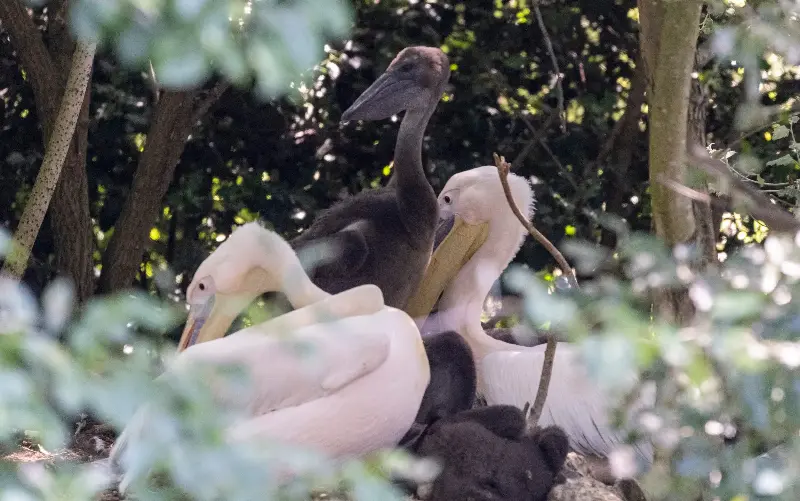
But for the first time in more than 360 years, the sound of pelican chicks has been heard in the Westminster park after four eggs hatched last month.
In the spring, the park’s six great white pelicans – called Isla, Tiffany, Gargi, Sun, Moon and Star – began displaying nesting behaviour, eating more fish and arriving in groups of three, suggesting they were taking turns to incubate eggs.
Then on Friday, the first pictures emerged of four dark, fuzzy chicks being shielded close to the water’s edge by a squadron of adult pelicans.
Mark Wasilewski, the park’s manager, said the arrival of the chicks was an “extraordinary moment”.
“Pelican chicks hatching in St James’s Park for the first time in over 360 years is an extraordinary moment – not just for the park, but for everyone who loves wildlife in London,” he told The Telegraph.
“None of us in the park thought we would ever witness this, and I cannot describe the excitement among the team when we discovered that eggs had been laid in April on the West Island of the park, and our nail-biting nervousness when we saw the first chick had hatched out.
“These four chicks represent something genuinely special – proof that our resident pelicans are truly thriving. We’re doing everything we can to give them the best possible start, and we can’t wait to watch them grow and take to the water alongside the rest of the flock.
“Our current squadron of six pelicans is the most mischievous that we have known for some time. The addition of four more will undoubtedly provide entertainment for our park visitors.”
The chicks are being protected in an area off limits to visitors. They are expected to take to the water and join the adult pelicans at around three months old.
The great white pelican has the second-largest wingspan of all living birds, stretching beyond 11ft, while adult males can weigh more than 32lb. The sociable birds are free to roam in the park and are fed daily on a diet of mackerel, herring and whiting, usually served at around 2.30pm.
They can mostly be found resting on their favourite rocks and catching fish near Duck Island, a wildlife sanctuary towards the eastern end of the park. One pelican was once known to fly over to London Zoo in Regent’s Park to steal fish for lunch.
Since their arrival in the Stuart era, more than 40 pelicans have lived in St James’s Park in varying numbers, the majority of whom have been of the great white variety.
The arrival of a pair of American brown pelicans in 1951 prompted the Daily Express to claim: “Next thing we’ll be having GIs on guard at Buckingham Palace.”
Over the years, the birds have never successfully reproduced, with their number periodically replenished by donations from Russia, the USA and the Czech Republic.
Previous attempts to breed them have proved fruitless – including a 1969 attempt by the park’s bird-keeper to build a nest himself – with experts suggesting that pelicans tend not to produce fertile eggs unless they are in flocks of 10 or more.
In the late 1970s, the park’s population dwindled to just one bird, nicknamed “Lady in the Lake”. However, they found a patron in Baron Campbell of Croy in the 1990s, who argued in Parliament for their protection.
Nowadays, all but one of the pelicans have their wings clipped to avoid them posing a danger to the public.
The safety precautions also help avoid further high-profile escapes. When two flew away in 1929, one was later seen in a tree in Chelmsford (some 30 miles away as the crow, or pelican, flies) where farmers were warned not to shoot it.
In his memoir Zoo Tails, Oliver Graham-Jones, a former senior vet at London Zoo in the 1960s, recalled how a pelican was once caught by a particularly strong side draught that blew it over Horse Guards Parade and across Whitehall.
The pelican allegedly crashed through a large set of windows in what was then the War Office building, interrupting a meeting of the foreign chiefs of staff.