



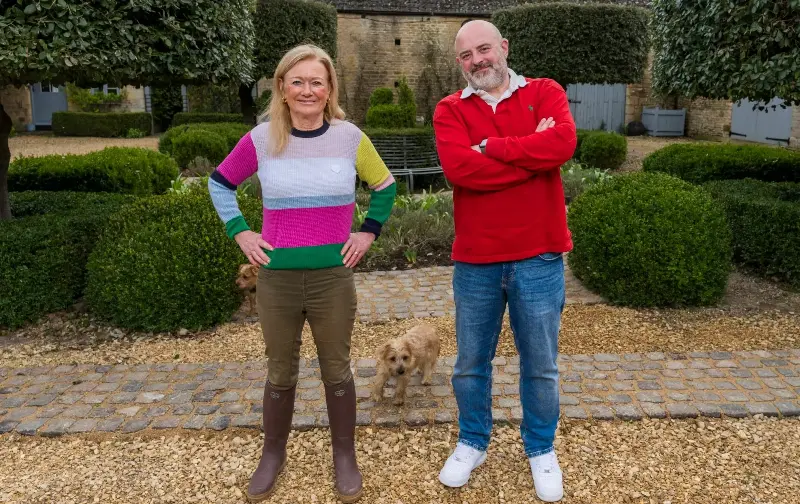
Motoring editor Tom Barnard and gardening writer Bunny Guinness have opposing views when it comes to this dilemma. Here are their arguments for and against turning front gardens into driveways. Let us know who you agree with in the comments section below.
‘Off-street parking will add thousands to the value of your house’
Tom Barnard
Times change. While most new-build houses need to have parking provision as part of the planning permission, those of us living in older properties are forced to adapt them for the modern way of life – and that means upgrading the scrappy patch of lawn outside your front door into somewhere to safely park your car.
The most obvious reason is convenience. No longer will you have to park several streets away on a rainy, dark night because there is no space outside your house. You can simply pull up mere feet from the door and unload the shopping – or your kids – safely on to your property.
It will free valuable spare time, too. While some people will love mowing the lawn and pruning the roses, it is a chore for most of us who prefer a BMW to a begonia or a Dacia to a daisy.
There are also good financial reasons for replacing plants with paving and mud with macadam. Off-street parking will add thousands to the value of your house – experts say it can increase the sale price by 10 per cent or more, depending on the location. In London or another large city, that could be a six-figure increase.
It will also save you money. Many councils charge for parking permits for on-street parking near your home, even for relatively modest models, while several have started to penalise those who own larger or big-engined cars. Islington council in north London, for example, charges £854.90 per year for cars with engines of 2,751cc and above, which includes a Volkswagen Golf R32, some BMW 1-Series models and sportier versions of the Audi TT.
Other local authorities such as Southampton and Slough will refuse to issue a permit at all for cars more than five metres long – that rules out a BMW 5-Series, Kia EV9 and Volvo EX90.
Then there’s the insurance. Tom Banks, motoring expert at Go.Compare, says: “Insurers will usually see parking on a private driveway as safer than leaving your car on the road overnight, where it’s more exposed to accidental scrapes and even theft. Generally speaking, there is a notable increase in premiums for people who park their car on the road.”
If you have an electric or plug-in hybrid car, the savings stack up even more. Parking next to your home means you can charge the car from your domestic power supply where overnight rates are about 8p per kWh compared with the 54p per kWh it costs for an on-street charge from the biggest provider, Shell Recharge. For an average-sized EV such as a Volkswagen ID.3 driving 8,500 miles per year, that’s a saving of £854 per year.
And what about the effect on the local environment? Modern permeable paving surfaces negate the risk of flooding, while having a gap in the parking on a street where there is an entrance to a drive will improve traffic flow on narrow roads, allowing drivers to pull in and let other cars pass.
All the time and money that will be saved by having a driveway could be spent with the family, perhaps enjoying time in the garden at the back of your house. That’s got to be better for us all.
‘There are many drawbacks to parking off-road immediately in front of your house’
Bunny Guinness
Car parking is often the most difficult element to accommodate in a garden design. The all-important impact on arrival is a bit of a disappointment if you have to pick your way through cars to reach the front door. In my view, most houses can have great kerb appeal with a cleverly designed entrance and front area (which hugely enhances the value), but not if its frontage is a car park.
Even people who spend hours in a gym seem to be addicted to having the car parked as close to their hallway as possible, surely we should all be encouraged to walk a few steps further each day? I recognise that street parking is becoming increasingly difficult with more than a third of households owning two cars or more and that safe parking close to your home is highly desirable.
There are many drawbacks to parking off-road immediately in front of your house. In a road near me, a suburban street that previously had hedges studded with small trees between the end of their front gardens and the pavement has now had the majority of the hedges and trees removed to allow multiple vehicular access to the front garden.
The visual appeal of the road has nose-dived, nearly all the trees and hedges have been grubbed up. The habitats for wildlife have correspondingly plummeted. I see why it has occurred. Residents there are charged for street parking if they have more than one car.
The majority of anxiety from paving over front drives is the increase in surface area of hard-standing that is impermeable to rain. The deluges of rain flow into the street and add to run-off, which increases the likelihood of flooding.
Using hard surfaces that are permeable is far preferable, while if you can incorporate flower borders and grass which are capable of absorbing large volumes of rain – all to the good. In the UK we are slowly realising that there are many types of paving, tarmac, setts, resin-bonded gravel and even unit paving slabs that are designed to be permeable. While working in Japan more than 25 years ago, my Japanese clients were amazed that I had not heard of permeable tarmac, which is ubiquitous there.
If you do have to park in your front garden, it is quite possible to have parking spaces designed so only certain parts for the wheels are paved (with a permeable paving or gravel and hopefully incorporating areas that can be planted).
Self-seeding plants that thrive in gravel (Verbascum Polar Sommer, Verbena bonariensis, Euphorbia myrsinetes and the like) can help keep the space interesting, softer and greener – and if the odd plant is trodden on/run over, another plant usually self seeds elsewhere to replace.
Then add a few small trees in baseless pots (no maintenance needed after the first few months) to get greenery at eye level, to help screen intruding looks from passers-by, to frame and flatter your home and of course provide extra housing for wildlife.
Please don’t simply spread a load of concrete but make sure your “front of house” looks its very best and does not exclude our native fauna that are becoming far more pressed for accommodation than we are.