



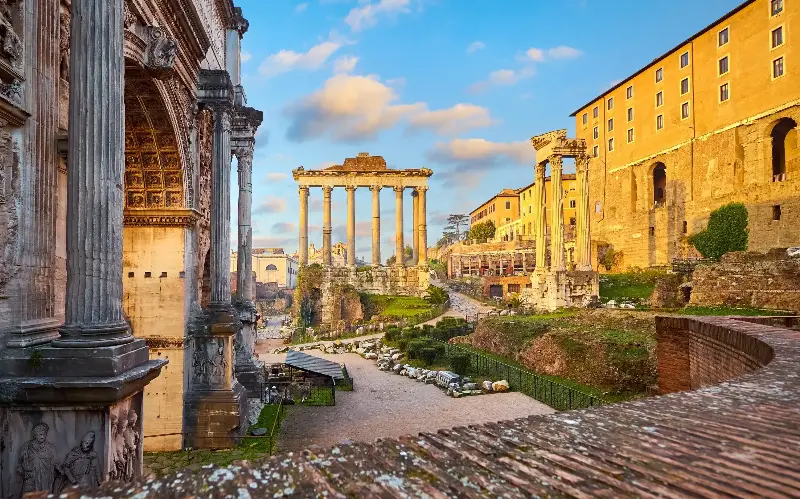
The challenge when visiting Rome is deciding what to skip: there are so many churches, archaeological sites, piazzas and paintings to see that a lifetime is hardly enough. Don’t try to cram too much in; Rome moves at a slower pace than many northern Italian cities, and to enjoy it you should take time out in pavement cafés as well as shuffle round the Sistine Chapel.
All our recommendations below have been hand-selected and tested by our resident destination expert to help you discover the best things to do in Rome. Find out more below, or for further inspiration, see our guides to the city’s best restaurants, hotels, nightlife and shopping.
Find activity by type:
- Best for ancient history
- Best religious sites
- Best for sightseeing
- Best for a slice of ‘la dolce vita’
- Best free attractions
- Best day trips
Best for ancient history
Colosseum
Get lost in the ancient world
Half circus, half sports arena, Rome’s most famous classical ruin is unmissable – especially now that they have extended the visitor route to the underfloor passageways through which gladiators and wild beasts made their entrances. The massive arena – officially called the Amphiteatrum Flavium – was inaugurated in AD 80, and seated well over 50,000 people.
Insider tip: The audio guides are worth investing in but check if yours functions before straying far from the rental kiosks; not all of them work.
Website: colosseo.it
Nearest metro: Colosseo
Price: ££
Ara Pacis
Admire the city’s ‘altar of peace’
Augustus marched home from three years of subjugating his formerly fractious empire in 13 BC, and the Senate promptly commissioned a monument. Four years later, the Ara Pacis was inaugurated: an ‘altar of peace’ within marble walls gloriously carved with friezes hailing the emperor, his family, and general prosperity.
Insider tip: Pieced together during the 20th century, it is now housed in a Richard Meier-designed museum.
Website: arapacis.it
Nearest metro: Flaminio
Price: £££
The Pantheon
Gaze at Rome’s best-preserved ancient building
It’s difficult to believe that the Pantheon, a temple to all the gods, has been standing here for almost 2,000 years; even the bronze doors are still intact. Hadrian built it on the site of an earlier temple, and it was completed in AD 125. It is the best-preserved ancient building in the city: its salvation was its conversion into a church in AD 608. The spectacular concrete dome has an open oculus and is a marvel of engineering that has inspired architects ever since.
Insider tip: The kings of united Italy are buried here, as is the artist Raphael.
Website: pantheonroma.com
Nearest metro: Spagna
Price: £
Le Domus Romane
Explore the remains of an ancient home
Beneath the council offices of the Province of Rome lies Le Domus Romane, a treat for anyone frustrated by the uncommunicative nature of many of the city’s ruins. The remains of a swanky home of a well-heeled Roman have been brought to life with a multimedia experience, transforming gloomy excavations into bright reproductions of a frescoed, peopled Roman dwelling, complete with indoor water features. The visit lasts 75 minutes, with a thorough but entertaining narration.
Insider tip: There are four English-language visits daily (check the website for times), and booking is recommended.
Website: palazzovalentini.it
Nearest metro: Colosseo
Price: ££
Super Pass
Take a deep dive into ancient history on the Palatine Hill
An acronym for Seven Unique Places to Experience in Rome, the Super Pass gives access to a clutch of ancient villas, temples, and other buildings that were previously closed to the public. Located on the Palatine Hill, the sites include the Criptoportico Neroniano, Aula Isiaca–Loggia Mattei, House of Augustus, House of Livia, Temple of Romulus, Santa Maria Antiqua, and Domus Transitoria, as well as the Palatine Museum.
Insider tip: Purchase a Full Experience ticket (Colosseum-Roman Forum-Palatine Hill-Super) that also includes entrance to the restricted arena floor inside the Colosseum online in advance.
Website: colosseo.it/en/area/the-palatine
Nearest metro: Colosseo
Price: ££
Forum and Palatine Hill
Stroll through the ancient city
Set in a small valley, the heart of the city hosted both the ancient Roman seat of government and the conurbation’s law courts, temples, monuments of triumph and shops. Above the Forum, the pretty Palatine Hill is where Romulus legendarily founded Rome, and where emperors such as Augustus built their palaces.
Insider tip: Entrance to the Forum and Palatine Hill also includes entrance to the Colosseum, valid the same day with one entrance to each site. Book online to minimise queuing, and try to go at either end of the day for fewer people.
Website: colosseo.it/en/area/the-roman-forum
Nearest metro: Colosseo
Price: ££
Baths of Caracalla
Tour an ancient thermal bath complex
It took rampaging Goths to close down the Baths of Caracalla, a massive thermal bath complex founded in AD 217 (they severed the water supply in AD 537). As well as two huge gyms, an open-air pool and rooms of varying temperatures, up to 1,500 ancient clients at a time could enjoy a library, shops and landscaped gardens. The towering ruins are extremely impressive today, though the sculptures that littered the place are now largely in Naples’ archaeological museum.
Insider tip: The summer season of the Rome Opera House is held here; it’s spectacularly floodlit on balmy evenings (see operaroma.it for programme).
Website: turismoroma.it/en/places/baths-caracalla
Nearest metro: Circo Massimo
Price: ££
The Appian Way
Tread the path of Roman soldiers
Since 312 BC, the Appian Way was the preferred route for moving troops southwards. It was also the well-off ancient Romans’ burial venue of choice. Few of the impressive mausoleums survive above ground, but make sure you see that of Cecilia Metella. Early Christians had less grand tombs, buried underground in many miles of catacombs. The largest complex is San Callisto, where nine popes and dozens of martyrs were among those laid to rest in 12 miles of tunnels.
Insider tip: Back above ground, the Appia Antica beyond Cecilia Metella is bucolic, and there’s a pleasant café at via Appia Antica 175 (appiaanticacaffe.it) that rents out bikes.
Website: catacombe.roma.it
Nearest metro: Circo Massimo
Price: ££
Best religious sites
The Vatican
Tackle the magnificent collections
This artistic treasure trove – one of the biggest museums in the world – can be rather overwhelming. The trick is to pick areas to visit and stick to them. As well as the holy grail of the Sistine Chapel, there’s plenty to enjoy along the way, from delightful frescoes by Pinturicchio and Raphael to striking classical statues such as the Laocoön and an Egyptian museum complete with mummies.
Insider tip: It’s well worth booking a timed slot online. Midweek late afternoons are the best times to go to minimise crowds. The museum is open and free for all visitors on the last Sunday of every month.
Website: museivaticani.va
Nearest metro: Ottaviano
Price: ££
Capuchin Church
Go underground to see monk skeletons
The creepy crypt beneath the Capuchin church has been spun into a Franciscan monk’s experience, complete with displays of the knotted whips of flagellating friars and cases of artefacts seized by missionaries. There’s also a St Francis canvas supposedly by Caravaggio, though it’s generally thought to be a copy.
Insider tip: Head straight for the main draw: the crypt where generations of monks’ bones are arranged artfully in patterns on walls and ceilings, and fashioned into macabre chandeliers. A jolly sign at the entrance reads ‘You will be what we now are’.
Website: museoecriptacappuccini.it
Nearest metro: Barberini
Price: ££
St Peter’s Basilica
Kiss the toes of St Peter
The largest church in Christendom, St Peter’s Basilica, was consecrated in 1626. A choral work by Bramante, Raphael, Michelangelo, Maderno and Bernini (among others), it replaced a classical basilica said to mark the burial place of Peter the Apostle. Bernini’s elliptical colonnaded piazza outside and his superb bronze baldachin over the main altar inside are scaled to fool your eye. In the first chapel on the right is Michelangelo’s moving Pietà. Closer to the altar, the toes of Arnolfo da Cambio’s bronze St Peter are worn shiny by pious kisses.
Insider tip: Note that a dress code is observed; no shoulders or knees on display.
Website: basilicasanpietro.va/en.html
Nearest metro: Ottaviano
Price: Free
San Clemente
Follow an ancient sewer under a church
San Clemente is one of Rome’s most worthwhile but least publicised sightseeing treats. The site descends through layers of history, from a street-level medieval and early-Renaissance church, with frescoes by Masolino, via a fourth-century early Christian church to the basement remains of a second-century insula (apartment block), complete with a shrine to the ancient god, Mithras.
Insider tip: When down here, listen for the sound of running water: an ancient sewer passes close by before dumping its contents in the Tiber.
Website: basilicasanclemente.com
Nearest metro: Colosseo
Price: £
The church of Santa Maria della Vittoria
Discover a fascinating sculptural scene
The main draw of Gian Lorenzo Bernini’s Santa Maria della Vittoria is a side chapel portraying The Ecstasy of St Teresa. The whole sculptural scene, executed in the mid-17th century, is pure theatre. In high-relief boxes to each side of the chapel, members of the Cornaro family, who commissioned the work, chat idly, barely watching the action. Meanwhile, above the altar, the saint swoons in all too carnal ecstasy, her drapery piled elegantly about her, bathed in divine light from a hidden window as a mischievous angel prepares to prick her with his arrow.
Insider tip: There are also artworks by Guercino, Nicolas Lorrain and Domenichino in the church.
Website: turismoroma.it
Nearest metro: Repubblica or Barberini
Price: Free
San Carlo alle Quattro Fontane
Admire dizzying architecture
What an architectural marvel the tiny church of San Carlo alle Quattro Fontane is. Enter this ingenious little place, created by baroque maverick Francesco Borromini, and you’d hardly guess that the whole footprint was the size of one of the pilasters of St Peter’s (this is why locals refer to it affectionately as San Carlino – “Little Saint Charles”). The tortured architect twisted lines and space to such an extent that volumes seem to appear out of nowhere in this oval creation, lit beautifully by high windows.
Insider tip: There’s a crypt below the church, and a tiny courtyard with perfectly proportioned Corinthian columns.
Website: sancarlino.ch
Nearest metro: Barberini
Price: Free
Sant’Agnese in Agone
Sneak a peek at the skull of a martyr
Rome often feels like one magnificent theatre, and nowhere is this truer than in Piazza Navona. The piazza takes its long shape from the ancient stadium upon which it was built. Amid the tourist tat are three fountains, the most impressive of which is Bernini’s central fountain of Four Rivers, with dramatic representations of the Ganges, Nile (head covered, because its source was unknown), Danube and Rio de la Plata. St Agnes is said to have been martyred here; her tiny skull resides in the chapel at the back of the Borromini-designed church dedicated to her.
Insider tip: You can book a guided tour to hear more in-depth history of the church.
Website: santagneseinagone.org
Nearest metro: Spagna
Price: Free
Best for sightseeing
Trevi Fountain
Make a wish
Niccolò Salvi’s gloriously exuberant Trevi Fountain was completed in 1732. It marks the end of the ancient Aqua Vergine aqueduct that carries water from the spring of the same name in the hills outside Rome. Legend has it that a pure young girl showed Agrippa the source of the spring, hence the aqueduct’s name. There’s always a crowd here, day and night, usually under the wary eye of cops who make sure nobody tries to imitate Anita Ekberg and Marcello Mastroianni’s fully-clad wade through the waters in Fellini’s La Dolce Vita.
Insider tip: Go very early or very late to minimise the throng.
Website: turismoroma.it
Nearest metro: Spagna
Price: £
Vespa tours
Zip through secret alleys
What could be more Roman than zipping around the Colosseum on the back of a Vespa? A great way to see sights away from the centre of town, which can be tricky to get to otherwise. In a half-day private tour, you’ll see a great deal with the friendly folk at Scooteroma. Choose a classic itinerary to take in the city’s highlights or a themed tour to focus on anything from food to street art.
Insider tip: Save yourself the stress of Roman traffic and be driven in convoy by the experts; this option means you can also arrange to be picked up wherever suits you.
Website: scooteroma.com
Price: £££
Piazza Pia
Admire a whole new pedestrian hub
Behold the newly reconfigured Piazza Pia, one of the key projects completed for the 2025 Jubilee, connecting Castel Sant’Angelo and St. Peter’s Square. What was previously a traffic-clogged thoroughfare will now be a central hub for pedestrians connecting some of the most iconic sites in Rome. With 200 new trees freshly planted and the installation of benches, this is an ideal spot for tourists to pause, relax and reflect.
Insider tip: Take a leisurely stroll along the Tiber, seeing the city from a whole new perspective.
Nearest metro: Ottaviano
Price: Free
Private tours
Roam the ruins with an expert historian
Taking a tour with a private guide can bring ruins to life or help you to skilfully negotiate intriguing backstreets, nipping into bucolic courtyards and pretty churches you wouldn’t know were there. Even a visit to the notoriously crowded Vatican Museums can become an entertaining breeze. Agnes Crawford, a transplanted Brit with a master’s degree from Edinburgh in architectural history, has been leading tours in Rome since 2001. She and her expert archaeologist colleagues specialise in personalised tours.
Insider tip: Mention any special interests when booking and your itinerary will be tailored to suit. A trip to Ostia Antica is always a hit with children.
Website: understandingrome.com
Price: £££
Best for art
Galleria Borghese
Visit one of the world’s finest art galleries
The Galleria Borghese was built within the Borghese Gardens in the early 17th century by Cardinal Scipione Borghese to house his collection of art, both ancient and modern. Downstairs sees sculpture jostle alongside some of Bernini’s greatest works (don’t miss Apollo and Daphne), and there is a gaggle of Caravaggios in Room VIII. The picture gallery upstairs is crammed with a veritable catalogue of Italian painting: Raphael, Titian and much more.
Insider tip: Visits have to be booked in advance via the website or phone, and run on two-hour timeslots – though if you turn up at a quiet time of year, there may still be spaces that same day.
Website: galleriaborghese.beniculturali.it
Nearest metro: Spagna
Price: £££
Galleria Doria-Pamphilj
Marvel at the artwork in this lavish family home
The art collection of the Doria-Pamphilj family is truly magnificent, as is the family’s palazzo, where works are displayed according to a 1760 inventory. Artistic highlights include the striking portraits of the Pamphilj pontiff Innocent X by both Velázquez and Bernini, as well as masterpieces by Caravaggio, Titian and Raphael.
Insider tip: The chatty audio guide narrated by half-British Prince Jonathan Doria-Pamphilj is included in the ticket price.
Website: doriapamphilj.it
Nearest metro: Spagna
Price: £££
Palazzo Altemps
Immerse yourself in ancient Roman sculpture
Powerful Roman families in the 16th and 17th centuries prided themselves on their collections of classical statuary, and they had no qualms about bringing in a sculptor of their own to replace missing arms and noses. Hence many of the remarkable ancient statues displayed in Palazzo Altemps’ gallery of collections from four dynasties look surprisingly intact. There’s an Ares patched up by Bernini, and an Athena returned to her full glory by Alessandro Algardi.
Insider tip: The building itself is also splendid; look out for the cherubs in the Chapel. Entrance to Crypta Balbi, Palazzo Massimo and the Baths of Diocletian is included.
Website: museonazionaleromano.beniculturali.it/palazzo-altemps
Nearest metro: Flaminio
Price: ££
Palazzo Massimo alle Terme
Browse a lesser-known palazzo museum
The Palazzo Massimo alle Terme is a 19th-century palazzo that houses another of Rome’s superlative collections of classical art. Masterpieces on the ground and first floors include Augustus as high priest, a discus thrower and a Greek bronze boxer, and a super collection of Imperial portraits. But it is the second-floor reconstructions of rooms from luxurious ancient houses, complete with brightly-coloured wall decoration, that are this museum’s real high point.
Insider tip: Make a beeline for the painted leafy, plant-and-bird-filled triclinium (dining room) from Livia’s villa north of Rome. The ticket includes entrance to Crypta Balbi, Palazzo Altemps and the Baths of Diocletian.
Website: museonazionaleromano.beniculturali.it/palazzo-massimo
Nearest metro: Termini or Repubblica
Price: ££
Villa Farnesina
Wander through an opulent pleasure villa
Agostino Chigi, banker to Pope Julius II, threw the wildest parties of the early 16th century in this pleasure villa on the banks of the Tiber. He commissioned Raphael to fresco the place with classical scenes. The artist and his students carried out his designs to the letter, most impressively in the Loggia of Psyche, where the garlands of fruit and flowers include species that had only recently arrived from the New World.
Insider tip: In the upstairs salon, look out for graffiti left by soldiers during the Sack of Rome on the painted view of 16th-century Trastevere.
Website: villafarnesina.it
Nearest metro: Colosseo
Price: £
National Etruscan Museum
Discover the lost secrets of Etruscan history
When the Romans vanquished the cultivated Etruscans of central Italy, they worked hard to expunge their memory. This intriguing culture finds an eloquent voice via the glorious artefacts of the National Etruscan Museum. The life-sized husband and wife reclining on the lid of their sarcophagus look distinctly clubbable, and the statue of Apollo from the temple at Portonaccio is a movingly lifelike masterpiece.
Insider tip: The museum is housed in a beautiful 16th-century villa built for Pope Julius III, partly by Michelangelo. Look out for the pretty sunken nympheum at the end of the courtyard.
Website: museoetru.it
Nearest metro: Circo Massimo
Price: ££
Capitoline Museums
Visit the oldest public museum
This is the world’s oldest public museum, dating back to a 1471 donation to the people of Rome by Pope Sixtus IV. Its gems, now spread through two palazzi on Michelangelo’s Piazza del Campidoglio, include Rome’s emblem of the bronze she-wolf, Bernini’s remarkable statue of Pope Urban VIII, and a picture gallery with paintings by Caravaggio, Tintoretto, Titian and others.
Insider tip: Look for the second century AD equestrian statue of Marcus Aurelius (the one in the piazza outside is a copy).
Website: museicapitolini.org
Nearest metro: Colosseo
Price: ££
Museum of 21st Century Arts (MAXXI)
Immerse yourself in the city’s edgiest modern art
Contained in a daring piece of contemporary architecture in the hip Flaminio district, the Museum of 21st Century Arts (MAXXI) was designed by “archistar” Zaha Hadid. The contents of MAXXI don’t always live up to its eye-catching exterior, but although the permanent art collection (free entry Tuesday-Friday) is not the world’s most exciting, MAXXI stages very good exhibitions and retrospectives, especially on architectural themes.
Insider tip: The piazza outside is well-used by locals, and a jolly spot for a coffee. Right behind the museum, you’ll find Neve di Latte, one of Rome’s truly great new generation ice-cream shops.
Website: maxxi.art
Nearest metro: Flaminio
Price: ££
Centrale Montemartini
Browse ancient art in an erstwhile power station
One of the most unlikely – and arguably more satisfying – venues in Rome’s panoply of ancient offerings, this decommissioned power station has had its huge turbines, boilers and cogs polished up to provide a dramatic backdrop for choice pieces from the Capitoline Museums’ storerooms. What counts as a “minor” ancient artwork or architectural decoration in Rome, of course, would be a major centrepiece elsewhere; the dreamy muse Polymnia and a towering statue of the goddess Fortuna are cases in point.
Insider tip: Joint tickets cover both the Centrale and the Capitoline Museums. Go to the museum’s website for updates on children’s activities and the occasional jazz concert.
Website: centralemontemartini.org
Nearest metro: Circo Massimo
Price: £
Best for a slice of ‘la dolce vita’
Trastevere
Wander pretty cobbled streets
You have to hand it to the Trastevere (pronounced ‘trast-everay’) district. Despite the contradiction of both containing some of the city’s priciest real estate and being overrun by tourists during the day and rowdy, hard-drinking Anglo-American college students at night, it still manages to exude a very special rough-edged charm. Being unthinkably picturesque helps, of course, as does having umpteen tempting cafés and bars.
Insider tip: To do Trastevere justice it’s worth popping into a handful of wonderful churches: Santa Maria in Trastevere, Santa Cecilia and San Francesco a Ripa are the most interesting.
Nearest metro: Piramide (or via Tram Line 8)
Aventine Hill
Have a picnic with a view
To be plebeian in Roman times simply meant you were not born into the ruling class. Many plebs were very rich – and the leafy Aventine Hill was their district of choice, a safe and salubrious distance from the rough-and-tumble river port down below. Pretty Parco Savelli, with its great views over the city, is a perfect venue for a sunset picnic with a good bottle of wine.
Insider tip: Nearby, peek through the famous keyhole of the Knights of Malta in Piazza Cavalieri di Malta for a magical view.
Nearest metro: Circo Massimo
Acqua Madre
Relax in a Roman bathhouse
Head for Acqua Madre hammam – this urban spa in an unassuming street in the former Jewish Ghetto is a (literal) dive into the past. The brick-vaulted rooms chart the same journey from tepidarium to calidarium to steam rooms and back again that the ancients were following two millennia ago, making this the closest thing in the city to a truly Roman thermal experience.
Insider tip: A wide range of massage options are available, some of which use fanghi (mineral-rich mud) and salts from the Dead Sea.
Website: acquamadre.it
Nearest metro: Colosseo
Price: ££
Best free attractions
Spanish Steps
Climb the famous steps
The celebrated Spanish Steps are named for their proximity to the Spanish Embassy, though building funds were French and the architect was Italian. The official name, Scalinata di Trinità dei Monti (that’s the French church at the top), must have proved too much for the Grand-Touring Brits who made this area their own in the 18th and 19th centuries. The charming boat fountain at the bottom is by Pietro Bernini, father of the more famous Gianlorenzo.
Insider tip: John Keats died at number 26 in a house that’s now an atmospheric museum.
Nearest metro: Spagna
Basilica of Santa Maria Sopra Minerva
Spy a secret Michelangelo masterpiece
Just around the corner from the bustling (and no longer free) Pantheon, the spectacular gothic Basilica of Santa Maria Sopra Minerva is home to an under-the-radar treasure: Michelangelo’s Risen Christ. Originally portrayed completely nude (the prudish bronze loincloth he now sports is a later addition), this understated figure is less theatrical than other Michelangelo masterpieces but its impeccable stance is just further proof of the artist’s unparalleled mastery of contrapposto forms.
Insider tip: Before you leave, take a moment to admire Filippino Lippi’s remarkable 15th-century fresco cycle decorating the Carafa Chapel.
Website: santamariasopraminerva.it
Nearest metro: Barberini
Altare della Patria
Marvel at the Vittoriano monument
The bombastic Vittoriano monument, Altare della Patria, is nationalist pomp at its most grandiloquent – an oversized monument to pint-sized monarch Vittorio Emanuele II, the first king of united Italy. A picturesque quarter of medieval houses on Roman foundations was razed to make room for what is known as “the wedding cake”. Work began in 1885 but proceeded at a snail’s pace and didn’t end until 1925. An unknown soldier was buried here in 1921, and still has a regularly rotated guard of honour.
Insider tip: From halfway up the monument, a lift shoots up to the roof, from which there are breathtaking views; but if you want to go to the top, you’ll need to pay €10 (£8.60) for the lift.
Website: vive.cultura.gov.it/en
Nearest metro: Colosseo
Explore the Jewish Ghetto
Connect with Rome’s Jewish history
The Jewish Ghetto was officially abolished in 1882, but this storied neighbourhood remains the focal point of the city’s Jewish community, the oldest in Europe. Despite its unfortunate history, “il ghetto” is one of the most picturesque quarters of central Rome, its narrow lanes lined with kosher restaurants, markets and butchers, as well as the ancient ruins of the Portico d’Ottavia and Teatro di Marcello.
Insider tip: For a deep dive into Roman Jewish culture, splurge on a ticket to the Jewish Museum of Rome and adjacent synagogue, which includes an audio guide and entrance to the 19th-century Great Synagogue.
Nearest metro: Colosseo
Gianicolo
Scale a steep hill to be rewarded with standout views
The Gianicolo (Janiculum) is not one of Rome’s famous seven hills, but it still dominates them all. With the height comes a view – a breathtaking panorama of all of Rome, fantastic in the day and even better at sunset. If you’re there at midday, you’ll hear a cannon being fired at the stroke of 12. A good viewpoint is the terrace by the grandiose Fontana Paola, just above the church of San Pietro in Montorio.
Insider tip: A courtyard next to this church is home to Renaissance architect Donato Bramante’s tiny 1502 church, the Tempietto (open Tues-Sun, 10am-6pm) – a miniature masterpiece accessible without charge through the Spanish Royal Academy.
Nearest metro: Ottaviano
Street art
Check out the city’s vibrant murals
Rome’s street art movement has reached critical mass, with a number of local muralists and stencil artists breaking out on the international scene. These politically and socially charged masterpieces decorating the city are, by definition, free and accessible to the public. The highest concentration of works is in the western neighbourhoods of San Lorenzo and Pigneto, and there is also some in Ostiense to the south.
Insider tip: Street art in Rome is in a constant state of flux, as works are continuously created and destroyed. Though no accurate, up-to-date maps are available, this map published by the city’s Mu.Ro street art museum is a good place to start.
Nearest metro: Pigneto; Roma Termini
Best day trips
Ostia Antica
Enjoy ruins without the crowds
Often deserted, Ostia Antica is ancient Rome’s impressively preserved port, once a buzzing town in its own right. The Med is two miles away and the river has now changed its course, but for well over 600 years, Ostia buzzed with maritime trade from the far reaches of the empire. Look out for the ancient bar-restaurant, with the day’s menu still frescoed on the walls.
Insider tip: Get there via a 30-minute hop-on commuter train from Piramide (it’s a short walk from Ostia Antica station). The ancient theatre is still used for plays and concerts during the summer: see its website for up to date infomation.
Website: ostianticateatro.it
Price: ££
Giardino di Ninfa
Escape to an Italian garden
One of Italy’s most beautiful gardens, Giardino di Ninfa was laid out between the 1920s and the 1960s by the Anglo-Italian Caetani family on the site of an abandoned medieval village 37 miles south of Rome. The name comes from the nymphaeum on the site, referred to by Pliny the Younger.
Insider tip: If you don’t have a car, take the train to Latina (on the main Naples line) and then a taxi. It is only open about 30 days a year, mostly over weekends and public holidays, check website for details. Booking is essential.
Website: frcaetani.it/portfolio/giardino-di-ninfa
Price: ££
How we choose
Every attraction and activity in this curated list has been tried and tested by our destination expert to provide you with their insider perspective. We cover a range of budgets and styles – from world-class museums to family-friendly theme parks – to best suit every type of traveller. We update this list regularly to keep up with the latest openings and provide up-to-date recommendations.
About our expert
Rebecca Winke
Rebecca Winke’s first visit to Rome was a coup de foudre, and her affection for the Eternal City has only grown over 25 years of living in Italy. She has mastered the art of navigating the city’s sampietrini cobblestones in heels but has yet to come away from a plate of bucatini all’amatriciana with an unsullied blouse.