



It’s quite a few years since I took my then nine-year-old son, Christian, to South Africa’s Madikwe Game Reserve, but he still recalls it as one of the most thrilling trips of his childhood. Even as I was checking us in to Jaci’s Camp, he was running in to tell me: “You’re never going to believe this but…” as he reported on brilliant crimson-breasted shrikes hopping through the gardens, vervet monkeys lounging in the trees and the meerkats who ran up to him, seemingly as fascinated by this small person as he was by them.
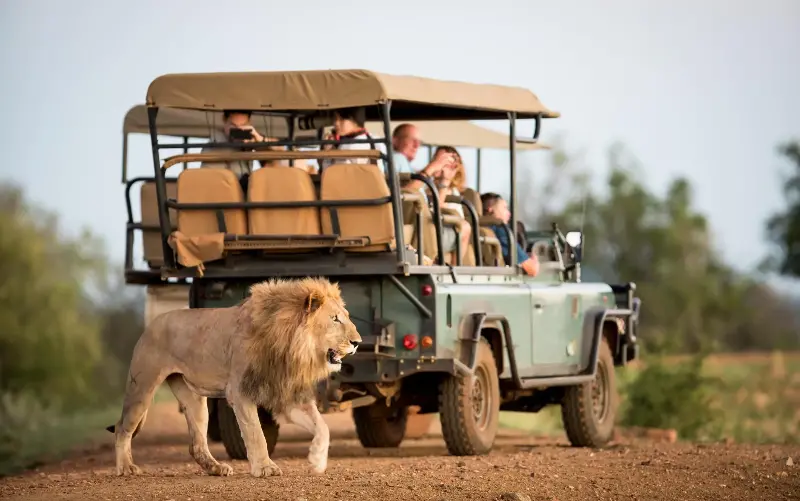
The bush is, of course, a world away from a UK city and the sense of freedom is palpable. There are constant new experiences: baboons spend their afternoons chattering noisily on your roof; on cold winter nights, a hot water bottle nestles in your mosquito-netted bed; sitting under the stars around the boma fire, people sing, dance, tell stories; you come home from your morning drive to shower outdoors in water heated by the African sun. And, most importantly, you ride in open-sided safari vehicles that take you within feet of some of the world’s most extraordinary creatures – a matter of pure amazement for a child.
On that Madikwe trip, we found ourselves one evening with a group of nine lionesses preparing for the hunt. Two of them squabbled and growled over a piece of antelope skin, the matriarch chased off a lone juvenile male and they paced around our Land Rover in the twilight, close enough to touch. If you’re looking to make memories, it doesn’t come much better than this.
An ideal adventure
I’d chosen Madikwe because it’s up in the high Transvaal where the anopheles (malaria-bearing) mosquito can’t survive, meaning that preventative medication isn’t needed. The Madikwe is not alone in this. Chris McIntyre, the managing director of Expert Africa, points out: “There are a number of other places, such as Namibia and the Eastern Cape, where the mosquitoes don’t carry malaria – though there are mosquitoes pretty much everywhere, so you do always need to spray.”
Chris and his wife, Susie, who was born in Zambia, have been taking their children on safari since they were babies. Susie believes that children often find small things to be the most exciting. “Especially when they’re younger, they like to see things up close,” she says. “While adults may spend half an hour looking at a distant endangered species through their binoculars, children are fascinated by a tortoise crossing the road.”
Another consideration for children is the rhythm of the day. Safari drives take place when the animals are at their most active – early in the morning and in the late afternoon and evening. There is, then, a long gap in the middle of the day when adults are happy to have a snooze or read a book by the pool. The lodge staff here come into their own. “They are always super child-friendly,” says Susie. “The kids are usually happy to get away from you and bake in the kitchen with the chef or go with the guide when he takes the safari vehicle for a spot of maintenance.
“You do have to be sure to pick a lodge that is genuinely family-friendly. This doesn’t mean one where a full-time nanny whisks your child away, but somewhere with family rooms and a vehicle and guide of your own, so you don’t have to have a really early start and you can move at a slower pace, stopping whenever you want so your guide can answer all the children’s inevitable questions.”
Finding a family-friendly lodge
For many in the safari world, the passion for Africa and its animals is bred in the bone. Adrian Gardiner pioneered rewilding in South Africa’s malaria-free Eastern Cape, where he set up Founders Lodge by Mantis and travelled across the country in an old refurbished railway carriage with his family, his dogs and a parrot.
Adrian is now 83, and his Founders Lodge sits on its own 400 hectares run by his son Paul, who pretty much grew up on safari. He agrees that safaris for families are about more than bouncing around in a jeep, however, so while the adults are enjoying siesta time, the lodge offers children something very different.
“We have Africa’s only Bear Grylls Survival Academy where they learn real outdoor skills in a safe environment. There are two swimming pools, too, which are a huge hit in the summer when temperatures reach 30C and higher. The railway carriage is still here, about a kilometre from the main lodge, with its own swimming pool and three bedrooms. We recommend it as a grand finale and spending a night out there is a big adventure for families – deeply atmospheric and genuinely memorable.”
Family connections are equally strong for Calvin Cottar and it was, perhaps, inevitable that he would become an expert in family safaris. “With four generations of Cottars involved in safaris before me, how could I not?” he asks. At his 1920s Camp in the private Olderkesi Conservancy, he welcomes children of all ages.
“It’s the chance for them to reconnect with their ancestral home – Africa,” he says. “Every day is your own here. You have your own vehicle and we tailor the day to suit you – so you don’t have to get up at five for the 6am safari. Children need variety, so beyond the wildlife drives, we offer walking and foraging safaris, Maasai beading and warrior school, stargazing, cooking pizzas in vintage safari trunks and even canvas bush bubble baths. Different ages are interested in different things. For teens we have a new Tracks for Tomorrow safari, while we have a special safari experience for younger children – Mara Minibeast Entomology.”
How young is too young?
Safaris can get under children’s skin early and, while the conventional wisdom is that the earliest age for safari is around eight, Anita Powell of Lewa Wilderness begs to differ. “[My daughter] Ella was two when she first went. It sounds too young but it was amazing, and the older two who were five and seven loved every moment. Young children have to burn off energy, so you need to be out of the vehicle a lot. We’ve ridden horses among giraffes with their six-day-old babies and zebras with five-week-old foals – the horses graze with them all so the wild animals are used to them and took no notice of us at all.”
And while the animals will, of course, amaze and delight children, they’re not the only draw. “Kids are naturally curious about people and other cultures so they love learning from the guides. Sitting on top of a vehicle being driven by a Maasai warrior with an enormous headdress is not something you forget easily.”
Even with plenty of activity, though, how long is the ideal safari holiday? Liddy Pleasants, founder of Stubborn Mule, feels that you have to go beyond the safari itself. “We find families prefer to have a few days in the bush but mix it up with some time in Cape Town or the Victoria Falls.
“For my 50th birthday, I went with a group of friends and their families to Kenya. We had some time in vehicles, went fishing and on camel rides and slept one night in a tree house. Variety is everything, especially with kids. There was even time for a few days on the beach at the end.”