



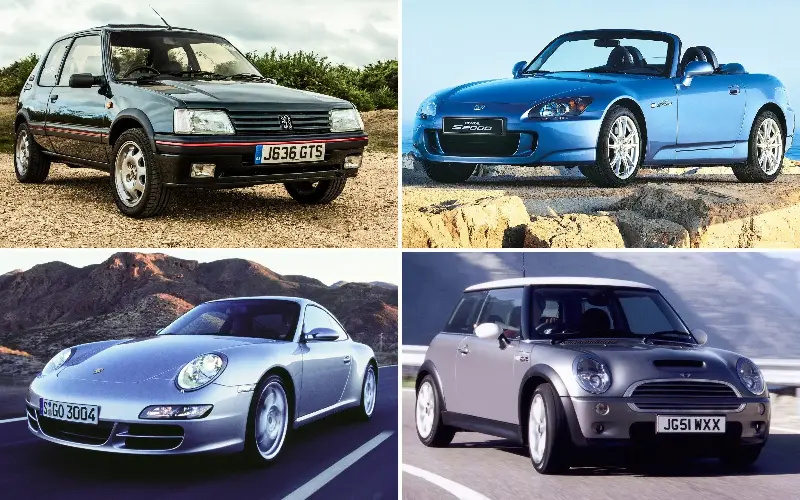
Life is too short to drive a boring car. As new cars become ever more homogeneous, a compelling antidote is to hand; there has never been a better time to add something interesting to your driveway, by taking on a brilliant “modern classic” car.
Not so long ago, owning a classic equated to 15 minutes of driving pleasure and three hours of sitting by the roadside waiting for the breakdown service. But modern classics offer a more risk-free path to motoring enjoyment, delivering more smiles per hour then the average new build, but far less pain than the post-war tweed and wire-wheel genre.
What defines a modern classic? Fundamentally they are interesting or significant cars, made from the 1980s onwards, that left a market or cultural footprint in some way. They tend to be from marques with a rich motoring provenance, so more likely Mercedes, BMW or Jaguar than Kia, BYD or Genesis.
Driving pleasure
Above all, modern classics are brilliant driving machines, designed with character and flair. They move you emotionally in the way they drive, look and feel.
Some were deemed classic almost from birth, such was their impact. Hot hatchbacks like the Volkswagen Golf GTI and Peugeot 205 GTi were early poster boys, with values often exceeding £20,000 for prime examples today. Rapid saloons such the BMW M3 or the brutal Sierra RS Cosworth followed suit, with values hurtling well beyond £50,000.
Most, however, have matured into classic status as time and perspective have added to their appeal. A generational shift has kicked in – those of us in our 40s and 50s lusted after a different breed of cars in our teens and these icons are more aspirational with the passing of time.
According to Sam Dawson, content editor of Classic Cars magazine, these connections run deep. “Nostalgia is very powerful; we were brought up with a different pool of cars and these same cars are now much more affordable – so you can literally buy the car of your childhood dreams.”
Star quality
Add a touch of showbiz sparkle and you have the makings of a bona fide classic. Remember Princess Diana in her Mercedes 500SL? Or DCI Gene Hunt’s Audi quattro in Ashes to Ashes, crime-fighter Luther’s Saab and even Lady Jane’s Range Rover in Lovejoy? A little stardust can go a long way.
These cars are not flawed, romantic flights of fancy, however. They represent a certain kind of sweet spot in car buying – all the character and thrills of driving a classic, but with benefits of modern motoring: reliable, largely rust-repellent and very safe; expect anti-lock brakes, crumple zones and even airbags.
At the heart of the appeal is a sensory driving experience, compared with the clinical whoosh and hover of modern electrified drivetrains. Power delivery is organic and engaging rather than blandly uniform and the handling rewards skill and judgment rather than punishing it.
As Dawson puts it: “A modern classic is analogue in the way you interface with it.You have to concentrate on driving it so there is a simplicity to the way you enjoy it.”
Electric vehicles deliver instant torque but it is often delivered in a slightly sterile fashion – like a food blender with more power. Drive an 1980s Renault 5 Turbo, a 1990s Bentley Continental Turbo R or a BMW M3 from the 2000s and you won’t stop talking about the experience for days.
Innovative designs
Not that it’s all about horsepower. The early Renault Espace, Land Rover Freelander and Citroën BX are all quirky and innovative designs, and all have passionate cult followings.
Simply sitting inside a modern classic is an experience. Tactile switchgear and unique dashboard layouts engage rather than confuse. If you want to operate the windows you press the button that says windows. If you want to turn on the radio you press the button… on the radio. New cars, by comparison, have touchscreens on wheels, requiring a degree in programming to adjust the air-conditioning.
In some ways Rolling Stones drummer Charlie Watts had it right on cars – he couldn’t drive but nonetheless collected them to look at and sit in. I doubt Watts owned a modern classic, but I have been known to sit in my 1991 Mercedes and just stare at the radio cassette player, a far preferable mental health fillip to a mindful YouTube video with piped-in whale music.
All this, of course, without the nannying arsenal of warning messages and correctional driving aids that blight the modern driving experience. Big Brother is definitely not watching you – he’s living his best life in a soft-top Saab instead.
Appreciating assets
There are financial incentives to owning these cars. Buy right and you have an asset that will appreciate steadily over time. Once your car hits its 40th birthday it will also be vehicle tax-exempt, with official classic status in the eyes of the DVLA and HMRC.
When it comes to buying, there are a few rules. Take your time and do your research in the classified adverts, on websites and in dealerships. If the car is not destined to be your daily driver you can afford to be picky. Condition trumps age and mileage: a well-kept higher mileage car will prove more reliable than a newer, lower mileage victim of neglect. Walk away if the service history is patchy and buy the owner as much as the car – follow your gut feel about the person selling it.
On a practical level, ownership shouldn’t be a source of anxiety. Most of these marques and indeed models have owners’ clubs that are well worth joining and the British Isles enjoys a network of brilliant specialist independent garages to keep things rolling.
So, carpe diem. Take the plunge and add some sparkle to your driveway. You won’t regret it.
11 modern classics to buy now
Audi TT Mk1 (1998-2006)
Price: £5,000-£10,000
Bauhaus-chic never looked so good. Go for a first-generation coupé. In silver.
Jaguar XK8 (1996-2006)
Price: £5,000-£15,000
Retro styling and V8 power – a classic Jaguar for a third of the price of a new Kia Sportage.
Peugeot 205 GTi 1.6 (1984-1992)
Price: £10,000-£20,000
One of the best-looking, best-driving cars of the 1980s. The faster 1.9-litre version is more prized – and a lot more expensive.
Porsche 911 Carrera 996 (1998-2006)
Price: £15,000-£25,000
The most affordable end of 911 ownership (purists prefer other variants). But, as they say, a 996-series 911 is better than no 911…
Mercedes 500 SL R129 (1989-2001)
Price: £10,000-£20,000
Bulletproof, stylish cruiser representing the peak of Mercedes’ over-engineering.
Citroën BX (1982-1994)
Price: £5,000-£10,000
Pure 1980s modernism; good ones are super-rare, especially the swift GTi version.
Volkswagen Golf GTI Edition 30 (2006-2008)
Price: £5,000-£15,000
The accomplished Mk5 Golf is undervalued and plentiful; these limited editions have lots of charm.
Honda S2000 (1999-2009)
Price: £10,000-£20,000)
A real driver’s car with a spectacular, high-revving four-cylinder engine. Far less common than the Mazda MX-5.
BMW M3 E46 (2000-2006)
Price: £20,000-£35,000
Values of the older generation E30 M3 have rocketed – expect the same for this visceral thrill, featuring one of the all-time great straight-six engines.
Volvo 850 T5-R Estate (1994-1995)
Price: £10,000-£20,000
The car that turned Volvo around; they even went racing in it. Be brave and go for the custard-yellow paint option.
Mini Cooper S R53 (2001-2006)
Price: £4,000-£10,000
Brilliant reimagining of the Mini concept by BMW; quirky and fun to drive – much like the original, but with a supercharger.