



“Was that a jackal?” said my Samos Outdoors guide, Giorgos, as a fleet-footed whirl of ginger fur whizzed across our path. I assumed he was joking, until he explained that Samos is home to one of Europe’s few island populations of this elusive omnivore. “They say there are more than 300. It’s a jungle out there,” he smiled, gesturing to the dense forest on either side of the road. “Up until the 19th century, we even had leopards.”
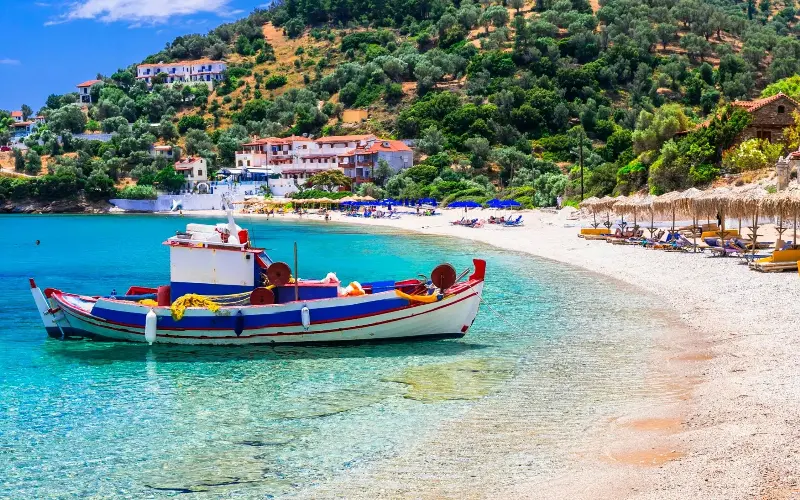
Covered almost entirely by forest, and surrounded by seas the colour of a peacock’s feathers, Andorra-sized Samos certainly seems as exotic as any tropical isle. It is renowned for its high biodiversity, and more than two-thirds of the island is mountainous. As we screeched around hairpin bends on narrow roads, we saw towering pine trees, green oaks, and silver-leaved olive groves. “We’re mountain people surrounded by water,” Giorgos told me. “We don’t even eat much seafood.”
Some 350km from Athens, but only a couple of kilometres from the Turkish coast, this northern Aegean island – which sits at a crossroads between Europe, Asia and Africa – was the birthplace of several of the world’s most celebrated ancient philosophers. Along a narrow paved road we entered Pythagorion, a welter of pastel-coloured houses crowded around a sheltered bay whose mirror-calm waters reflected the jaunty reds and blues of bobbing kaiki fishing boats. Maths was never my strong suit, but near the harbour it’s tough not to be impressed by the life-size copper-green statue of the man who solved the problem of the hypotenuse. “Pythagoras sacrificed 100 oxen in thanks when he found the answer,” said Giorgos proudly.
After an hour’s stroll amongst white-tailed sea squill and fluted Doric columns in the Unesco Heritage site of the Heraion of Samos, followed by a 20-minute scramble through the tomb-like 6th-century BC Eupalinos aqueduct, we headed back to the island’s capital, Vathy. Sitting at a wobbly wooden table at Yianni’s, a locally loved kafenion along one of the old town’s side streets, we wolfed down the spicy red pepper and feta dish tirokafteri, crispy phyllo pastry-baked aubergines, and doorstep slabs of freshly made moussaka topped with a creamy béchamel as light as marshmallow.
Food is a major leitmotif on this island – especially appropriate, as it’s where nature-loving philosopher Epicurus was born. The following day, we headed for Vourlioti, a family-run dairy in Mytilini, where we snacked on their unique organic armagalo cream cheese, produced only on the island. Mixed with orange blossom honey from local producer BeeLove Samos, the tangy curd tasted like the freshest yogurt ice cream. Next, we drove switchback roads to Karlovasi on the island’s northwestern coast, where we gorged on dakos rusks drizzled with local producer Theorema’s fruity green organic olive oil.
In Karlovasi, we wandered along the harbour ringed with tavernas and bars and then visited the island’s tanning museum – the only one in Greece – which showcases the vital role the industry played in the island’s economy until the late 1930s. Then we forged high into the Kerkis mountains, via lush countryside dotted with cypress spears and palatial villas that reminded me of Tuscany, and stopped off at Marathokampos, a traditional village. Here we paused to sample salty touloumotyri, cheese cured in goatskins, and giaprakia, rice-stuffed cabbage leaves, before crossing the peninsula to Agios Isidoros’ sleepy harbour, where we met fishermen who still made the traditional wooden kaiki fishing boats.
Most of the beaches in Samos – including pretty Avlakia, where I cooled weary feet in clear, cool water that afternoon – are covered in tiny pebbles, and though there are a few sandy options (Kokkari and Psili Ammos, for example), they tend to fill with locals in the summer months. Giorgos told me that’s when he prefers to take a boat out to Kasonisi, an islet sitting in a tranquil turquoise bay just off the island’s eastern coastline, or Mikro and Megalo Seitani, with their rugged sea caves and sheer cliffs.
As we stared out over the Aegean, Giorgos told me about the island’s syrupy sweet wine. Made here for more than 3,000 years, it’s been praised by everyone from Hippocrates to Byron (in the case of the latter, as good an endorsement as you’re ever likely to get). According to legend, Dionysus taught the Samians to make wine in gratitude for their help in defeating the Amazons.
Because of its high sugar content, the fortified tipple – made from muscat grapes – didn’t spoil like ordinary table wines, so it was exported as far afield as Egypt and Italy. Later, Samos’s small berried muscat grape even survived the phylloxera plague that destroyed most of Europe’s vines, and today Muscat of Samos is exported all over the world.
Keen to try it, I headed for the family-owned Vakakis winery later that afternoon, where I sipped sweet whites and crisp rosés. But the best was yet to come: With visible pride, owner Nikos appeared with his latest project, a crisp, cool retsina fermented with just a hint of pine resin – a far cry from the gut rot of my island-hopping years back in the Eighties.
I arrived back in Vathy as the sun began to set over the bay, sitting down for a final meal with Giorgos at Zen, another traditional kafenion on the lively harbour-front. Over crispy revithokeftedes (chickpea fritters) and mastelo pan-fried cheese drizzled with marmalade, Giorgos explained that he’d just celebrated his birthday.
“I was born here 37 years ago,” he told me, grinning. “And do you know what’s really wonderful? We have so few tourists that Samos hasn’t changed an iota since I was a child,” he added, raising his glass of the punch-packing spirit souma in a triumphant toast.
Essentials
Samos Outdoors (samosoutdoors.com) can organise day and week-long tours and customised itineraries for Samos. Aegean Air (aegeanair.com) flies from Athens to Samos from €53 (£46); Jet2 (jet2.com) has direct flights from Stansted, Birmingham and Manchester from €56 (£48); based at Samos Airport, Hertz (hertz.gr) has car hire from €41 (£35) a day.
In Vathy’s cobbled backstreets, Aeolis hotel (aeolis.gr) has cosy rooms from €105 (£90); eat at Ta Fanaria (Kanari st); Yianni’s kafenion (49, Lykourgou st); Zen (39, Sofouli st).
Heidi was a guest of Discover Greece (discovergreece.com)