



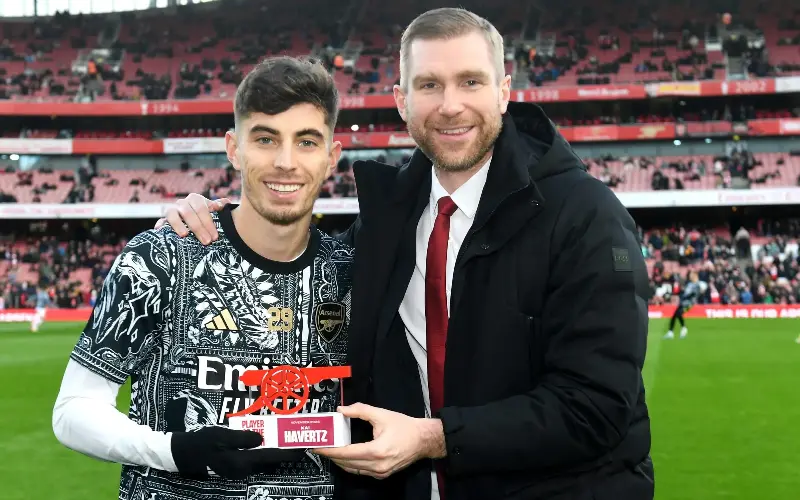
Per Mertesacker, the former Arsenal and Germany defender, will leave his role as Arsenal academy manager at the end of this season.
The 41-year-old, who took control of the academy in 2018 after seven years as an Arsenal first-team player, has said he wants to “explore something new”.
Richard Garlick, Arsenal’s chief executive offer, said the club will be “incredibly sad” to see Mertesacker depart.
Mertesacker will remain in his post until the end of the season to support the club’s succession planning.
Mertesacker’s human touch will be sorely missed
Shortly before he left Arsenal for Manchester City in the summer of 2016, Mikel Arteta had a message for Ivan Gazidis, then the club’s chief executive. “You can’t lose Per,” Arteta told Gazidis. “You can’t lose this guy. Just put him somewhere.”
Arteta knew then how important a figure Mertesacker had become at the Emirates Stadium, and he also knew that Mertesacker could remain an important figure long after his playing career had ended. The club evidently agreed, appointing Mertesacker as their academy manager in 2018.
Mertesacker’s departure after this season will mark the end of a 15-year spell (seven years as a player, eight as academy manager) in which he has effectively become an institution within the institution. Everyone at Arsenal knows Mertesacker, whose influence has extended far beyond his day job with the academy, and his decision to leave has triggered considerable sadness within various departments.
Dignified and thoughtful, Mertesacker has been so much more than an academy manager over these past eight years. He has been an ambassador for the club on many occasions – such as when he was involved in their honouring of Holocaust Memorial Day, or when he opened a new mental health centre in north London – and he has also, briefly, been a first-team coach. Mertesacker worked as an assistant to interim head coach Freddie Ljungberg in 2019.
In the eyes of most Arsenal supporters, Mertesacker’s legacy as academy manager will be the development of youngsters Ethan Nwaneri, Myles Lewis-Skelly, Max Dowman and Marli Salmon into first-team players. These four teenagers all joined the club at a young age, before progressing through an academy that had been reshaped by Mertesacker.
There is so much more to the German’s role, though, than the progression of elite-level wonderkids. “I am taking care of 180 kids who think they are the one percent who can make it in professional football,” he told Telegraph Sport in 2019. “That’s what I deal with on a daily basis.”
The responsibility on Mertesacker has been enormous, and it is clear that he has often felt the weight of it. In 2023 he told Telegraph Sport that the difficult parts of the job, which include informing young players and families that they are being released, had not become any easier over time.
“I go into these meetings and I am nervous, similar to playing 300 games and going into an FA Cup final feeling nervous,” he said. “Whenever I go into a tough conversation with a staff member, or the decision is to release someone because we believe it is better for the individual, I will still be nervous and stutter when I talk.”
As academy manager, Mertesacker has placed huge emphasis on education and human values. His message to players and families has often involved the words “respect, discipline and humility”, and he has clearly been shaped by his own experiences as a young player, including the time his father made him turn down a professional deal because he had been offered too much money.
It has undoubtedly helped Mertesacker’s standing with young players and their families that he had such a successful playing career. He won the World Cup with Germany, after all. But he knew he could not rely on his CV for long. “The reputation that you have built maybe lasts a couple of years,” he said in 2023. “You have to quickly move into adapting, learning quickly to lead 80 to 100 members of staff that we have in the academy.”
Mertesacker being Mertesacker, he will probably be disappointed that more academy players have not burst into Arteta’s squad over the past few years. Standards can always be higher, and Arsenal have recently embarked on a recruitment drive to bring in more high-class youngsters from around the world.
But there is no doubt that Mertesacker’s imminent departure is a blow to the academy, and to Arsenal as a whole. This is a club that has endured so much change over the past decade – at playing level and executive level – but their tall and friendly German has been one of the few constants. First as a player, then as a captain and more recently as one of the people most responsible for shaping Arsenal’s future. He will certainly be missed.