



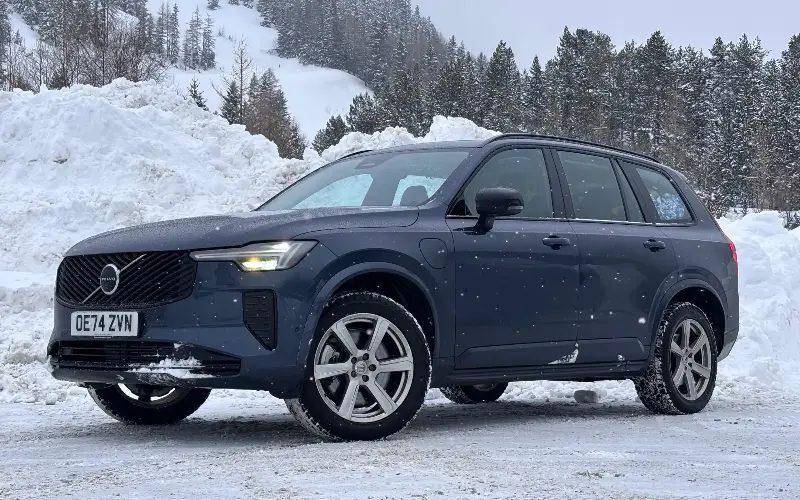
The terminal at Dover is crawling with Volvo XC90s. From the one I’m sitting in, I can spy four more waiting to board the next ferry to France.
It’s no wonder the XC90 has become the vehicle of choice for trips to the Alps as the ski season draws to a close. There are more dynamic SUVs, but who cares about handling when you have to spend all day on motorways, before picking your way up a snow-covered pass with more switchbacks than a Labour policy position?
But all is not well in the land of the middle-class ski-goer. It’s 11 years since this second-generation XC90 was launched, and ostensibly, its replacement is here, in the form of the electric EX90.
However, the sort of XC90 owner who uses their car to get their family to the slopes is suspicious of changing to a large EV. Winter temperatures will dent the range and high-speed running means limited opportunities for regeneration, while during a busy weekend such as half-term, the chances of finding a free charger on the major routes through France are slim.
No wonder Volvo’s chief executive, Håkan Samuelsson, has had to U-turn, telling investors that the company will need to build a new XC90. That wasn’t part of the plan; while the new car is hastily developed, Volvo’s ski-faring customers will have to make do with the older model.
To find out whether it can still cut it, I’m following the XC90 faithful to the Alps, with children in tow – not to mention skis, boots, winter jackets, bedding, board games and more snacks than you can shake a stick at. This is the sort of trip at which the XC90 should excel.
Inside job
During the crossing, I fiddle with the new, larger touchscreen. It’s one of many small tweaks Volvo has made throughout the XC90’s life and, as a result, it still feels modern inside.
The screen itself uses Android software. While you still have to prod it a few more times than you’d like to adjust the temperature, the layout is pretty clear and the screen responds swiftly to every touch. The native Google Maps and Spotify apps work well, too.
The rest of the interior is, frankly, a tour de force. The mix of soft-touch plastics, upholstered infill panels, open-pore wood grain and splashes of brushed chrome give the feel of an upscale hotel lounge. From inside, you’d never guess that this was a car technically overdue for replacement.
It’s huge, too. With the third row of seats folded down, there’s 680 litres of boot space. And because all three middle-row seats can slide individually, we’ve been able to fit the skis into the boot diagonally without having to fold the central seat.
To comply with the requirement for winter-rated tyres on the winding road up to our base in Les Arcs, the XC90 has General Grabber all-terrain tyres. I had been concerned that the knobbly rubber would increase road noise. But no; once on the autoroute, the XC90 demonstrates why it’s such a popular choice for trips like these. Road and wind noise are almost non-existent even at the French speed limit, while the air suspension soaks up lumps in the road as though they weren’t there.
Several hours later, we’re still backache-free thanks to the superbly supportive and infinitely adjustable seats. This is still one of the most comfortable ways to do this journey.
Hybrid theory
Not, however, one of the cheapest. This T8 plug-in hybrid isn’t ideal; having charged it fully at home and kept that charge in reserve to deploy once we were in France, the range had dropped to zero within about 20 minutes of autoroute running. Buyers will have to get used to this with the new model; it’s rumoured that it will only be available as a plug-in hybrid.
This at least presents the opportunity to gauge the T8’s fuel economy at autoroute speeds, fully laden, on all-season tyres – and with a depleted battery.
After 350-odd miles and with 100 left according to the range readout, I thought about stopping to fill up. But the larger aires (autoroute rest areas) are packed; in the end, the fuel (and, more saliently, toilet) stop can wait no longer and we resign ourselves to a 45-minute queue simply to get off the motorway and onto a petrol forecourt.
Despite that, the sybaritic atmosphere within the Volvo keeps the stress level down. Travel games and sandwiches turn the enforced stop into a lunch break, while I notice that the queue for the bank of EV chargers at this aire is equally lengthy. At least once we get to the pumps we’ll be away in minutes; in an electric alternative, refilling might easily have taken double the time.
Off the motorway
Soon afterwards, the sat nav takes us off the motorway to avoid the first queues, tracking the course of the Rhône towards Chambéry. Here, the XC90 feels less at home, its steering light and wandery. The chunky tyres don’t help, but even shod with normal rubber this is a heavy car, one not designed for exuberant driving.
The air suspension does a decent job of stifling body roll, but there’s surprisingly little traction at times – the front wheels spinning long before the car engages drive at the rear. I resolve to select full-time 4WD when the going gets tough later on.
Because of the horrendous traffic, we arrive at the turning for Les Arcs four hours later than planned. Sleet turns to snow as we start the 1,300m ascent, but even with the tarmac hidden beneath an increasingly thick white duvet, the XC90 feels unstoppable. At the top, it hikes up the unploughed driveway that leads to our apartment with ease.
The following day, the trip computer reveals that the XC90 has managed 31mpg. Ouch. But I doubt the alternative – a mild hybrid petrol – would have been much better. I can’t help but regret that the XC90 is no longer offered with a punchy diesel engine. Perhaps Volvo could be tempted into another U-turn?
The Telegraph verdict
At least I was spared the need to charge en route. Doing so would likely have added at least an hour, perhaps two, to the journey time.
That is why the EX90 will struggle to replace the XC90; for a winter getaway at least, the electric newcomer can’t quite do what its predecessor could.
Which is why Volvo has had to keep this car going; quite simply, even after 11 years, it’s so competent for long journeys it leaves the car intended as its replacement in its shadow.
The facts
On test: Volvo XC90 T8 Plug-in Hybrid Plus
Body style: five-door SUV
On sale: now
How much? £76,265 on the road (range from £73,765)
How fast? 112mph, 0-62mph in 5.4sec
How economical? 235.4mpg (WLTP Combined)
Engine & gearbox: 1,969cc four-cylinder petrol engine, eight-speed automatic gearbox, four-wheel drive
Electric powertrain: AC permanent magnet synchronous motor with 18.8kWh battery, 7.4kW on-board charger, Type 2 charging socket
Electric range: 41 miles (WLTP combined)
Maximum power/torque: 400bhp/493lb ft
CO2 emissions: 27g/km (WLTP Combined)
VED: £110 first year, £620 next five years, then £195
Warranty: Three years / unlimited miles
Spare wheel as standard: no (not available)