



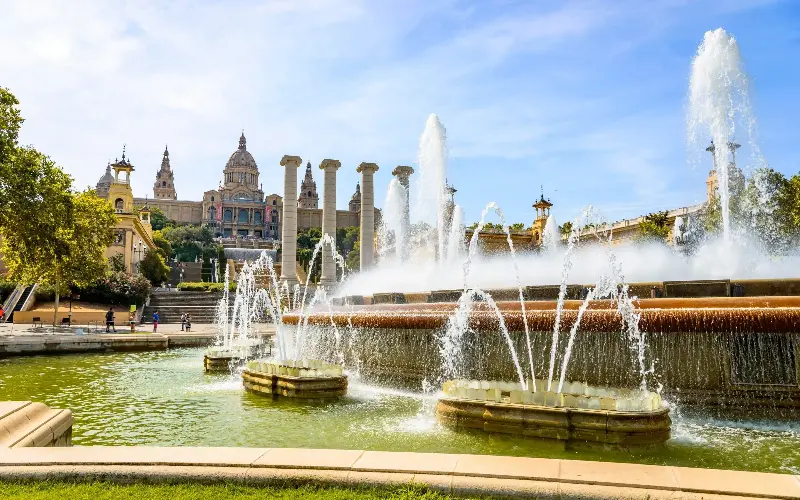
Barcelona is an architectural and cultural hub studded with brooding cathedrals, myriad museums, stadiums and magnificent Gaudí creations.
From marvelling at Modernista buildings to exploring the Hansel and Gretel-inspired Park Güell, here are the best things to do in the Catalan city.
All our recommendations below have been hand-selected and tested by our resident destination expert to help you discover the best things to do in Barcelona. Find out more below, or see our in-depth guides to the city’s best hotels, restaurants, bars and nightlife and shopping.
Find activity by type:
- Best for sightseeing
- Best for families
- Best art galleries
- Best for architecture
- Best for history
- Best free things to do
Best for sightseeing
Park Güell
Marvel at mosaics
Gaudí’s Park Güell was intended to provide attractive housing for the upper classes, based on the English ‘garden cities’ (hence the anglicised spelling of ‘Park’). It was never completed, but what remains is fairly extraordinary, with Hansel and Gretel-inspired gatehouses, the much-photographed ‘Dragon’, and the gloriously colourful winding tiled bench with a view across the city and out to sea.
Insider tip: For a kitsch but hugely entertaining experience nearby, particularly if you have children in tow, check out the 4D documentary at the Gaudí Experience.
Website: parkguell.barcelona
Nearest bus: H6 or D40 to Travessera de Dalt, and then a ten-minute walk.
Prices: £
Sagrada Família
Take in the city’s great unfinished basilica
Gaudí‘s film-set basilica, Sagrada Família, is still a work in progress, but the final tower is set to be added in 2026. The molten wax-like spires of the Nativity façade and the stark, angular sculpture of the Passion facade are well known, but detail erupts everywhere. Most dramatically advanced is the interior, where a forest of pillars reaches up to the roof, creating a dream-like effect.
Insider tip: Take the lift up one of the spires for an aerial view, but be warned that the descent, down steep stone steps, is not for vertigo sufferers. You can avoid queues by pre-booking a slot online beforehand.
Website: sagradafamilia.org
Nearest metro: Metro Sagrada Família
Prices: £££
Picasso Museum
Pick your way through Picasso’s masterpieces
You can gauge Barcelona’s popularity in any given period by the length of the queues at the Picasso Museum, which can be impressive. It’s a worthwhile wait, however, to see the early, pre-Cubist and (mostly) lesser-known works of the city’s adopted son. Highlights include the wonderful Las Meninas series, based on Velázquez’s painting of the same name.
Insider tip: If you time your visit right, almost at the end of the day, you’ll be more than compensated for having slightly less time by the space and quiet afforded by having fewer visitors around.
Website: museupicasso.bcn.cat
Nearest metro: Metro Jaume I
Prices: ££
Mirador de Colom
Discover Barcelona’s best view
Mirador de Colom, Barcelona’s answer to Nelson’s Column (which, apparently, provided the inspiration), is topped with a statue of Christopher Columbus, believed by many to be not Italian, but Catalan. You can reach the top, 200ft up, via a slightly creaky lift. The monument sits at the base of La Rambla, near the port.
Insider tip: The view over the city and out to sea is spectacular, but the faint of heart might want to avoid it on windy days, when the just-perceptible sway can be quite unnerving.
Website: barcelonaturisme.com/mirador-de-colom
Nearest metro: Metro Drassanes
Prices: £
Best for families
CosmoCaixa
Visit Europe’s largest science museum
Said to be the biggest science museum in Europe, CosmoCaixa has state-of-the-art interactive exhibits, with children’s sections dynamic and fun enough that the little ones don’t realise how much they are learning. The big hit is the ‘Flooded Forest’, a mocked-up section of rainforest complete with native species of flora and fauna.
Insider tip: Check out the entertaining ‘sound telescope’ (two satellite dishes positioned 50 metres apart, via which children can have a whispered conversation); these days it is rather forgotten, on an underused terrace away from the action.
Website: cosmocaixa.com
Nearest metro: FGC train to Avda Tibidabo
Prices: £
Camp Nou
Indulge your inner footie fan
Barça FC has the largest fan base in the world, and the Camp Nou stadium is the most visited attraction in Barcelona along with the Sagrada Família. What is now called the ‘Total Xperience’ includes a tour of the pitch, the visitors’ changing rooms, the tunnel, the commentary boxes, three shots at the ‘Robokeeper’ and, of course, the museum – one of the most cutting-edge in Europe.
Insider tip: Be warned that there’s a terrible dearth of decent places to eat and drink near the stadium, so steer clear of lunchtime visits, although you will do better if you head into the Les Corts neighbourhood, specifically with the tapas bars and cafés around the Plaça de la Concòrdia.
Website: fcbarcelona.cat
Nearest metro: Metro Collblanc or Maria Cristina
Prices: £££
Jardí Botànic de Barcelona
Stroll through a botanical garden
High up on Montjuïc, alongside the Olympic Stadium, is the city’s Botanic Garden, a brave new world of sharp lines and zig-zagged paths, a million miles from Kew’s gentle segues or the formal elegance of most French or Spanish gardens. Its 14 hectares, from which there are peerless views, are divided into zones bursting with plants from – variously – Australia, California, South Africa, Chile and the Mediterranean.
Insider tip: You can pick up an audioguide or, at weekends, take free guided tours. A combined ticket (€8 adults, €4 reductions) will also grant entry to the Museu de Ciències Naturals natural history museum.
Website: museuciencies.cat
Nearest metro: Metro Paral·lel, then Funicular de Montjuïc
Prices: £
Parc de la Ciutadella
Picnic in the city’s greenest park
For Old City residents, Ciutadella is the nearest they have to a back garden, and so year-round you’ll see kids learning to rollerskate or cycle, musicians practising and old ladies walking their tiny dogs. Plenty is on offer for tourists, too, including a boating lake, a waterfall partly designed by Gaudí, the city zoo, snack bars and an abundance of sculptures. There are picnic zones, outdoor ping-pong tables, and a couple of playgrounds – including one for blind or disabled children.
Insider tip: The most peaceful place to read or picnic is next to the pond in the formal rose gardens.
Website: barcelona.cat
Nearest metro: Metro Arc de Triomf
Prices: Free
Barceloneta
Go for a dip on a man-made beach
The city’s beaches are not entirely natural, and were only really created – with sand dredged from the seabed, and palm trees imported from Malaga – around the time of the 1992 Olympics, before which Barcelona was said to ‘turn its back on the sea’. The result is six kilometres (four miles) of sand, which gets quieter the closer you get to the Fòrum.
Insider tip: The liveliest part is the Platja de Barceloneta, marked by Rebecca Horn’s tower of rusty cubes. If you have children in tow, head right and walk to the end, for rock pools and a rope-climbing frame.
Website: barcelonaturisme.com/barceloneta-beach
Nearest metro: Bus 47, H16 or V15 to Passeig Marítim
Prices: Free
Best art galleries
Museu Nacional d’Art de Catalunya
Get a taste of Catalan creativity
A wonderful overview of local art from the 10th century to the present day, the MNAC (Museu Nacional d’Art de Catalunya) is something uniquely Catalan and gives a sense of the region’s history as well as its art. The Gothic paintings and Modernista furniture stand out, but the highlights are the Romanesque murals, painstakingly transferred from abandoned churches in the Pyrenees.
Insider tip: It’s a huge building, with a vast collection and good temporary exhibitions, but tickets are valid for two days, and the website has some imaginative and quirky virtual tours that can help to prepare a focused visit.
Website: museunacional.cat
Nearest metro: Metro Plaça Espanya
Prices: ££
Museu Frederic Marès
Spend time among a sculptor’s collection
Frederic Marès was a sculptor and collector whose real passion was for sculpture from every period, and this is most notable in the jaw-dropping collection of mostly Romanesque crucifixes. These and other pieces – Roman, Gothic and from all periods in between – are displayed in the basement and on the ground and first floors of the Museu Frederic Marès, while upstairs is where things get kooky.
Insider tip: So dizzying are the rooms filled with keys; ‘gentlemen’s accessories’; clocks, weapons and religious artefacts, or tin soldiers, music boxes and board games, that the museum allows a second (free) visit within six months.
Website: barcelona.cat/museufredericmares
Nearest metro: Metro Jaume I
Prices: £
The Museum of Contemporary Art of Barcelona (MACBA)
Scope out local talent
The Museum of Contemporary Art of Barcelona (MACBA) is as renowned for its building – a stark white affair, designed by Richard Meier, which dwarfs its neighbours and looms over a plaza teeming with skateboarders – as its holdings. The collection is long on local talent, most notably Catalan artist Antoni Tàpies, but you’ll also find work from Paul Klee, Claes Oldenburg, Lothar Baumgarten and many more.
Insider tip: Note that the MACBA is the only Barcelona museum that has Tuesday as its closing day, so it’s a good place to plan a visit for Monday, when everything else is closed.
Website: macba.cat
Nearest metro: Metro Catalunya
Prices: ££
The Centre de Cultura Contemporània de Barcelona
While away time in a cultural hub
The Centre de Cultura Contemporània de Barcelona is a hub for the arts, with exhibitions, conferences, festivals, concerts and open-air cinema in summer. Its range is nothing if not broad, and exhibitions cover every kind of topic, from literary to political, in a range of styles – painting, photography and sculpture.
Insider’s tip: The Terracccita Bar at the back of the building is a good place for a snack or a coffee and has a peaceful terrace flanked by Richard Meier’s handsome MACBA building.
Website: cccb.org
Nearest metro: Metro Catalunya
Prices: £
CaixaForum
Browse some striking art installations
CaixaForum, a converted textile factory (and one-time police barracks) designed by Modernista architect Puig i Cadafalch, has been turned into a handsome exhibition space, one which generally has the most interesting shows in town. In addition to its striking installations – the spiky entrance by architect Arata Isozaki, and the colourful Sol LeWitt mural – CaixaForum Barcelona presents rotating temporary exhibitions, some of which draw from the Fundación La Caixa’s collection of approximately 800 works.
Insider tip: Its quiet café, and particularly the leafy patio, makes for a nice pitstop in the area even if you’re not visiting the exhibitions.
Website: caixaforum.es
Nearest metro: Metro Espanya
Prices: £
The Fundació Joan Miró
Experience art on the hill
The Fundació Joan Miró is not seen as a Barcelona must-visit, compared to say, the Museu Picasso, Camp Nou or the Sagrada Família, and yet not only does it contain a truly exceptional collection of art (principally from not only Joan Miró, but also Alexander Calder, Marcel Duchamp and Sir Anthony Caro, it also has a Le Corbusier-inspired building, and a breathtaking view right across the city.
Insider tip: The temporary exhibitions are of unfailingly high quality, and on one side of the building, there is an intriguing sculpture garden. Guided tours of the main collection are given in English at 4pm on Wednesdays and Fridays.
Website: fmirobcn.org
Nearest metro: Metro Paral·lel, then Funicular de Montjuïc
Prices: ££
Best for architecture
Palau de la Música
Catch a concert in a Modernista masterpiece
Gaudí fans will not forgive me for this, but the Palau de la Música concert hall is my favourite Modernista building in the city. Designed by Gaudí‘s contemporary, Lluís Domènech i Muntaner, it’s an exhilarating sight, its polychromatic exterior only hinting at the flamboyant design inside, particularly the auditorium, which is crowned with an inverted dome in stained glass.
Insider tip: The guided tours are fascinating, but even more fun is absorbing the bas-relief models of the muses and frothy sculptures of choir girls and Valkyries on stage while watching a concert – and there are all types, from classical to flamenco.
Website: palaumusica.org
Nearest metro: Metro Urquinaona
Prices: ££
Catedral de Barcelona
Explore the stupendous Gothic cathedral
The Gothic cathedral sits like some brooding Disney confection in the heart of the highest point of the Barri Gòtic. It was originally the site of the Roman temple, back when the city was Barcino. Nowadays, it houses a number of smaller chapels, a wonderfully carved choir, and a lift up to the roof for an amazing panoramic view of the city.
Insider tip: Don’t miss the elegant cloister, home to 13 noisy, clanking geese. These represent the 13 years and 13 tortures of Saint Eulàlia, who is buried in the crypt and to whom the cathedral is dedicated.
Website: catedralbcn.org
Nearest metro: Metro Jaume I
Prices: £
Casa Batlló
Delight in Modernista monuments
The jewel in the crown of the Passeig de Gràcia, the Casa Batlló sits like a hunched, scaly but colourful dragon (Gaudí‘s homage to Catalunya, whose patron saint is St George). The building itself is an apartment block, dramatically remodelled by Gaudí in the early 1900s, and now open to the public, who can finally appreciate his swirling interiors and woodwork.
Insider tip: Take a moment to appreciate the other Modernista beauties on this block – the geometrically designed Casa Amatller and the creamy cupcake that is the Casa Lleó i Morera. Between them, they display the various architectural styles of the movement.
Website: casabatllo.es
Nearest metro: Metro Passeig de Gràcia
Prices: £££
Palau Güell
Get a crash course in Gaudí
The façade of Palau Güell displays few of Gaudí‘s trademark motifs, but is a dark and forbidding affair, drawing on Gothic designs, and bristling with spiky wrought iron. Inside, even the stained glass and shafts of light do little to lighten the sombre mood, but this is a building full of joyful little details, from the Moorish-influenced tiles and woodcarvings to the kaleidoscopic chimney pots on the roof.
Insider tip: Check the website for details of the organ concerts that occasionally take place in the central atrium; a very special way to see the building.
Website: palauguell.cat
Nearest metro: Metro Liceu
Prices: ££
La Pedrera
Immerse yourself in Gaudí‘s architecture
La Pedrera means ‘the quarry’, and is the contemptuous nickname given to Gaudí‘s apartment block at the time of its construction. It has a strange, maritime feel to it, with twisting columns and undulating wrought-iron balconies that look like they’re fashioned from kelp, and you’ll struggle to find many straight lines in the show apartment. In the eaves is an exhibition of the architect’s life and work.
Insider tip: An atmospheric night-time tour (from 9pm in summer, 7pm in winter) includes a son et lumière extravaganza, with videomapping making the most of the famous warrior-like chimneys, subject of a thousand postcards.
Website: lapedrera.com
Nearest metro: Metro Passeig de Gràcia
Prices: £££
Best for history
Santa Maria del Mar
Admire the city’s most beautiful medieval church
An unmissable 14th-century church, the Santa Maria del Mar is not especially captivating from the outside, but spectacular within. Its spacious single nave is majestic, with impossibly high pillars supporting a vaulted roof, and a giant rose window above the main entrance. Torched by the anarchists in the early 20th-century, it’s free of the frills and furbelows found in most Catholic churches of the period.
Insider tip: For the fascinating story of how this, the ‘people’s cathedral’, came about, and just how important it’s been to the barrio over the centuries, I can recommend Ildefonso Falcones’ Cathedral of the Sea, a Gothic page-turner.
Website: santamariadelmarbarcelona.org
Nearest metro: Metro Jaume I
Prices: £
Temple d’August
Uncover Roman history
In Roman times, the hill where the city’s cathedral now stands was home to a complex that included the main temple and forum, along with a smaller temple, the Temple d’August (dedicated to the emperor Augustus). Today, you can see the four Corinthian columns that formed part of the temple, but for centuries, they were hidden in the fabric of other buildings; they were only rediscovered in the 19th century. A more recent discovery is the townhouse, mosaics and other Roman remains nearby at Carrer Fruita 2.
Insider tip: They are found within the patio of a mountaineering centre, but are accessible to the public, and entrance to the space is free.
Website: museuhistoria.bcn.cat
Nearest metro: Metro Jaume I
Prices: Free
Monestir de Pedralbes
Find peace in a medieval convent
Off the beaten track and correspondingly peaceful is this beautiful 14th-century convent, Monestir de Pedralbes, still home to a body of Poor Clare nuns. It’s a closed order, so you won’t see them, but visitors do have access to most of the complex. The kitchen, pharmacy and dining room are barely changed since medieval times, but the real highlight is the elegant Gothic cloister, with its triple gallery of slender columns.
Insider tip: It’s not particularly easy to get to by public transport (a little walk from the nearest FGC station), but it’s one of a handful of further-flung destinations usefully served by the Bus Turístic.
Website: monestirpedralbes.barcelona
Nearest metro: FGC train Reina Elisenda
Prices: £
The Museu Marítim
Deep dive into the city’s nautical past
The Museu Marítim holds a collection of all things nautical, including several seafaring vessels, along with some often-excellent temporary exhibitions. As with so many of Barcelona’s museums, however, the building alone is worthy of a visit – in this case, we’re talking about the lofty arches of the 14th-century Royal Shipyards, one of the finest examples of the Catalan Gothic style still standing.
Insider tip: The entrance fee includes admission to the handsome Santa Eulàlia schooner, moored nearby at the Moll de la Fusta in the port.
Website: mmb.cat
Nearest metro: Metro Drassanes
Prices: £
Recinte Modernista de Sant Pau
Discover Barcelona’s best-kept secret
Barcelona’s best-kept secret is this Modernista complex, the Recinte Modernista de Sant Pau, set in peaceful gardens. Until a few years ago, it functioned as a hospital, but it has undergone massive renovation, although most of it is still open to the public. It takes the form of intricately ornamented brick pavilions, each of which was once a ward, while the more gruesome hospital matters took place underground.
Insider tip: The proximity to the Sagrada Família can make for some awful tourist traps, but Can Pizza is a good option for lunch or dinner.
Website: santpaubarcelona.org
Nearest metro: Metro Sant Pau Dos de Maig
Prices: ££
Best free things to do
La Rambla
Stroll along the Old City’s main artery
The city’s most renowned street, La Rambla, is a mile-long avenue that begins at the port, and ends at Plaça Catalunya. The stalls of caged animals and birds have been replaced with upmarket souvenirs and tourist information points, but the colourful flower stalls remain, as does Miró‘s pavement mosaic, halfway up. Dotted along the boulevard are the Wax and Erotic museums, the Palau de la Virreina information centre and exhibition space and, of course, the wonderful Boqueria food market.
Insider tip: The best time to walk it is first thing in the morning, before the crowds arrive.
Website: barcelonaturisme.com/la-rambla
Nearest metro: Metro Liceu
Montjuïc
Explore a hilltop haven
The hill of Montjuïc is perhaps best known for its museums – the MNAC, the Fundació Joan Miró, and the Olympic, archaeological and ethnological museums – but it is also home to several themed gardens spread over the hillside, including the Jardí Botànic. At its peak is the hulking castle, now open to the public, and some striking architecture around the Olympic stadium complex, along with an outdoor public swimming pool with views across the city, and the vertiginous cable cars, which glide above it all.
Insider tip: An outdoor cinema festival, Sala Montjuïc, takes place in the moat of the castle in the summer months.
Website: telefericdemontjuic.cat/en
Nearest metro: Metro Paral·lel, then Funicular de Montjuïc
El Born
Scope out Barcelona’s prettiest neighbourhood
El Born has medieval buildings to match any in the Barri Gòtic, pedestrianised streets, and an increasing number of charming cafés and boutiques. Its central axis is the Passeig del Born – once a medieval jousting ground, and now flanked with the glorious Santa Maria del Mar church at one end and the Born Centre de Cultura i Memòria at the other.
Insider tip: It’s worth walking up to the less gentrified section of the neighbourhood, above Carrer Princesa, which has its own share of sights – the Modernista Palau de la Música concert hall, the colourful Santa Caterina market, and the medieval church of Sant Pere.
Website: barcelona.com/neighborhoods/el-born
Nearest metro: Metro Jaume 1
Born Centre de Cultura i Memòria
Learn more about the roots of the Catalan independence drive
The gorgeous old Born market lay unused for decades, but it has now been transformed into an impressive archaeological exhibition space, the Born Centre de Cultura i Memòria. The slatted iron and patterned brickwork framework surrounds a sunny atrium, where visitors can walk around the medieval remains of buildings razed to the ground after the Catalans’ defeat in the War of Spanish Succession in 1714 – giving the building huge symbolic significance in the current political climate.
Insider tip: The space is free to enter, but there’s also a ticketed exhibition space that looks at life at the time, the battle and its aftermath.
Website: elborncentrecultural.bcn.cat
Nearest metro: Metro Jaume I
How we choose
Every attraction and activity in this curated list has been tried and tested by our destination expert, to provide you with their insider perspective. We cover a range of budgets and styles, from world-class museums to family-friendly theme parks – to best suit every type of traveller. We update this list regularly to keep up with the latest openings and provide up-to-date recommendations.
About our expert
Sally Davies
After stints living in Seville and Madrid, in 2001 Sally settled in Barcelona’s El Born, a stone’s throw from Ciutadella Park and the Santa Caterina market, two of her favourite places anywhere.