



People say that everything changes when you cross the Tamar from Devon into Cornwall. And it’s true. Everything becomes slightly poorer, prettier, sweeter, rainier. The light sharpens, even as the B-roads begin to narrow in the mizzle.
But those who really love Cornwall know there is a second, secret frontier. It lies at the sea-sprayed western edge of little Penzance, the last proper town in West Britain, where the land curves away and the Atlantic begins to feel infinite. Cross that invisible line and you enter a coastline that is magical, strange, ancient – and still possessed of an historic remoteness, despite the ravages of mass tourism. This peculiar charm is why I chose it as the setting for my new thriller novel, The Wrecker’s Girl.
The spell begins as Penzance merges into Newlyn. In the 1880s this medieval harbour became an artist’s colony, and it retains a bohemian air. Yet it is still a working, authentic fishing port: the connoisseur’s St Ives – full of busy trawlers and lobster merchants, rather than chic galleries and tote bags.
From Newlyn, you have two choices. A short detour inland leads to Madron Well, one of the most atmospheric sacred sites in the British Isles. Here a medieval stone baptistry, shrouded by damp greenery, shelters a spring that has been sacred since prehistory, sought out by the sick who came to imbibe its curative, iron-rich water. Even now, fraying ribbons and scraps of cloth – called “clouties” – hang from the surrounding trees, as offerings to pagan deities. On a bright day it is enchanting; on a dark day, slightly menacing.
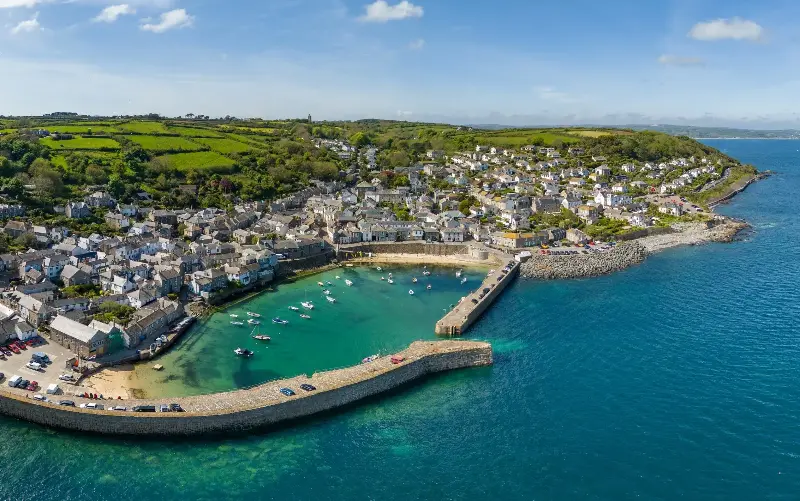
Alternatively, when heading west from Newlyn you can take the coastal road, which wriggles through dense, arthritic woodland and sudden plunging lanes, until you drop into absurdly cute Mousehole, pronounced “Mowzel”. Here the harbour-wall curls in tightly, sheltering a handful of boats. Some lanes are barely shoulder-width – if you’re driving, park and walk. In winter, Mousehole feels like a day-dream for smugglers. In summer, it feels like a place getting begrudgingly rich from the trippers.
For rest and recreation, the Ship Inn sits handily in the middle of Mousehole, right above the water, and boasts low ceilings, chunky crab sandwiches and windows that fill with spray in rough weather. If you want to stay, it also has simple, pleasing rooms upstairs. Wake early, open the curtains, and you are gazing straight at the roiling ocean.
The coast path continues from here, offering some of the finest walks in the realm. You can hike past Point Spaniard, along cliff ledges thick with thrift and sea campion, and be rewarded with constant views over Mount’s Bay. Inland, tiny, defiant fields are scattered with megaliths and prehistoric burial mounds. The Merry Maidens stone circle is especially poignant: girls frozen into stone for scandalously dancing on the Sabbath. Two menhirs, the Pipers, stand nearby, skirling for eternity. This is the kind of place that makes a writer overwrite.
Now comes Lamorna Cove, tucked into another wooded valley. The water here is usually calm enough for swimming, even when the open sea is choppy. It is pebbly rather than sandy, it’s also clear, clean and wonderfully refreshing after a hot walk, with a cute café above the waters.
Half a mile inland you’ll find the Lamorna Wink, one of Cornwall’s best pubs. Expect slate floors, roaring fireplaces and quirky opening hours.
Further west comes Porthcurno, where submarine cables once linked Britain to its empire; today, sunbathers bask where global communications were born. Around here you’ll also find the improbable miracle that is the Minack Theatre, hanging off a cliff, sculpted by one woman and her gardener in the 1930s; Shakespeare is regularly performed against a backdrop of the mighty Atlantic. It is one of the most grandly located theatres on the planet.
I could go on, because there is so much more: the Stone Age villages, the wind-scoured headlands, the forgotten coves and zawns. But half the fun is discovering the hidden places for yourself. This lovely, intricate shoreline rewards the explorer.
At the end of this seaside adventure you come to Land’s End, where the flower-strewn meadows finally yield to the waves. Ignore the touristic frivolities and walk out onto the granite. Let the wind rearrange you. On a clear day, far out on the horizon, the Isles of Scilly shimmer like a dream, allegedly remnants of the drowned kingdom of Lyonesse. You may get the urge to make up stories.
The Wreckers Girl by S.K. Tremayne is published by HarperCollins