



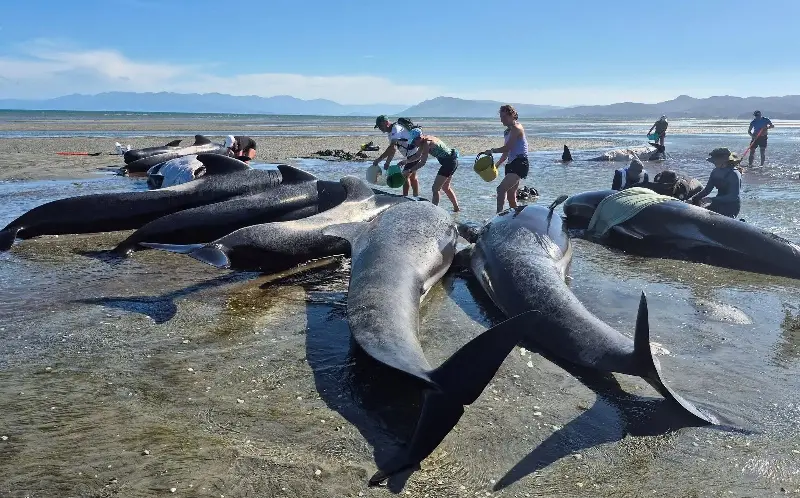
A rescue mission has been launched to save a pod of whales stranded on a remote New Zealand beach.
Some 55 pilot whales washed up on Farewell Spit, on the country’s southern island on Thursday, with six dying on the shore.
Volunteers rushed to the scene and most of the group has gradually able to make their way back into the water on their own, but 15 remained stuck overnight.
Project Jonah, a New Zealand marine rescue organisation, said that, with the help of 200 volunteers, most of the stranded whales “slowly but steadily headed out to deeper water [with a bit of encouragement]”.
The remaining whales are around 1km offshore in “hip-deep” water and not out of danger. The organisation said that a team will remain on site to ensure the whales are not re-stranded.
On Friday morning, volunteers were seen pouring buckets of water over the animals and draping them in wet clothes in order to keep them cool and calm.
While the skies turned overcast at midday, in the morning the weather had been hot and sunny, which was dangerous for the whales.
Louisa Hawkes, who works for Project Jonah, had explained earlier in the day that because the stranded whales were stuck across a long 1km stretch of beach, it was going to be “quite tricky” to bring them together and refloat them.
“When that tide comes in, we’re going to have to move really quickly to group these whales together, then move them out to deeper waters,” she said.
Farewell Spit common for whale strandings
Pilot whales are social animals, so it was critical they were brought back together and refamiliarised before they swim back out to sea.
Farewell Spit, a long thin stretch of land at the northernmost tip of the South Island, experiences a high volume of mass strandings.
New Zealand’s department of conservation said the strip is a “naturally occurring whale trap” both because it occurs along a migratory route for whales and because it forms intertidal sand flats.
“Whales may be easily deceived and caught out by the gently sloping tidal flats and a rapidly falling tide,” the agency explained.
“Pilot whales have strong social bonds and if one whale heads into shallow water, the rest of the pod will follow due to their natural instinct to look after one another.”
In February 2017, more than 400 long-finned pilot whales washed up on the spit – New Zealand’s largest single stranding for more than 100 years.