



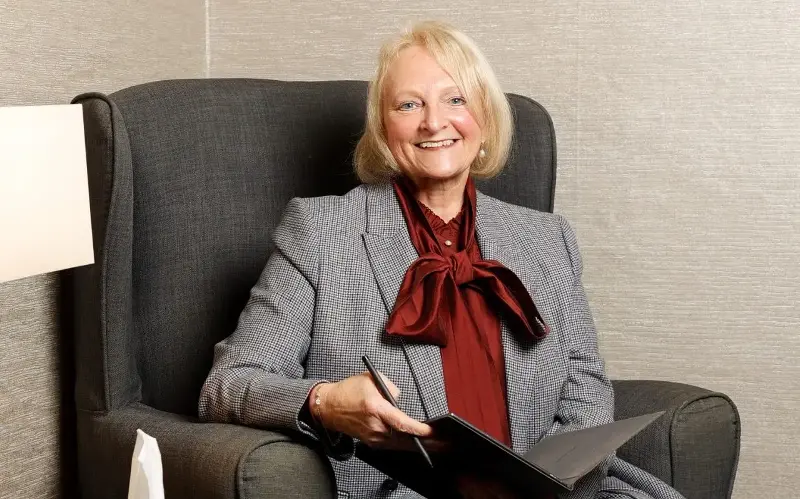
Over the past two decades, Michelle Bassam has witnessed subtle changes in her consulting room. “Twenty years ago, I would counsel a couple because the husband had an affair with his secretary,” she says. “Now, it’s more likely to be: ‘he opened an OnlyFans account when he was away at a conference, and he’s still looking at it.’”
Technology, and its implications – round-the-clock gambling, porn and compulsive online shopping – looms large in Bassam’s day-to-day caseload. But on a fundamental level, the themes tearing couples apart are the same as they’ve always been: money, family issues, affairs and a lack of communication.
“The main problem is that couples have forgotten how to talk to one another,” she says. “We are in such a rush on our phones and devices that we don’t slow down and really listen to what the other person has to say. The respect has gone.”
Bassam, 65, who works for Harley Therapy in London, has over 25 years’ experience in couples’ counselling, with qualifications in psychology, psychodynamic counselling and psychosexual therapy. She is divorced with two grown-up children and has been with her current partner for 15 years.
“As I’ve grown older, I’ve started to understand myself more,” she says. “My partner and I don’t have the perfect relationship, but we know we are built to last. Whatever is going on, our relationship comes first. We have one another’s back, we laugh and we listen. But we also give each other space.”
Is your marriage also destined to go the course? Bassam reveals the top things to look out for.
Jump to:
Signs your marriage will survive
You don’t have contrasting personalities
The “opposites attract” trope of romantic fiction can be exciting at first, but often comes with a limited shelf life. “For example, a noisy person will initially see a calmer person as valuable,” she says. “But soon people revert to type. When there is so much contrast in your personality, a relationship can become very lonely. If a gregarious person becomes frustrated by a more introverted partner, they might start to rely on happiness outside their relationship, and that can lead to problems.”
On the other hand, this does not mean that you and your partner have to be mirror images of one another. “Ideally, your partner will bring out the best in you,” says Bassam. “They should give you room to think, and time to reflect. As long as you feel secure and ‘heard’ in your relationship, contrasting personality types can work very well together.”
You know each other’s ‘love language’
Not every partner communicates in the same way, says Bassam, and this can lead to arguments or disappointment. “You might be upset that your husband hasn’t bought you flowers for Valentine’s Day, but in fact he has cleaned the house, or arranged dinner out for another time,” says Bassam. “This is what we call your partner’s ‘love language’.”
Not everyone speaks the same vernacular, but doing something practical – as long as it’s delivered with affection – can have just as much value as the more demonstrative kind. Whether you prefer receiving gifts, spending time together or having someone take out the bins, identifying your own and your partner’s love language can help you both communicate affection in a meaningful way.
You value the same things
This is probably the most important predictor that your marriage will go the distance.
“Values range from ‘big’ things, like the acceptance that you will both contribute to the household income or have children, to expectations such as cleanliness and the importance of exercise and sleep,” says Bassam. “It’s also important to realise that our priorities can change throughout a marriage because of retirement, redundancy and illness.”
These values should be established well before you tie the knot. “Dating is like a job interview – you’re assessing someone for the most important role of your life,” says Bassam. “As your relationship progresses, you need to think about things such as their background, and where you both intend to live. Online dating can often make you miss out this step – so don’t rush it.”
You don’t let things get too emotional
Couples in a relationship that’s built to last make the effort to talk to one another in gentle, respectful tones, says Bassam. “Many people have a naturally aggressive default tone,” she says. “For example, they will tell their spouse: ‘I need this. I want to go there.’ It’s far better to turn down the volume and consider what you need as a partnership.”
Healthy couples also know how to moderate their emotions when things get heated. “They tell their partner: ‘Now might not be the right time to have an argument – let’s do this in 20 minutes, when we’ve both calmed down’,” says Bassam. “In a good relationship, you won’t follow one another around the house shouting.”
You are a team
Not everyone can be on top form all of the time. “The best couples can sense when the other is exhausted, and don’t only think of the effect this will have on themselves as individuals,” says Bassam. “For example, if you’re having a particularly stressful day at work, you can tell your partner: ‘I can only pick up 30 per cent today, please can you do the other 70 per cent’ – and you know that, down the line, this will be reciprocated.”
In a less healthy relationship, everyone is jealously guarding their own patch, Bassam says. “So if a wife might say, ‘Please can you take the kids to school?’, the husband should not automatically ask ‘why?’, then come back with a list of all the things he has to do himself.”
Signs that you should throw in the towel
Multiple affairs
Bassam is optimistic that most marriages have the potential to last, and can even survive an isolated affair. “But multiple affairs are probably a sign that it’s time to move on,” she says.
In this case, one person should have the courage to say “stop”. “If you’ve interrogated your relationship – perhaps with a therapist – and the person you fell in love with is no longer ‘there’, it is acceptable to move on,” says Bassam. “The goal is to try to do this as pleasantly as possible.”
“People used to be far more wary of divorce, and felt they had to stay together for the children,” she says. “Now, parents see the value of growing up in an ‘apart’ family, where children understand that both their mother and their father have a right to be happy.”
Lack of mutual respect
Bassam accepts that some everyday issues can niggle and eventually lead to flashpoints. “If your partner consistently leaves the toilet seat up, for example, your annoyance isn’t only that you have to physically keep putting it down. It’s because your partner is saying: ‘you’re not important and I’m not listening to what matters to you’,” she says.
“Everyone has the right to live in comfort and a safe space, and to find a way to maintain balance,” she says. “When we take time to explain what is bothering us, and in return take responsibility for what might be annoying or upsetting our partner, life starts to change for the better.”
Refusing to take responsibility
Another red flag to watch out for is one or both partners refusing to take responsibility. “It’s very common for people to refuse to admit their mistakes, or the part they have to play in a disagreement,” she says.
In recent years, Bassam has become used to unhappy spouses badging their partner “a narcissist”. “This term has become so overused, especially by women when talking about their male partners,” says Bassam. “In making this extreme accusation, we need to look at ourselves. We may also be at fault in this equation.”