



Often overlooked in favour of its regional rivals, Poland is emerging as one of the continent’s most engaging and varied destinations for those in the know, with almost 20 million visitors arriving last year.
Many travellers head to Poland for the historical weightiness of Krakow and Warsaw. Yet an ever-increasing number of visitors are discovering places beyond the city – whether that’s testing out the improving ski possibilities of the south, indulging in some seaside fun on the most impressive beaches in Central Europe, or hiking through relatively undiscovered national parks.
In addition, Poland has never been easier to visit with some surprisingly good links with the UK’s regional airports. The Polish railway system also continues to be upgraded, adding numerous direct, fast services to neighbouring countries.
Poland is a rapidly modernising country, yet the people retain their traditional heart. And the good news is that it remains one of Europe’s most affordable destinations, with food, accommodation and admissions all low compared to UK prices.
Take ski passes – they cost a fraction of those in the Alps. Four-star hotels are also very affordable, and you can easily feast on filling Polish dishes with a three-course meal being less than £20.
Here’s how to experience the best the country has to offer.
Where to go
Warsaw
The Polish capital has long since thrown off its grey, communist-era garb and has emerged confidently into the 21st century as a forward-looking, bold metropolis packed with museums, restaurants (including 50 fully vegan eateries) and some striking architectural monuments.
Warsaw’s varied historic sites are essential viewing during any city break, with each one telling a fascinating story. The Warsaw Uprising Museum is a huge, moving experience that recounts the doomed revolt against Nazi occupation in 1944. You’ll need at least half a day to do it justice.
The POLIN Museum of the History of Polish Jews, an award-winning institution that examines the millennium-long presence of Jews across Poland, is equally unmissable. Warsaw has around 50 other museums that focus on everything from the Cold War to Marie Curie.
The city has architecture spanning many centuries, but as Warsaw was essentially destroyed during the Second World War, much of what you see – such as the Royal Castle – is the result of postwar rebuilding efforts. One structure that was added in the Communist era was the Palace of Culture and Science, a typical Stalinist skyscraper that dominates the cityscape. The observation point on the 30th floor has the best views of the city.
When the sightseeing day is over, head to the Praga district on the east bank of the Vistula where restaurants, cafés and clubs abound in a former working-class neighbourhood.
Where to stay
As the capital and Poland’s largest city, Warsaw has places to stay for every purpose and budget. In the Old Town, the Hotel Verte has rooms that are works of understated art, starting at £190 including breakfast.
How to get there
Wizzair fly to Warsaw from Luton and Stansted while Polish airline LOT and British Airways service Heathrow. Return flights start from around £80.
Krakow
By far Poland’s biggest tourist destination, Krakow is a true period city that rivals Prague when it comes to historical grandeur and ambience. For centuries, the city was the capital of the Polish kingdom, with the royal family residing at Wawel Castle, the jewel in the Polish architectural crown. This large complex includes the former royal staterooms and living quarters, the cathedral where coronations took place and a multitude of other attractions.
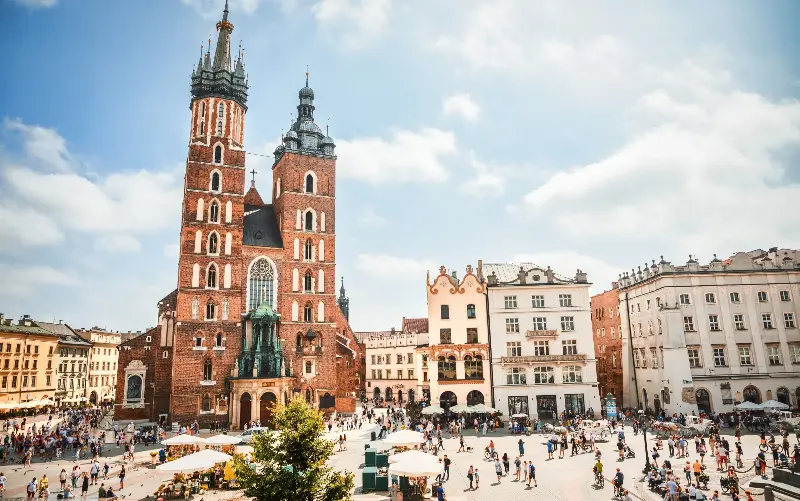
Back in the old centre, the medieval marketplace, or Rynek, is one of Europe’s finest piazzas, dominated by the irregular towers of St Mary’s Church. It’s just a short walk to the old Jewish Quarter of Kazimierz, which you could explore for days.
A more recent addition to the city’s list of sites is Oskar Schindler’s Enamel Factory (of Schindler’s List fame) which tells the horrific story of Krakow under Nazi occupation. Popular trips from Krakow include those to the remarkable subterranean world of the Wieliczka Salt Mines, and to the former concentration camp at Auschwitz-Birkenau, a sobering reminder of Poland’s turbulent 20th century.
Where to stay
Krakow has plenty to offer when it comes to places to stay. One standout is the strikingly-designed and commendably central Balthazar Design Hotel which has wonderfully ornate double rooms from £150 – including breakfast. In Kazimierz, the Puro offers swish, 1930s-style rooms – also from around £150 with breakfast.
How to get there
There are direct flights from seven airports in the UK, including Wizzair from Luton and Gatwick, and Ryanair from Manchester. Other options include: Newcastle, Leeds, Birmingham and Edinburgh. Basic tickets (without luggage) start at around £40 return.
Baltic Coast
Poland’s stretch of Baltic coast is home to some of the most glorious beaches you’ll find in Central Europe, each hemmed with grains of creamy white sand. Resorts such as Kołobrzeg, Świnoujście and Ustka make for superb family holidays. Just make sure you pick up that most Polish of seaside snacks – the waffle.
But the north coast isn’t all about bucket-and-spade fun. Poland’s sixth-largest city, Gdansk, is awash with history – from medieval to new millennium and everything in between. There’s a lot of Second World War heritage in town too – this is where the first shots of the conflict were fired and the city was essentially wiped off the map in 1945, only to be rebuilt over the next couple of decades almost exactly as it was.
The Museum of the Second World War is arguably the best museum of its kind in the world – and the story it tells leaves few unmoved. If heavy history is not your thing, shopping in Gdansk comes in the shape of amber, fossilised tree resin that washes up on Baltic beaches, and is waiting to be collected. The north coast’s beaches are most definitely a high summer affair, but you can easily visit Gdansk at any time of year.
Where to stay
In Gdansk, the gloriously old-world Podewils sits just back from the river and has double rooms from £150 including breakfast. Alternatively, the modern Hampton by Hilton puts you right in the thick of the old centre action for £110 per double with breakfast. On the coast, the Sofitel Grand Sopot is a palatial five-star hotel and local landmark, built in 1927. It has rooms from £101 per night.
How to get there
There are direct flights to Gdansk from Manchester and London Stansted with Ryanair, and from Luton with Wizzair. Basic fares start at around £40 return. Sopot is eight miles from Gdansk, around 15 minutes via local train.
Southern Mountains
Skiers heading into Europe make a beeline for the Alps, but Poland boasts a lot of great piste fun at a much lower cost. The country’s southern borders are formed by several ranges, collectively known as the Carpathian Mountains. These form the border with neighbours Slovakia and the Czech Republic.
The peaks here are great for hiking from spring through to autumn, while the ski season starts sometime in mid-December and usually lasts until around mid-March. The main resort is Zakopane in the Tatra Mountains, a range Poland shares with Slovakia, and which offers the best skiing. For a less commercial alpine experience, head to the remote Bieszczady range in the country’s far southeast, bordering Ukraine – here you’ll find traditional timber churches, heaps of back-country hiking and lots of old European folk tradition.
Where to stay
Zakopane has over 140 places to stay but they still fill up in winter. The Bachleda Residence Zakopane offers luxury quarters and a long list of facilities right in the heart of the town. Rates start at around £140 for a double room with breakfast. Grand Hotel Stamary also boasts stylish rooms, as well as a spa and swimming pool – only in a more traditional complex. Doubles come in at around £150.
How to get there
To reach Zakopane, take a flight to Krakow and continue by bus or train. For other, more remote places in the Carpathian Mountains, you will need to navigate Poland’s public transport system. Alternatively, you can rent a car at Krakow or Warsaw Airports.
Getting to Poland
Poland is particularly well connected to the UK with departures to many regional hubs, though mostly by low-cost carriers such as Ryanair and Wizzair. Flixbus operate coach services between the UK and Poland while those wanting to travel by train must first take the Eurostar to Brussels, then a sleeper to Berlin. From here there are services to Warsaw and northern Poland.
When to go
You can find a reason to travel to Poland at any time of year – there’s skiing in the south in winter, beach days on the north coast in summer, and cities such as Gdansk and Krakow to explore in between. Just be aware that Poland’s winters can be bitterly cold and summer in the north can be slow to show up. Snow is essentially guaranteed in the mountains of the south. Times to avoid are Christmas and Easter when locals retreat into their family circle – most businesses close and the streets are deserted. In general, check before booking that your stay doesn’t coincide with a national holiday.
How much does it cost?
By European standards, Poland is still a relatively inexpensive country for travel, though no longer the bargain basement affair it was just five years ago. If you were to travel by regional train, stay in cheaper hotels and eat at canteens called bar mleczny (milk bars), you could get by on less than £50 a day… but £100 is more realistic. Food, transport and accommodation are particularly good value for money.
Know before you go
Poland is in the Schengen Zone. UK visitors must have a passport with at least three months’ validity after the date they plan to leave. In addition, the EU will soon begin to operate its new ETIAS system which will require visitors from the UK to provide personal information and details about any trip. This will cost €20 per traveller, up from the original cost of €7.
Poland’s currency is the złoty (zł) with around 5zł to the pound. Cash is still used in many situations in Poland, so a combination of card and cash is best to plan for. Withdraw złoty with your UK debit card rather than taking Sterling to exchange. Avoid Euronet cash machines in popular tourist spots which charge extortionate fees.
You’ll need a UK to EU plug adaptor for any electrical devices and chargers you take to Poland.
The UK Global Health Insurance Card is valid in Poland.
What to book
Escape to Poland
They offer a whole range of city breaks and tours across Poland, including intriguing options such as Gdansk food tours, Chopin Warsaw tours and trips to thermal spas in the Tatra Mountains. Packages include three tours, hotel and airport transfer, but not flights. Prices start at around £400pp. (escape2poland.co.uk)
Freedom Treks
Freedom Treks offer a self-guided Krakow and Dunajec Gorge cycling holiday. Seven nights in 3 and 4-star hotels with half board, luggage transfer and side trips start at £650pp, excluding flights. (freedomtreks.co.uk)
Martin Randall
They specialise in cultural tours. In August 2026, the company is running a tour examining the history and culture of Gdansk and Eastern Pomerania, led by a historian from the University of East Anglia. Eight days from £4,020 without flights, £4,260 with flights. The last day is spent exploring Warsaw. (martinrandall.com)
Cox & Kings Travel
Cox and Kings can tailor make anything – from a weekend in Krakow to an itinerary linking several cities across Poland. They can also tie the country into a wider European tour, usually by rail. Prices vary. (coxandkings.co.uk)
KE Adventure
They specialise in trekking and walking holidays across the world. Their guided High Tatras Trekking tour leads you through the Carpathian Mountains on the Polish and Slovak side, and gives you a day to rest in Krakow. From £1,195, including five nights in mountain refuges, two nights in a hotel and all food out on the trails. Excludes flights. (keadventure.com)